

On this page
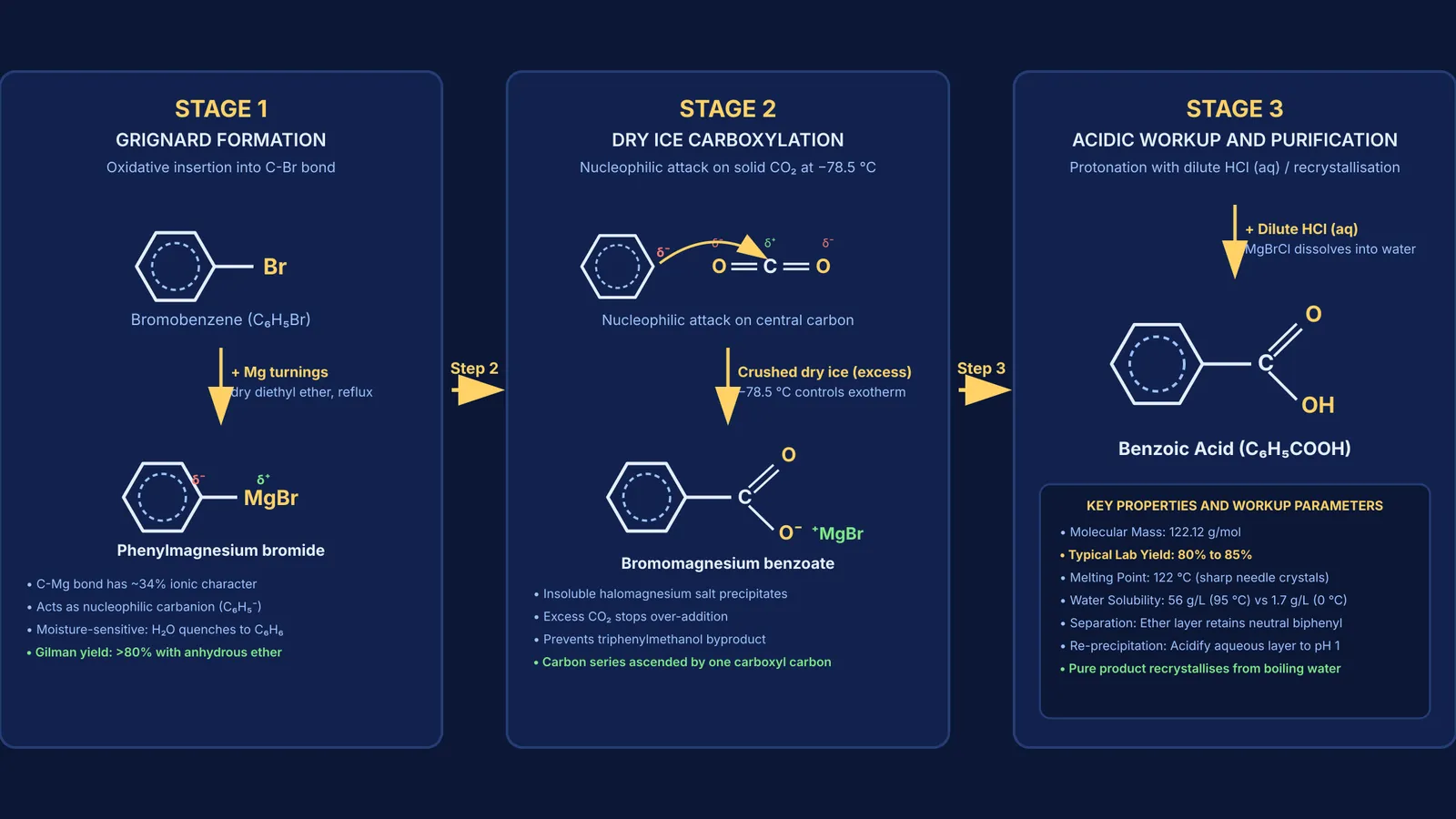
In organic chemistry, converting an aryl halide like bromobenzene into an aromatic carboxylic acid is a core reaction. The transformation proceeds via an organomagnesium intermediate: bromobenzene reacts with magnesium turnings in dry diethyl ether to form phenylmagnesium bromide, which is added to crushed dry ice (solid carbon dioxide) and acidified to yield benzoic acid. According to the NCERT Class 12 Chemistry textbook, this carboxylation route reliably ascends the carbon series, adding one carboxyl carbon directly to the aromatic ring.
Why use a Grignard reagent to make benzoic acid?
Aryl halides resist direct nucleophilic substitution because the carbon-bromine bond has partial double-bond character from resonance with the aromatic ring. Directly displacing the halogen with cyanide or hydroxide under mild conditions is ineffective. The Grignard reaction overcomes this inertness by reversing the electronic polarity of the aryl carbon, turning an electrophilic center into a nucleophilic carbanion equivalent.
Chemist Victor Grignard won the 1912 Nobel Prize in Chemistry for discovering that organomagnesium halides forge carbon-carbon bonds, as recorded by the Nobel Foundation. When phenylmagnesium bromide attacks carbon dioxide, the nucleophilic phenyl ring binds the central carbon of O=C=O, expanding the six-carbon benzene skeleton into benzoic acid.
How does phenylmagnesium bromide form in dry ether?
The first step inserts magnesium metal into the carbon-bromine bond:
C6H5Br + Mg → C6H5MgBr
This reaction requires dry diethyl ether or anhydrous tetrahydrofuran (THF). Anhydrous conditions are vital for two reasons:
Solvent stabilisation: Ether oxygen lone pairs coordinate as Lewis bases to electron-deficient magnesium, stabilising the organometallic complex.
Moisture exclusion: Phenylmagnesium bromide is an extremely strong base. Ambient water rapidly protonates the reagent (C6H5MgBr + H2O → C6H6 + Mg(OH)Br), quenching it into volatile benzene.
In quantitative studies in the Recueil des Travaux Chimiques des Pays-Bas, Henry Gilman showed that anhydrous conditions and fresh magnesium routinely deliver organomagnesium halide yields above 80%. Adding a trace iodine crystal helps initiate the reaction by etching the passivating oxide layer.
Why is solid carbon dioxide preferred for carboxylation?
In the laboratory protocol detailed in the Journal of Chemical Education, phenylmagnesium bromide solution is poured over crushed dry ice (solid CO2 at −78.5 °C):
C6H5MgBr + CO2 → C6H5COOMgBr
The nucleophilic phenyl carbon (δ⁻) attacks the electrophilic carbon (δ⁺) of linear O=C=O, breaking a C=O π bond to form insoluble halomagnesium benzoate.
Using solid dry ice rather than gaseous CO2 provides two key advantages:
Temperature control: Carboxylation is strongly exothermic. Dry ice maintains a reaction temperature of −78.5 °C, dissipating the heat of reaction and preventing thermal decomposition.
Preventing over-addition: A large excess of cold solid CO2 ensures the Grignard reagent reacts exclusively with carbon dioxide. Under limited CO2 or at higher temperatures, unreacted phenylmagnesium bromide attacks the newly formed carboxylate intermediate, forming unwanted triphenylmethanol.
What happens during acidic workup and purification?
After excess dry ice sublimes, the mixture is hydrolysed with dilute hydrochloric acid:
C6H5COOMgBr + HCl → C6H5COOH + MgBrCl
Dilute acid protonates the benzoate salt to free benzoic acid, dissolving magnesium salts into the aqueous layer.
Purification follows a standard acid-base extraction and recrystallisation procedure documented in the Journal of Chemical Education:
Dissolve the crude solid in ether and extract with aqueous sodium hydroxide (NaOH). Benzoic acid converts into water-soluble sodium benzoate (C6H5COONa) in the aqueous layer.
Separate the ether layer, which retains neutral impurities such as biphenyl from Wurtz-type coupling.
Re-acidify the aqueous layer with concentrated HCl to pH 1, precipitating pure benzoic acid.
Recrystallise from boiling water. Benzoic acid dissolves well in boiling water (roughly 56 g/L at 95 °C) but poorly in cold water (1.7 g/L at 0 °C), giving crystals with a sharp melting point of 122 °C.
To compare acid strengths and reactivity trends, review our guide to carboxylic acids and derivatives.
How do you avoid common exam and laboratory traps?
Following a structured stoichiometry and handling checklist prevents frequent mistakes:
Stoichiometric calculation: Converting 15.70 g of bromobenzene (0.10 mol, molar mass 157.01 g/mol) requires 2.43 g of magnesium (0.10 mol, molar mass 24.31 g/mol). Using a 10% excess of magnesium (2.67 g) ensures full conversion. Based on 80% to 85% yields reported in the Recueil des Travaux Chimiques des Pays-Bas, expected product is 9.77 g to 10.38 g of benzoic acid (theoretical yield 12.21 g for molar mass 122.12 g/mol).
Prevent biphenyl coupling: Rapid halide addition or excessive heat promotes homocoupling into biphenyl; see our guide to Wurtz-Fittig and Fittig reactions.
Avoid incompatible functional groups: Grignard reagents cannot form if starting halides contain acidic hydrogens or carbonyls; check our guide on Grignard reagent reactions.
When working through complex organic mechanisms, the Fermi Problem Library offers worked problems with a step-by-step solver that explains the reasoning rather than printing an answer. For multi-step synthesis maps, the Fermi Concept Library covers every concept in physics, chemistry, biology, mathematics and computing, each with its own lesson and its place in the map.


