

On this page
William Henry Taylor and William Colebrook Reynolds were distilling nitric acid under vacuum to make it very pure when they noticed that even weak daylight seemed to break it down. Their 1912 paper, "The Decomposition of Nitric Acid by Light", J. Chem. Soc. Trans. 101, 131–140, signed from the Wellcome Chemical Works, Dartford, Kent, showed three things. Light attacks the vapour, not the liquid; sunlight can build up more than 18 atmospheres of oxygen in a sealed tube; and in the dark the products slowly re-form nitric acid. We read the paper in the scanned 1912 volume and checked the numbers against the page images. Reynolds also appears in Carr and Reynolds' hyoscyamine rotation trap. This is history only: sealed tubes of strong nitric acid under pressure can burst.
Why does nitric acid turn yellow?
Your textbook writes the decomposition as 4HNO₃ → 4NO₂ + O₂ + 2H₂O. It balances: 4 H, 4 N and 12 O on each side. The brown NO₂ dissolves in the remaining acid and colours it yellow. Our post on nitric acid lab preparation and why it is yellow covers the lab side.
Reynolds and Taylor wrote the same change as 4HNO₃ = 2H₂O + 2N₂O₄ + O₂, after Berthelot showed in 1898 that the products are oxygen, nitrogen peroxide and water. Both forms are right. NO₂ dimerises, 2NO₂ ⇌ N₂O₄, so their "nitrogen peroxide" is a mixture of the two.
Does light break down the liquid or the vapour?
The vapour. Veley and Manley had suggested this in 1898, and Reynolds and Taylor confirmed it. They wrapped the vapour space of sealed tubes in "several folds of black silk bandages" and left them in direct sunlight for several days. The liquid stayed colourless, even with 100% acid. Then one minute of direct sunlight on the vapour produced visible colour.
With a little carbamide (urea) dissolved in the acid, oxygen still built up but the nitrogen peroxide was destroyed, so the liquid stayed colourless: colourless does not always mean undecomposed. And where Berthelot said 60% acid did not decompose, they saw colour with 50% acid in strong sunlight.
How much oxygen pressure can sunlight build up?
Far more than Berthelot, who saw over one atmosphere only once. Reynolds and Taylor reached "pressures of over eighteen atmospheres", they wrote, "even in sunlight in the neighbourhood of London". Their Fig. 1 plots oxygen pressure at 18 °C against how full the tube was. The highest curve, 100% acid exposed for 30 days in August and September 1910, peaks just under 19 atm when the tube is a little over half full. Their tubes held about 10 c.c.
How full the tube is matters. Each strength of acid has one filling that gives the highest pressure, and the peak moved with the season: summer days are brighter and longer, and nights, when recombination happens, shorter.
The container matters. Quartz gave higher pressure than glass "in the ratio of 7:10". Blue and colourless glass gave identical results, but "only slight decomposition occurred in an amber-coloured tube". The same logic sits behind storing chloroform in dark bottles.
The gas really is oxygen: alkaline pyrogallol absorbed 97 to 98% of it from 70% acid and about 99% from 100% acid.
Worked example: how much acid makes 18 atm?
Take a 10 mL tube, 55% full of 100% HNO₃, with 18 atm of O₂ at 18 °C. The 55% is our reading of the Fig. 1 peak; the density of about 1.51 g/mL is a standard handbook value.
Gas space: 45% of 10 mL = 4.5 mL = 4.5 × 10⁻³ L.
Moles of O₂: n = pV ÷ RT = (18 × 4.5 × 10⁻³) ÷ (0.08206 × 291.15) = 3.39 × 10⁻³ mol.
Moles of HNO₃ used: the equation needs 4 HNO₃ per O₂, so 4 × 3.39 × 10⁻³ = 1.36 × 10⁻² mol, or 1.36 × 10⁻² × 63.01 = 0.855 g.
Acid in the tube: 5.5 mL × 1.51 g/mL = 8.31 g.
Fraction decomposed: 0.855 ÷ 8.31 = 10.3%. The same reaction also makes 0.624 g of NO₂, most of which dissolves in the liquid.
So about a tenth of the acid puts 18 atmospheres on the glass. This ignores dissolved oxygen and dilution by the water formed, so treat it as an estimate.
Is the decomposition reversible?
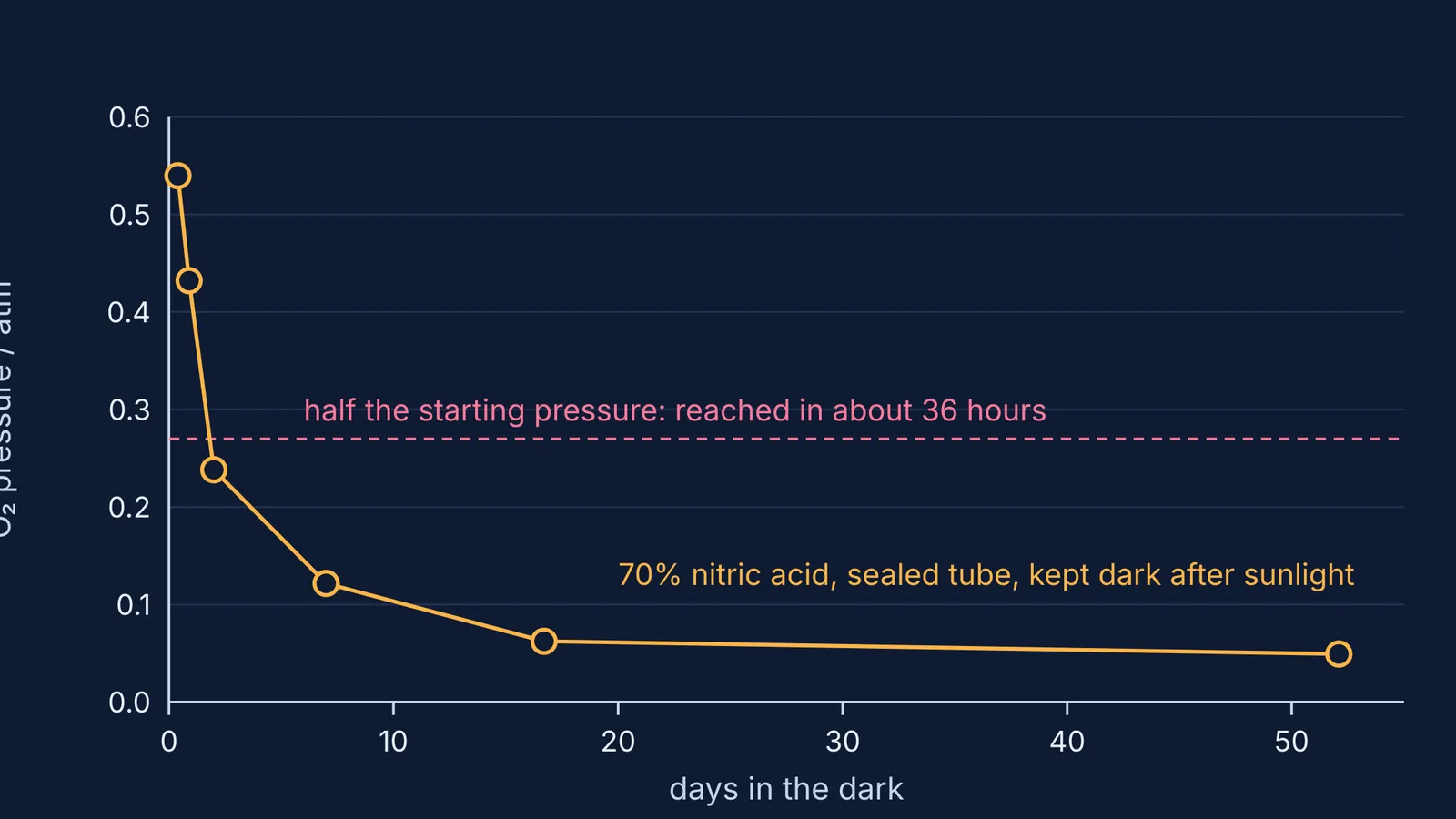
Yes. Berthelot had said it was not. Reynolds and Taylor wrote that he had been "misled by the slowness of the change in the reverse direction with concentrated acid". Tubes of 70% acid, exposed until no further change and then kept in the dark, lost half their oxygen pressure "in thirty-six hours", and after several weeks nearly all the oxygen was absorbed. Their Fig. 2 shows the pressure falling from about 0.54 atm to about 0.05 atm over 52 days. Stronger acid recombined more slowly; 100% acid still held more than half its original pressure after many weeks.
This is an equilibrium read with Le Chatelier's principle:
Light pushes the reaction forward. The tube settles where the light-driven forward rate matches the reverse rate: a steady state for that light.
Dark leaves only the reverse: O₂ and NO₂ recombine with water to re-form HNO₃.
Pressure. Written all in the gas phase, 4HNO₃ ⇌ 4NO₂ + O₂ + 2H₂O turns 4 gas molecules into 7. Raising the pressure favours the side with fewer gas molecules, which is HNO₃. Building up O₂ in a closed tube also pushes the reaction back, which is why the pressure levels off.
The authors reasoned the same way: the oxygen pressure "should vary inversely as the square of the concentration of both the water and the peroxide", which is what K = [N₂O₄]²[H₂O]²[O₂] ÷ [HNO₃]⁴ says for their equation.
What happens to pure nitric acid in the dark?
It decomposes on its own, after a delay. Sealed 70% and 90% acid stayed colourless for many weeks in the dark, but 100% acid turned yellow after an "induction period" of about a month. One tube, 78% full, was found after twelve months at 9.7 atmospheres. They warned that the pressure from storing anhydrous acid in air-tight containers "may conceivably have been the cause of accidents".
Where does this appear in JEE and NEET?
Class 12, p-block: decomposition of HNO₃ and why concentrated nitric acid is yellow and stored in dark bottles.
Class 11, Equilibrium: reversible reactions, writing K, and Le Chatelier with pressure and concentration.
Class 11, States of matter and mole concept: pV = nRT and 4 HNO₃ per O₂.
For practice on these numericals, Fermi Test Prep offers JEE Main and Advanced preparation with an AI tutor. For Le Chatelier's principle and the equilibrium constant, the Concept Library has a lesson for every concept in chemistry, with its place in the map.
Quick checklist
4HNO₃ → 4NO₂ + O₂ + 2H₂O; NO₂ and N₂O₄ are both "nitrogen peroxide".
Light acts on the vapour, not the liquid (Veley and Manley, confirmed 1912).
Over 18 atm of O₂ in sealed tubes in London sunlight; amber glass blocked most of it.
About 10% of the acid can make 18 atm in a small gas space.
In the dark the products recombine: 70% acid lost half its O₂ pressure in 36 hours.
100% acid decomposes in the dark after about a month; 9.7 atm after a year.


