On this page
The lab preparation of nitric acid is a short experiment that examiners love, because almost every line of it has a reason behind it. You heat a nitrate with concentrated sulphuric acid and collect the acid that distils over. Then come the questions: why must the temperature stay below 200 °C (Vedantu solutions), why must every part be glass, and why is the product yellow when pure nitric acid is colourless? Each answer comes down to one chemical reason.
How is nitric acid prepared in the laboratory?
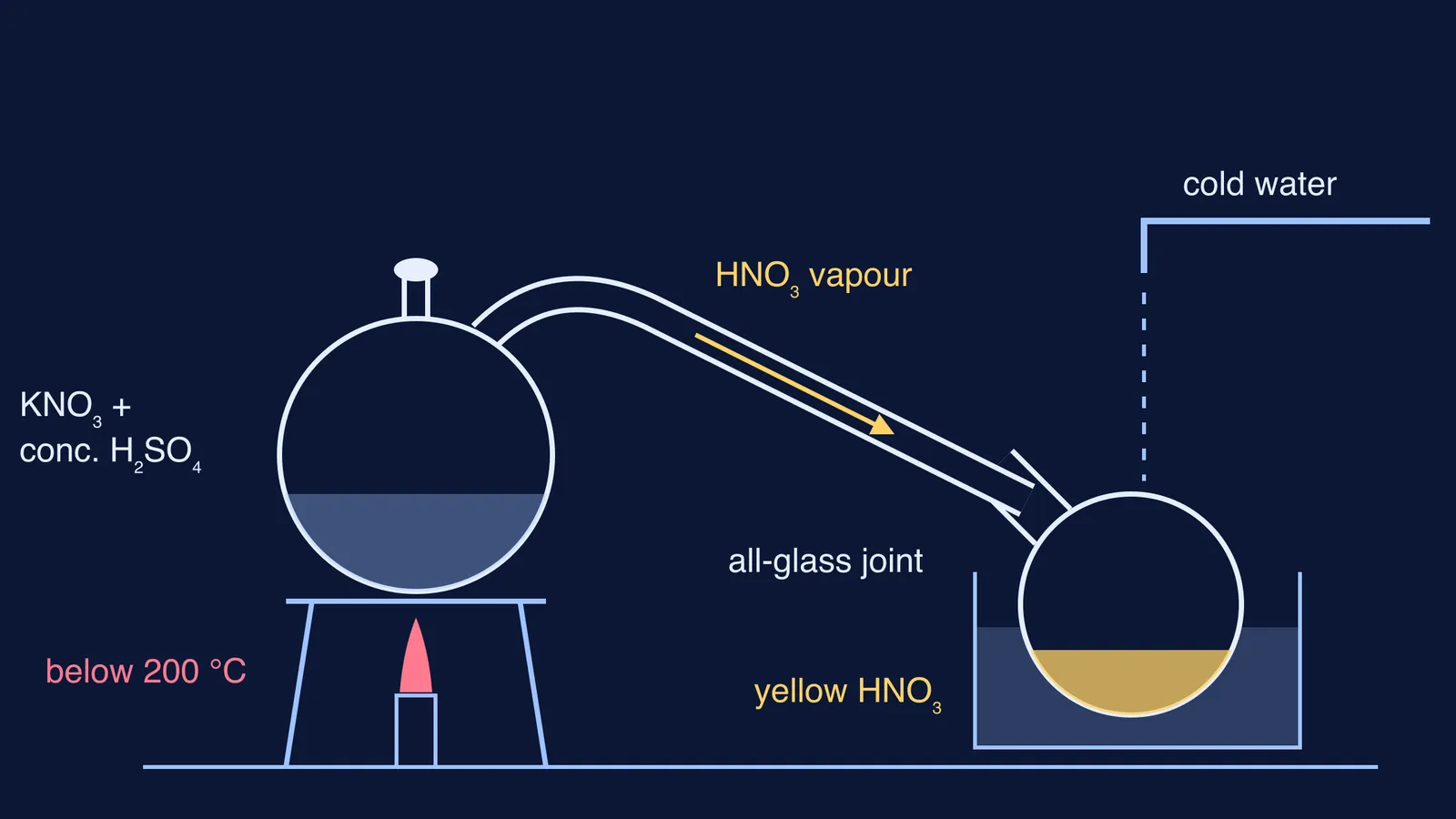
Potassium nitrate (or sodium nitrate) is heated with concentrated sulphuric acid in a glass retort, and the nitric acid vapour is condensed in a receiver cooled with water.
The equation is KNO₃ + H₂SO₄ → KHSO₄ + HNO₃, and potassium bisulphate is the by-product left behind (potassium bisulfate, Wikipedia). With sodium nitrate the same reaction gives NaHSO₄ instead (nitric acid, Wikipedia).
Why does this work? Nitric acid boils at 83 °C (Wikipedia), so it leaves the hot mixture as vapour while the much less volatile sulphuric acid stays behind, and removing the product keeps the reaction going.
The same logic explains a common one-mark question. Concentrated hydrochloric acid cannot replace sulphuric acid here, because HCl is itself volatile and its vapour would come over mixed with the nitric acid (Vedantu solutions to Concise Chemistry). You will see the same "less volatile acid pushes out a more volatile one" idea in our post on making hydrogen chloride in the lab and the fountain experiment.
Why is the temperature kept below 200 °C?
Standard answer keys give three reasons for not heating the mixture above 200 °C (Vedantu solutions):
At higher temperature the residue becomes a hard crust of sulphate (sodium sulphate or potassium sulphate) that sticks to the wall of the retort and is very hard to remove.
The glass apparatus may be damaged by stronger heating.
Nitric acid itself decomposes, giving nitrogen dioxide, so you lose product.
The third reason matters most for the rest of the story. Heat or light breaks nitric acid down by the reaction 4HNO₃ → 2H₂O + 4NO₂ + O₂ (Wikipedia).
Why is an all-glass apparatus used for nitric acid?
Nitric acid vapour corrodes cork and rubber, so the usual stoppers and connecting tubes cannot be used (BYJU'S Selina solutions). Cork and rubber are organic materials, and the US safety agency NIOSH lists combustible materials among the things nitric acid reacts with (NIOSH Pocket Guide).
So the retort's own long glass neck goes straight into the receiver, and any stopper is made of glass.
Why does nitric acid look yellow?
Pure nitric acid is colourless (Wikipedia), but samples are often described as colourless, yellow or red (NIOSH Pocket Guide). The colour comes from dissolved gas, not from the acid itself.
During distillation a little nitric acid decomposes, and the reddish-brown nitrogen dioxide formed dissolves in the acid and turns it yellow (Vedantu solutions). Push this further and you get fuming nitric acid, which NIOSH describes as concentrated nitric acid containing dissolved nitrogen dioxide (NIOSH). Because light also breaks the acid down (Wikipedia), a bottle left in sunlight slowly turns yellow too.
You can remove the yellow colour in two ways: bubble dry air or carbon dioxide through the acid to drive out the NO₂, or add water so the NO₂ dissolves (Vedantu solutions). To see what this concentrated acid does next, read our post on what copper gives with dilute and concentrated nitric acid.
How do you write the full answer in an exam?
Use this checklist for a long answer or a labelled diagram. Each step carries its reason, as given in the Vedantu solutions.
Reactants: potassium nitrate (or sodium nitrate) and concentrated sulphuric acid.
Equation: KNO₃ + H₂SO₄ → KHSO₄ + HNO₃ (below 200 °C).
Apparatus: all-glass retort, because nitric acid vapour corrodes cork and rubber.
Condition: below 200 °C, to avoid a hard sulphate crust, damage to the glass and decomposition of the acid.
Collection: vapour condensed in a receiver cooled by running water.
Observation: the acid is yellow because dissolved NO₂ is present; remove it by blowing dry air through or adding water.
Diagram labels: retort, mixture, burner, receiver, cold water.
A model answer to the favourite reasoning question, "Why is the nitric acid collected in the lab yellow?": some nitric acid decomposes on heating (4HNO₃ → 2H₂O + 4NO₂ + O₂), and the reddish-brown NO₂ dissolves in the acid, so it looks yellow. Cause, equation, observation.
If you keep mixing up which reason belongs to which condition, the Fermi Concept Library gives each chemistry concept its own lesson and shows where it sits in the map. For practice questions, the Fermi Problem Library has worked problems with a step-by-step solver that explains the reasoning rather than printing an answer.
The lab method only makes small amounts. To see how nitric acid is made by the tonne from ammonia, read our post on the Haber and Ostwald process conditions.