

On this page
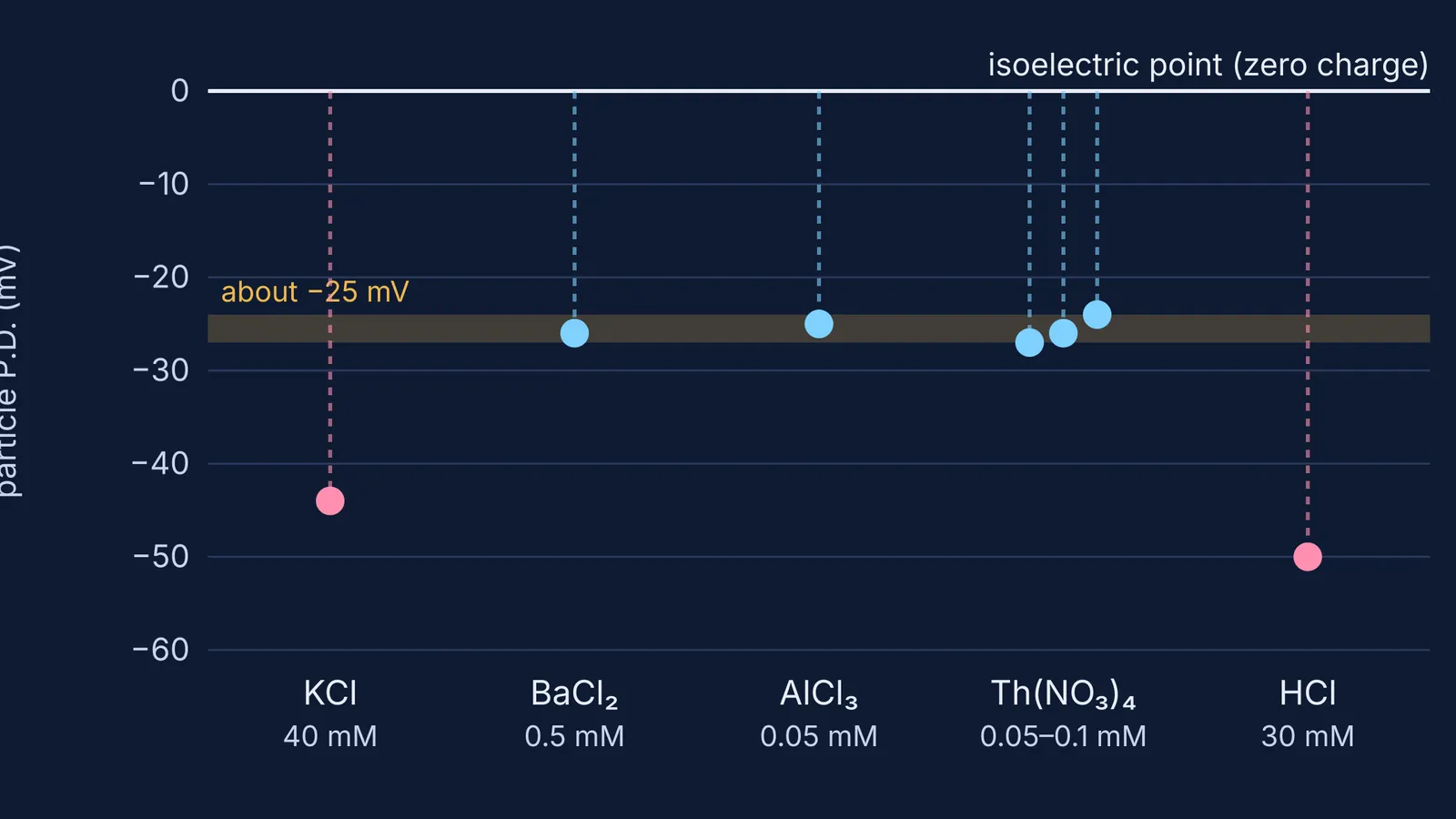
The textbook story of coagulation is simple. Salt ions cancel the charge on a sol's particles, the charge reaches zero, and the particles clump. In 1916 Frank Powis at the University of Leeds tested that story with arsenious sulphide sol. He measured the potential of the particles at the lowest salt concentration that made them coagulate quickly. For barium, aluminium and thorium salts it was still about 0.025 volt. The particles were not neutral at all.
Who was Frank Powis, and what did he publish?
The paper is Frank Powis, "The Coagulation of Colloidal Arsenious Sulphide by Electrolytes, and its Relation to the Potential Difference at the Surface of the Particles", Journal of the Chemical Society, Transactions, volume 109 (1916), pages 734–744 (DOI 10.1039/CT9160900734; scan of Table I on the Internet Archive). It is signed from "The University, Leeds" and was received on 23 June 1916.
We have not checked his life story, so this post sticks to what the paper prints. He had already studied oil-in-water emulsions (Zeitschrift für physikalische Chemie, 1914) and concluded that an emulsion was stable while the potential stayed above "a certain value". He published the sol results early because "it is doubtful whether there will be opportunity to carry this work further". He does not say why.
Arsenious sulphide (As₂S₃) is a toxic arsenic compound. This post covers only the history and the numbers.
What did "coagulation value" mean in his test tubes?
He mixed 5 c.c. of sol with 5 c.c. of salt solution, turned the tube over twice, and watched. With barium chloride (final concentration in millimoles per litre):
0.3 and below: no turbidity even after a day.
0.4: turbid after five hours, but the fine particles were still floating after several days.
0.5: turbid within minutes; after a day the precipitate had settled under clear liquid.
0.8 and above: large flakes formed while mixing and settled fast.
His verdict: "there is no definite concentration above which coagulation occurs almost immediately, but below which no coagulation occurs." The change happens between 0.3 and 0.8 mM. He blamed the spread of particle sizes, since larger particles coagulate more easily, and he showed that gentle shaking changed how flakes formed. So he defined his coagulation value as the lowest concentration at which rapid coagulation occurred: 0.5 mM for BaCl₂.
Did the particles lose their charge before they coagulated?
No. Powis measured the potential with a moving-boundary U-tube, the method shown in our post on electrophoresis and electro-osmosis in colloids. He called it the "P.D." (potential difference at the surface). Today we would call it the zeta potential. His Table I, all values negative because As₂S₃ is a negative sol:
KCl, 40.0 mM: 0.044 V
BaCl₂, 0.5 mM: 0.026 V
AlCl₃, 0.05 mM: 0.025 V
Th(NO₃)₄, 0.05, 0.07 and 0.1 mM: 0.027, 0.026 and 0.024 V
His conclusion, in his words: the "coagulation concentration" is not that at which the P.D. becomes zero, that is, the isoelectric point, "but is much lower, and that here the P.D. has still a relatively high value." A positive ferric hydroxide sol told the same story. It coagulated rapidly in 0.4 mM sodium sulphate while its potential was still +0.03 V.
For the barium, aluminium and thorium salts the values agree closely, around 0.025 to 0.027 V. That supports his idea of a critical potential: a sol stays stable while its particle potential is above some critical value and coagulates once salt pushes it below. The idea was later built into double-layer theory; our profile of J. N. Mukherjee and the charge on colloid particles picks up that thread.
Potassium chloride did not fit. At 40 mM the sol coagulated at 0.044 V, and hydrochloric acid at 30 mM gave 0.050 V. Powis suggested that a high concentration of a weak coagulant adds "a kind of salting out effect". So do not write that every salt coagulated the sol at 26 mV.
Worked example: do his numbers follow the Hardy–Schulze rule?
Coagulating power is the inverse of the coagulation value: the less salt you need, the more powerful the ion. Take KCl as 1.
Find the counter-ion. The sol is negative, so the cations count: K⁺, Ba²⁺, Al³⁺ and Th⁴⁺.
Ba²⁺: 40 ÷ 0.5 = 80.
Al³⁺: 40 ÷ 0.05 = 800.
Th⁴⁺: Powis says the equal-effect concentration lies between 0.05 and 0.10 mM, so 40 ÷ 0.10 to 40 ÷ 0.05 gives 400 to 800 (571 at 0.07 mM).
Compare with z⁶, the high-potential limit of modern theory covered in our post on the Hardy–Schulze rule: 1 : 64 : 729 : 4096. The z² limit gives 1 : 4 : 9 : 16.
The order K⁺ < Ba²⁺ < Al³⁺ holds, and 80 and 800 sit close to 64 and 729. That comparison is ours, not Powis's. But look at the steps. Going from K⁺ to Ba²⁺ cuts the concentration 80 times; going from Ba²⁺ to Al³⁺ cuts it only 10 times. Hardy's 1 : x : x² pattern needs the same factor each step. Powis said so plainly: his four concentrations "by no means form the geometric series which is often said to hold".
Thorium breaks the pattern outright. z⁶ predicts about 0.01 mM for Th⁴⁺ (40 ÷ 4096), yet thorium nitrate was no stronger than aluminium chloride. Powis also noted that thorium nitrate behaved differently in the tubes and wrote that "the reason for this difference in behaviour was not ascertained".
What happens if you add too much thorium nitrate?
The charge flips. In 0.5 mM thorium nitrate the arsenious sulphide particles carried +0.03 V, numerically larger than the 0.026 V at which the negative sol had coagulated. This is the charge reversal you meet in theory. Even so, he never got a stable positive sol in a test tube. Most of it coagulated during mixing, before every particle met the full thorium concentration. He suspected that slow addition of dilute sol to the thorium solution, with shaking, would have worked.
Where does this fit in your syllabus?
Hardy–Schulze, coagulating power, electrophoresis and charge reversal sit in Class 12 Surface Chemistry. That chapter still appears in the CBSE practical syllabus, but JEE and NEET syllabi have changed in recent years, so check the current official syllabus for your exam.
If the double layer and zeta potential feel abstract, the Fermi Concept Library gives every concept in chemistry its own lesson and its place in the map. To watch charge and counter-ions change, the Fermi Simulation Lab has interactive simulations for ideas easier to see than read.
Quick checklist
Frank Powis, University of Leeds, J. Chem. Soc. Trans. 1916.
Coagulation values: KCl 40, BaCl₂ 0.5, AlCl₃ 0.05, Th(NO₃)₄ 0.05–0.1 mM.
Potentials at rapid coagulation: about −0.025 V for Ba²⁺, Al³⁺ and Th⁴⁺ salts; −0.044 V for KCl.
Coagulation does not need zero charge, only a potential below a critical value.
Relative powers 1 : 80 : 800 against z⁶ = 1 : 64 : 729; not a geometric series.
Th⁴⁺ was no stronger than Al³⁺, and in excess it reversed the charge to +0.03 V.


