

On this page
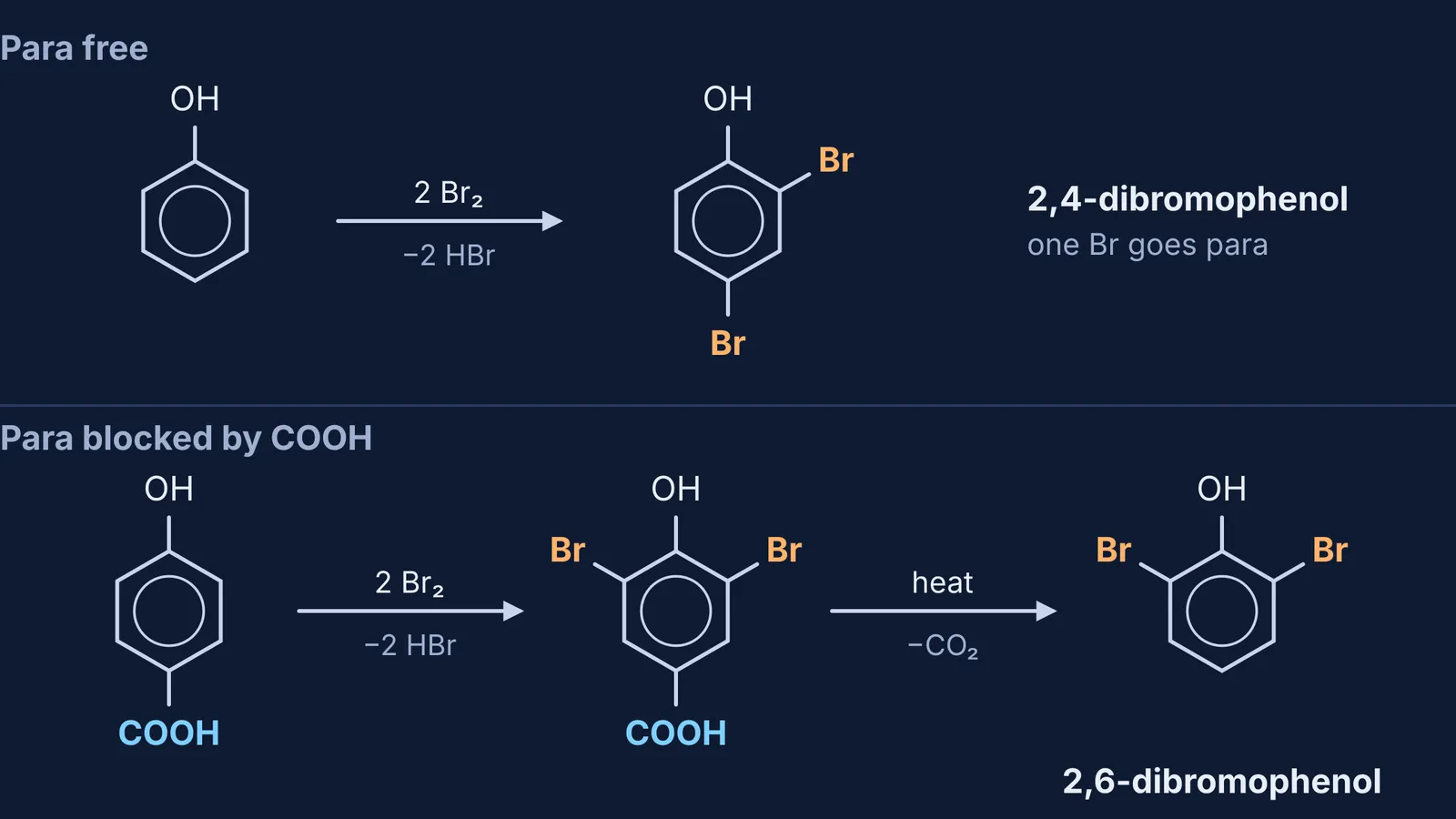
NCERT tells you that bromine water gives 2,4,6-tribromophenol and that bromine in CS₂ gives 2- and 4-bromophenol. Neither tells you how to make one particular dibromophenol cleanly. In 1912 Frank George Pope and Arthur Samuel Wood, at East London College, needed "considerable quantities" of both 2,4- and 2,6-dibromophenol. The 2,4-isomer was easy. The 2,6-isomer was not, because bromine keeps going to the para carbon. So they filled the para carbon with a COOH group first, brominated, and then knocked the COOH off as CO₂.
What did Pope and Wood publish in 1912?
The paper is F. G. Pope and A. S. Wood, "The Bromination of Phenol. 2:4- and 2:6-Dibromophenol", J. Chem. Soc. Trans. 101 (1912) 1823–1829. We read it in the scanned 1912 volume and checked every number we quote against the page images. The paper prints only their names and East London College, University of London; we have not checked other biographical details. F. G. Pope is not W. J. Pope of the first convincing chiral nitrogen salt.
This post covers the history and the logic, not a procedure. Bromine is hazardous, and the authors report sealed tubes that "burst in the majority of the preparations".
Why is 2,4-dibromophenol easy to make but 2,6-dibromophenol hard?
The –OH group activates the ring and directs bromine to the two ortho carbons (2 and 6) and the para carbon (4). Our post on why bromine water gives 2,4,6-tribromophenol shows the resonance structures.
With two bromines, only two products have both on activated carbons: 2,4 and 2,6. Para is open in phenol and reacts readily, so one bromine ends up at C-4, and direct bromination gives 2,4.
Pope and Wood brominated phenol in hydrobromic acid and got 55 g of crude 2,4-dibromophenol from 23.5 g of phenol, "87–88 per cent". They also put its melting point at 40 °C, as Körner had, and said other workers' 34–36 °C was "probably due" to traces of water that are hard to remove.
Worked example 1: check their yield.
C₆H₅OH + 2Br₂ → C₆H₃Br₂OH + 2HBr. Each side has C 6, H 6, O 1, Br 4.
Phenol is 94.11 g/mol and dibromophenol (C₆H₄Br₂O) 251.91 g/mol.
23.5 ÷ 94.11 = 0.2497 mol, so the theoretical yield is 0.2497 × 251.91 = 62.90 g.
Yield = 55 ÷ 62.90 × 100 = 87.4%, matching their 87–88%.
How does a COOH on the para carbon force bromine to 2 and 6?
Pope and Wood started from p-hydroxybenzoic acid, where the para carbon already carries COOH. Today we would call this a blocking group; they did not use the term. Look at what each group wants:
–OH directs ortho and para. Para is taken, so it sends bromine to its two ortho carbons.
–COOH directs meta. Its two meta carbons are those same two carbons.
Both groups agree, so the product is 3,5-dibromo-4-hydroxybenzoic acid. (Here the COOH carbon is C-1; once COOH is gone, the same carbons become C-2 and C-6 of the phenol.)
C₇H₆O₃ + 2Br₂ → C₇H₄Br₂O₃ + 2HBr
Each side has C 7, H 6, O 3, Br 4. They used 128 g of bromine for 55.2 g of acid. That acid is 55.2 ÷ 138.12 = 0.3996 mol and needs 0.7993 mol of Br₂, or 127.7 g, so 128 g is the stoichiometric amount. They said a 90% yield of the dibromo acid "is possible", against Robertson's 80%.
The block was not perfect. A little 2,4,6-tribromophenol formed "by replacement of the carboxyl group in a portion of the acid by bromine". Attack at a carbon that already carries a group is now called ipso substitution.
How did they take the CO₂ off, and what did the rate tell them?
C₇H₄Br₂O₃ → C₆H₄Br₂O + CO₂
Both sides have C 7, H 4, O 3, Br 2. It is the reverse of Kolbe's reaction, where CO₂ goes onto a phenoxide ring.
They heated the acid in sealed tubes with dilute sulphuric acid, with piperidine, with water alone, and with sodium hydroxide. Water gave good yields but the tubes kept bursting. Alkali stopped the bursting but lowered the yield: 30 g of dibromo acid gave 13 g of 2,6-dibromophenol.
Worked example 2: the 2,6 yield.
C₇H₄Br₂O₃ is 295.91 g/mol, so 30 g is 0.1014 mol.
One acid gives one phenol: 0.1014 × 251.91 = 25.54 g in theory.
Yield = 13 ÷ 25.54 × 100 = 50.9%. About half was lost.
The rates gave a clue. Losing CO₂ was slower the more mineral acid was present, faster in water, and faster still with bases. They called it "an ionic reaction", probably due to the rising concentration of the acid's anion, and drew that ion losing CO₂. That is an inference from rates; they proposed no mechanism beyond the equation.
How did they prove the bromines were at 2 and 6?
They nitrated each isomer. In 2,6-dibromophenol both ortho carbons are full, so the nitro group can only go para; the product (m.p. 144–145 °C) was 2,6-dibromo-4-nitrophenol. The 2,4-isomer gave a different compound, 2,4-dibromo-6-nitrophenol (m.p. 117.5 °C). It is the trick behind Körner's isomer count for benzene: add one more group and see what forms. Of the six dibromophenols (2,3; 2,4; 2,5; 2,6; 3,4; 3,5), only 2,4 and 2,6 have both bromines on activated carbons.
How do you find % bromine from a mass of AgBr?
They weighed bromine as silver bromide, the method of Carius's sealed tube.
Worked example 3: the ethyl ether of 2,4-dibromophenol, C₈H₈OBr₂. 0.2041 g gave 0.2766 g AgBr.
Fraction of Br in AgBr = 79.904 ÷ 187.77 = 0.4255.
Mass of Br = 0.2766 × 0.4255 = 0.1177 g.
% Br = 0.1177 ÷ 0.2041 × 100 = 57.67% (paper 57.66).
Calculated for C₈H₈OBr₂ (279.96 g/mol): 159.81 ÷ 279.96 × 100 = 57.08%. The paper prints 57.14, so its own found and calculated figures differ by about half a point.
The methyl ether of the 2,6-isomer gave 59.73% (calculated 60.09%), and 2,6-dibromophenol itself 64.0% (calculated 63.44%). A monobromophenol would be 46.18% and tribromophenol 72.46%, so the analysis clearly says "two bromines".
Where does this come up in JEE and NEET?
Class 12, Phenols: o/p direction by –OH, bromination, and Kolbe's reaction.
Class 12, aromatic substitution: two directing groups that agree, and blocking a position.
Class 11, Organic chemistry: % halogen from mass of AgX.
Class 11, Basic concepts: percentage yield.
Fermi Test Prep is built for JEE Main and Advanced preparation, with an AI tutor. For more yield and Carius numericals, the Fermi Problem Library has a step-by-step solver that explains the reasoning.
Quick checklist
With para free, direct dibromination of phenol gives 2,4.
Put COOH on para: OH (o/p) and COOH (meta) both point to the carbons next to OH.
Remove COOH as CO₂ to get 2,6; balance both steps.
Yields: 87.4% (2,4) and 50.9% (2,6, alkali run).
% Br = mass AgBr × 79.904 ÷ 187.77 ÷ sample mass × 100.
"Blocking group" is our word; their "ionic reaction" is an inference from rates.


