

On this page
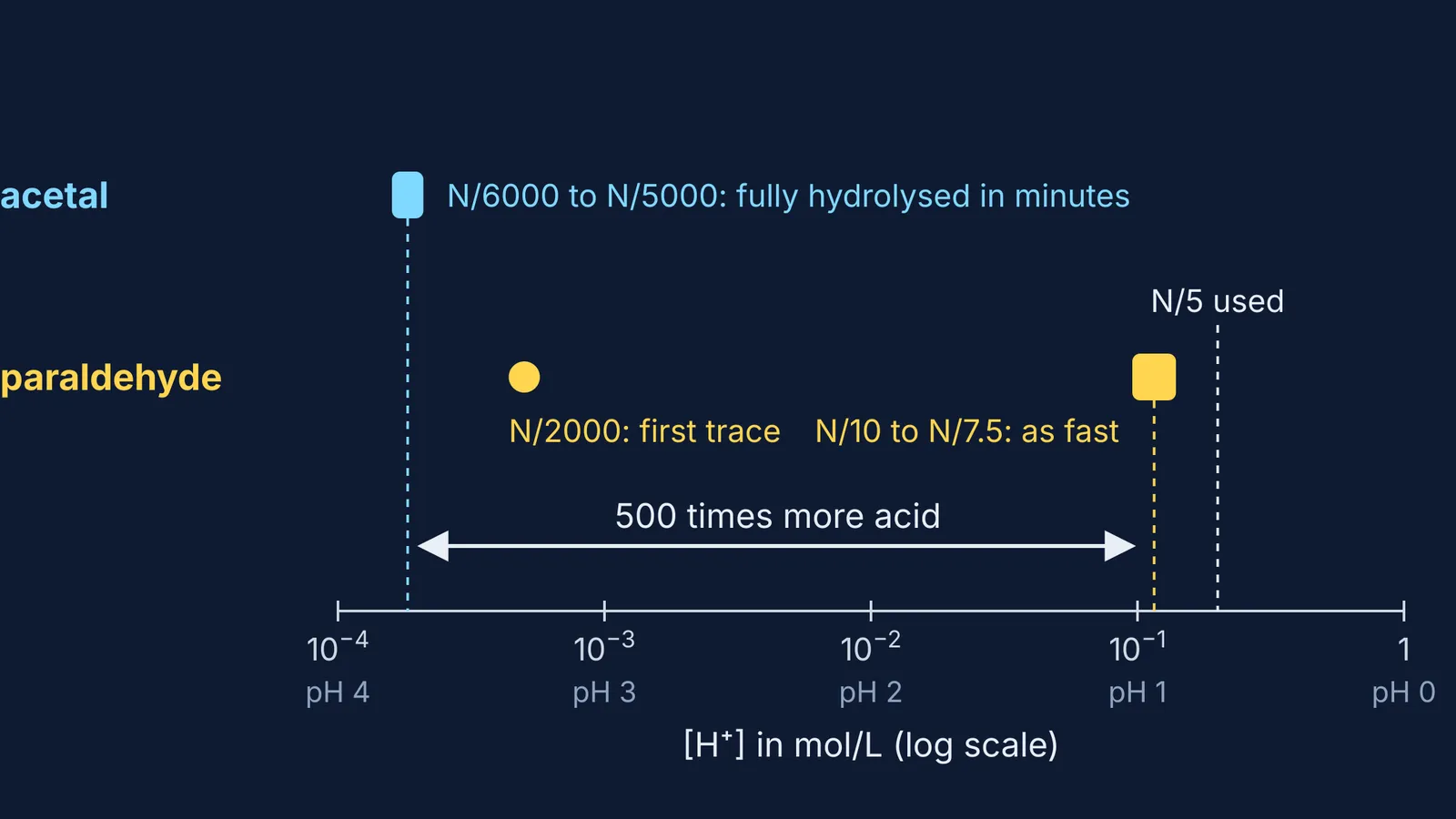
In Class 12 you learn that acetals survive base but fall apart in aqueous acid. In 1916, at Bangor in North Wales, Phyllis Violet McKie and K. J. P. Orton turned how fast they fall apart into a method of analysis. They compared two acetals, acetal itself and paraldehyde, in the same dilute acid. At an H⁺ concentration of about N/5000, acetal was gone after a few minutes' boiling. Paraldehyde gave no acetaldehyde at all until the acid reached N/2000, and needed about N/10 to keep pace. That is roughly 500 times more acid for the same speed.
Who was Phyllis McKie and what did the paper show?
The paper is K. J. P. Orton and P. V. McKie, "The Estimation of Mixtures of Paracetaldehyde and Acetal", J. Chem. Soc. Trans. 109 (1916) 184–186. We read it in the scanned 1916 volume and checked every quote and number below against the page images. It prints the authors' full names, Kennedy Joseph Previté Orton and Phyllis Violet McKie, and is signed from "University College of North Wales, Bangor", received on 9 February 1916. The paper does not say who did which part, and we have not checked anything else about McKie's life.
Orton appears in other Fermi News posts, including Chattaway and Orton's 1899 work on chlorine landing on nitrogen first and Jones and Orton's 1909 bleaching powder crystals. This short paper is the one with McKie's name on it.
What are acetal and paraldehyde?
Acetal here is a specific compound, 1,1-diethoxyethane, CH₃CH(OC₂H₅)₂. It is acetaldehyde joined to two ethanol molecules.
Paraldehyde, which the paper calls paracetaldehyde, is the trimer of acetaldehyde, (CH₃CHO)₃. It is a six-membered ring of alternating carbon and oxygen atoms. Each ring carbon carries two oxygens, so it is a cyclic acetal.
Both give acetaldehyde in acid, with H⁺ acting only as a catalyst:
CH₃CH(OC₂H₅)₂ + H₂O → CH₃CHO + 2C₂H₅OH
(CH₃CHO)₃ → 3CH₃CHO
Both balance. In the first, C 6, H 16 and O 3 appear on each side.
How different are their hydrolysis rates?
The paper puts it plainly: "Whilst acetal is not hydrolysed, or hydrolysed very slowly, in neutral or alkaline aqueous solutions, hydrolysis is very rapid in the presence of traces of strong acids." A 1 per cent solution of acetal in an N/6000 strong acid "is completely hydrolysed after a few minutes' boiling".
Paraldehyde is far tougher. When it is distilled with acid, "no acetaldehyde can be detected in the distillate until the concentration of the hydrion has risen to N/2000". ("Hydrion" is the old word for H⁺.) And "it is only in solutions of N/10—N/7·5 of a strong acid that the conversion to acetaldehyde attains a speed comparable to that of the hydrolysis of acetal in the highly dilute acid."
N/10 against N/5000 is a factor of 500. N/7.5 against N/6000 is 800. So paraldehyde needs roughly 500 to 800 times more acid.
How did the analysis work?
Add 0.2 to 0.4 g of the sample to 30 c.c. of dilute acid in a small Kjeldahl flask fitted to a condenser.
Distil into a cooled receiver holding about 10 c.c. of water or alcohol: 7 c.c. when acetal is being found, 10 c.c. for paraldehyde.
For acetal, use [H⁺] = N/5000. Only acetal reacts.
For paraldehyde, or the total of both, use 30 c.c. of N/5 hydrochloric acid.
Measure the acetaldehyde in each distillate by Ripper's hydrogen sulphite method or Seyewetz's neutral sulphite method. "Both methods give quite concordant results."
The neutral sulphite method rests on the bisulphite-type addition you meet in Class 12: CH₃CHO + Na₂SO₃ + H₂O → CH₃CH(OH)SO₃Na + NaOH. The NaOH released is titrated with acid, and the paper's table does list titres of 0.099 N sulphuric acid.
The check: "An alcoholic solution made up to contain 1·67 grams of acetal and 1·964 grams of paracetaldehyde in 100 c.c. gave on analysis 1·664 grams of acetal and 1·960 grams of paracetaldehyde." That is 99.6% and 99.8% recovery. The paper also prints four test analyses. Their "used" and "found" masses agree closely, but when we recalculated the "found" masses from the printed titres they did not reproduce, so we quote only the mixture above.
Why does paraldehyde resist acid?
The paper gives no reason. Here is the modern reading.
Acid hydrolysis of an acetal is acetal formation run backwards, as described in how acetals protect carbonyl groups:
H⁺ protonates one OC₂H₅ oxygen.
Ethanol leaves, helped by a lone pair on the other oxygen, giving the cation CH₃CH=O⁺C₂H₅. This is usually the slow step.
Water attacks, and loss of H⁺ gives a hemiacetal.
The same steps release the second ethanol and CH₃CHO, and H⁺ is returned.
Cyclic acetals generally hydrolyse more slowly than open-chain ones. One common explanation: when a ring C–O bond breaks, the leaving oxygen stays attached to the same molecule and can close the ring again before water arrives. That is a general trend, not something measured in 1916.
Worked example: [H⁺] from dilution and the 500-fold rate gap
Dilution. 7 c.c. of N/100 acetic acid made up to 30 c.c.: c = 7 × 0.01 ÷ 30 = 2.33 × 10⁻³ M.
Weak acid [H⁺]. With Ka = 1.75 × 10⁻⁵ (CRC data via LibreTexts), [H⁺] ≈ √(Ka·c) = 2.02 × 10⁻⁴ M, or 1/4950. Ionisation is about 8%, above 5%, so solve the quadratic: 1.94 × 10⁻⁴ M, or 1/5170, pH 3.71. Either way it is close to N/5000. (Ka is for 25 °C and shifts a little on heating.)
Strong acid route. The paper's alternative, 0.000219 g of HCl in 30 c.c.: 0.000219 ÷ 36.46 = 6.01 × 10⁻⁶ mol, ÷ 0.030 L = 2.00 × 10⁻⁴ M, exactly N/5000.
Rate gap. Suppose each hydrolysis is first order in the acetal, with k = k_H[H⁺]. Equal speeds at N/5000 for acetal and N/10 for paraldehyde mean k_H(acetal) ≈ 500 × k_H(paraldehyde).
What that means in time. Take an illustrative acetal half-life of 2 minutes at N/5000 (our round number, not the paper's). Then k = 0.693 ÷ 2 = 0.35 min⁻¹, and 99.9% is gone after ln 1000 ÷ k = 20 minutes. Paraldehyde in the same acid would have a half-life of 1000 minutes, about 17 hours. In 10 minutes only 0.7% of it would react, which is why the N/5000 run sees only acetal.
Where does this come up in JEE and NEET?
Class 12 Aldehydes and Ketones: acetal formation and hydrolysis, protecting groups, and bisulphite addition.
Class 11 Equilibrium: [H⁺] = √(Ka·c) after dilution, and when to use the quadratic.
Class 12 Chemical Kinetics: first-order half-life and catalysts.
For more weak-acid and half-life numericals, the Fermi Problem Library has a step-by-step solver that explains the reasoning. For exam practice, Fermi Test Prep covers JEE Main and Advanced preparation with an AI tutor.
Quick checklist
Acetal, CH₃CH(OC₂H₅)₂, and paraldehyde, (CH₃CHO)₃, are both acetals and both give CH₃CHO with acid.
Acetal: fully hydrolysed in minutes at N/6000 to N/5000.
Paraldehyde: first trace at N/2000, comparable speed only at N/10 to N/7.5.
7 c.c. of N/100 acetic acid in 30 c.c. gives [H⁺] ≈ 2 × 10⁻⁴ M, about N/5000.
Known mixture: 1.664 of 1.67 g acetal and 1.960 of 1.964 g paraldehyde found.


