

On this page
In 1909 William Jacob Jones and K. J. P. Orton, of the University College of North Wales, Bangor, described the first crystals of bleaching powder. They had formed by chance in a forgotten bottle. The crystals held calcium chloride and calcium hypochlorite in a 1 : 1 mole ratio, even though the solution they grew from held them at 1.77 : 1. That result helped settle a fifty-year argument about whether bleaching powder is one compound or a mixture.
Their paper, "A Crystalline Bleaching Powder", is in the Journal of the Chemical Society, Transactions, volume 95, pages 751 to 757. The scanned volume is on the Internet Archive. The paper gives only the authors' names and their college. Orton appears in two earlier stories on chlorine and iodine, chlorine landing on nitrogen first in N-chloroacetanilide and why cold hypoiodite lasts only minutes.
Why did chemists argue about the formula of bleaching powder?
Jones and Orton open with the history:
Odling, 1861, proposed one compound: a calcium atom carrying one Cl and one OCl, which we write CaOCl₂. It was meant to explain two facts. The powder does not deliquesce, though CaCl₂ does, and carbon dioxide drives out most of its active chlorine (88% at most).
Lunge backed Odling's formula after long study.
Kraut, 1882, replied that non-deliquescence only shows a double salt, CaCl₂·Ca(OCl)₂, like the known non-deliquescent CaCl₂·Ca(O₂C·CH₃)₂·5H₂O. Lunge and Naef answered in 1883 that the two formulas "have quite the same meaning".
Ditz, 1901 to 1902, said the powder is a mixture of two substances: compound A, a basic salt with lime, formed at −10 °C, and compound B, CaOCl₂·H₂O, which "provides 48.9 per cent of active chlorine".
von Tiesenholt and Winteler concluded that ordinary bleaching powder is "a very complex material" with basic chlorides and hypochlorites.
Nobody had a crystal of the bleaching compound to analyse. Kingzett (1875) had got crystals from bleaching-powder extracts, but Jones and Orton agreed with him that his analysed sample was a hydrated calcium hypochlorite, Ca(ClO)₂·4H₂O, a different substance.
How did a bottle in a cupboard grow crystals?
A concentrated bleaching-powder solution had been "left for some weeks in a dark cupboard in the autumn". It was never below 8 °C and usually about 12 °C. Long colourless prisms, 0.5 to 1.2 cm, had grown separately from the walls, about 0.9 g in all.
With water they fell apart, giving an alkaline solution with chloride and hypochlorite and a residue mainly of Ca(OH)₂, "very much in the same manner as ordinary bleaching powder".
They did not deliquesce. After several days in air, calcium carbonate had formed, hypochlorite had turned into chloride and chlorate, and the material became deliquescent.
At 100 °C they lost 37.5% of their weight with no loss of active chlorine.
What did Jones and Orton find in the crystals?
They had to analyse samples of 0.064 to 0.148 g. The results: CaCl₂ 12.66%, Ca(ClO)₂ 15.82%, CaO 28.00%, water lost at 100 °C 37.48%, water held as Ca(OH)₂ 6.04%. They proposed, "on the exactness of which too much stress cannot be laid", the formula 2(Cl·Ca·O·Ca·Cl), 2(OCl·Ca·O·Ca·OCl), 5Ca(OH)₂, 37H₂O.
The key comparison was with the liquid:
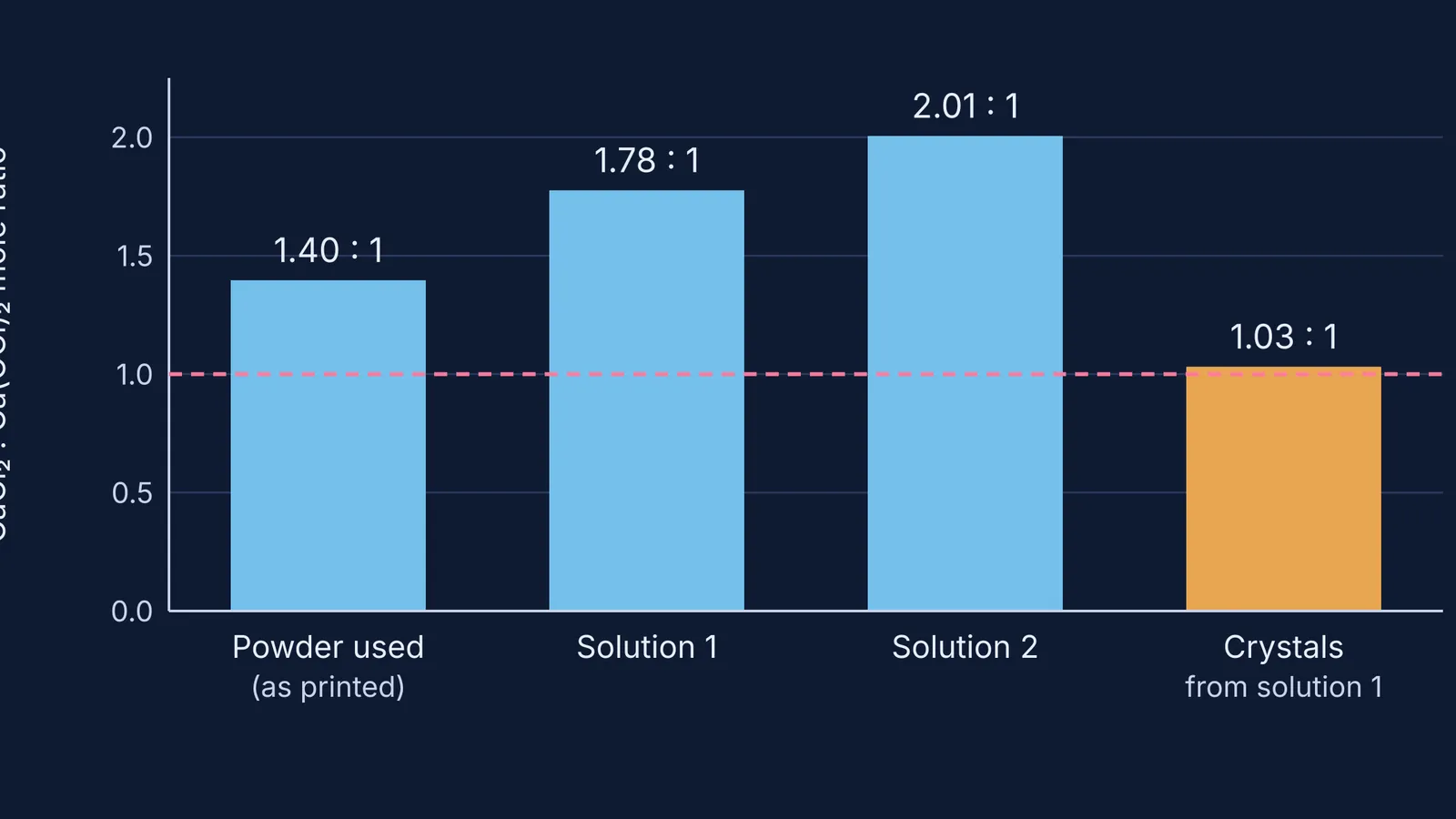
The bleaching powder used had CaCl₂ : Ca(ClO)₂ = 1.396 : 1.
The solution held 96.71 g L⁻¹ CaCl₂ and 70.15 g L⁻¹ Ca(ClO)₂, a ratio of 1.77 : 1.
Crystals from it at about 12 °C: 1.03 : 1 by our calculation.
Crystals from the mother liquor at −5 °C: 1 : 1, with less lime.
A stronger solution, ratio 2.004 : 1, gave crystals only at −18 °C, together with ice. Still 1 : 1, with still less lime.
Whatever the liquid held, the solid kept chloride and hypochlorite at 1 : 1, while the lime varied. They concluded that there is a real compound of calcium chloride and hypochlorite, probably as basic salts, with lime held in variable amount as an "isomorphous mixture". The 1 : 1 ratio is what textbook formulas such as Ca(OCl)₂·CaCl₂·Ca(OH)₂·2H₂O try to show.
What is available chlorine, and how do you calculate it?
Available (or "active") chlorine is the mass of Cl₂ that would do the same oxidising work as the sample, per 100 g. Each OCl⁻ takes chlorine from +1 to −1, a gain of 2 electrons, the same as one Cl₂. Chloride already at −1 counts zero. So Ca(OCl)₂ counts as two Cl₂ (n-factor 4). Using Cl = 35.45:
Odling's CaOCl₂. M = 126.98. One OCl⁻ gives one Cl₂ = 70.90 g. Available chlorine = 70.90/126.98 × 100 = 55.8%.
Ditz's CaOCl₂·H₂O. M = 144.99. 70.90/144.99 × 100 = 48.9%, matching Ditz's figure.
Ca(OCl)₂·CaCl₂·Ca(OH)₂·2H₂O. M = 142.98 + 110.98 + 74.09 + 36.03 = 364.08. Two Cl₂ = 141.8 g. 141.8/364.08 × 100 = 39.0%.
The 1909 crystal formula. M = 1769.2, with four OCl groups, so four Cl₂ = 283.6 g. 283.6/1769.2 × 100 = 16.0%. They found 15.7%.
The real powder they started from had 31.16%, well below 55.8% or 39.0%: commercial bleaching powder is a mixture.
How does iodometry count the chlorine?
The oxidising chlorine is measured with iodide and thiosulphate:
OCl⁻ + 2I⁻ + 2H⁺ → I₂ + Cl⁻ + H₂O (charge −1 on each side)
I₂ + 2S₂O₃²⁻ → 2I⁻ + S₄O₆²⁻ (charge −4 on each side)
So 1 OCl⁻ = 1 I₂ = 2 S₂O₃²⁻ = one Cl₂ = 2 equivalents. One millilitre of N/10 thiosulphate is 0.1 meq, or 3.545 mg of available chlorine.
Worked from their data:
0.1163 g of crystals freed iodine equal to 5.15 mL of N/10 solution.
5.15 × 0.1 = 0.515 meq.
0.515 × 35.45 = 18.26 mg of available chlorine.
18.26/116.3 × 100 = 15.7% (they print 15.66).
Then the mole ratio from their percentages: CaCl₂ 12.66/110.98 = 0.1141 mol per 100 g; Ca(ClO)₂ 15.82/142.98 = 0.1106. Ratio = 1.03 : 1. The solution, 96.71/110.98 to 70.15/142.98, gives 1.78 : 1 (they print 1.77).
Where does this come up in JEE and NEET?
s-block (Class 11): composition and uses of bleaching powder, and why its formula is written several ways. Preparation is covered in bleaching powder from chlorine and slaked lime.
Some basic concepts: percentage composition to mole ratio and formula.
Redox titrations: iodometry and n-factors of OCl⁻ and Ca(OCl)₂.
For more available-chlorine and n-factor numericals, the Fermi Problem Library has a step-by-step solver that explains the reasoning. To revise redox equivalents from the start, use the Concept Library.
Quick checklist
CaOCl₂ (Odling, 1861) against CaCl₂·Ca(OCl)₂ (Kraut, 1882) was the debate.
1909 crystals: CaCl₂ : Ca(OCl)₂ = 1 : 1 from solutions at 1.77 : 1 and 2.0 : 1.
Lime and water varied; the chloride to hypochlorite ratio did not.
Available chlorine: 55.8% (CaOCl₂), 39.0% (textbook hydrate), about 31% for their real powder.
Each OCl⁻ = one Cl₂ = one I₂ = two thiosulphate.


