

On this page
If a question asks you to change one group in a molecule and leave a ketone untouched, it is usually testing one idea: protection. Here is how an acetal hides a carbonyl group, why ethylene glycol is used, and a three-step conversion to practise.
What is an acetal, and how does it form?
An acetal is a carbon bonded to two OR groups, made when an aldehyde or ketone reacts with two equivalents of alcohol, according to Chemistry LibreTexts/19:_Aldehydes_and_Ketones-_Nucleophilic_Addition_Reactions/19.10:_Nucleophilic_Addition_of_Alcohols-_Acetal_Formation). On the way it passes through a hemiacetal, which has one OR group and one OH group on the same carbon.
The acid-catalysed mechanism on that LibreTexts page has seven steps. In plain words:
Acid protonates the carbonyl oxygen, making the carbonyl carbon more electrophilic.
An alcohol oxygen attacks that carbon.
Losing a proton gives the hemiacetal.
Acid protonates the hemiacetal's OH, turning it into a good leaving group.
Water leaves, pushed out by a lone pair on the neighbouring OR oxygen, giving an oxonium ion.
A second alcohol oxygen attacks the oxonium ion.
Losing a proton gives the acetal.
The whole sequence is an equilibrium. Chemists drive it forward by removing water as it forms, with molecular sieves or a Dean-Stark trap, which is Le Chatelier's principle at work (LibreTexts/19:_Aldehydes_and_Ketones-_Nucleophilic_Addition_Reactions/19.10:_Nucleophilic_Addition_of_Alcohols-_Acetal_Formation)). The trap is named after E. W. Dean and D. D. Stark, who refined an earlier design in 1920 to measure water in petroleum (Journal of Industrial and Engineering Chemistry, 1920). With toluene as solvent, water distils over and sinks in the trap while toluene flows back (Dean-Stark apparatus, Wikipedia).
Why use ethylene glycol to protect a ketone?
Ethylene glycol (HOCH2CH2OH) carries both OH groups in one molecule, so the second attack happens inside the same molecule and closes a five-membered ring called a 1,3-dioxolane. Cyclic acetals are more stable towards hydrolysis than open-chain ones, and they form quickly because the ring-closing step is fast (LibreTexts/19:_Aldehydes_and_Ketones-_Nucleophilic_Addition_Reactions/19.10:_Nucleophilic_Addition_of_Alcohols-_Acetal_Formation)). Dioxolanes are made by acetalisation of aldehydes and ketalisation of ketones with ethylene glycol (Dioxolane, Wikipedia). Some textbooks call the ketone version a ketal; the chemistry is the same.
How do acetals protect carbonyl groups in synthesis?
Once the C=O is gone, there is nothing left for a nucleophile to attack. Acetals behave like ethers: in neutral to strongly basic conditions they ignore hydride reagents such as LiAlH4 and NaBH4 and organometallic reagents such as Grignard reagents (RMgX) and organolithiums (RLi) (LibreTexts/19:_Aldehydes_and_Ketones-_Nucleophilic_Addition_Reactions/19.10:_Nucleophilic_Addition_of_Alcohols-_Acetal_Formation)). Their weak point is aqueous acid, and that is exactly what you use to take the protecting group off at the end.
So every protection problem has three moves: protect, react, deprotect. Working chemists look up the options for each functional group in Greene's Protective Groups in Organic Synthesis, edited by Peter G. M. Wuts (Wiley, 2014). For revising the carbonyl reactions this builds on, see our guide to reactions of aldehydes and ketones.
Worked example: reduce an ester but keep the ketone
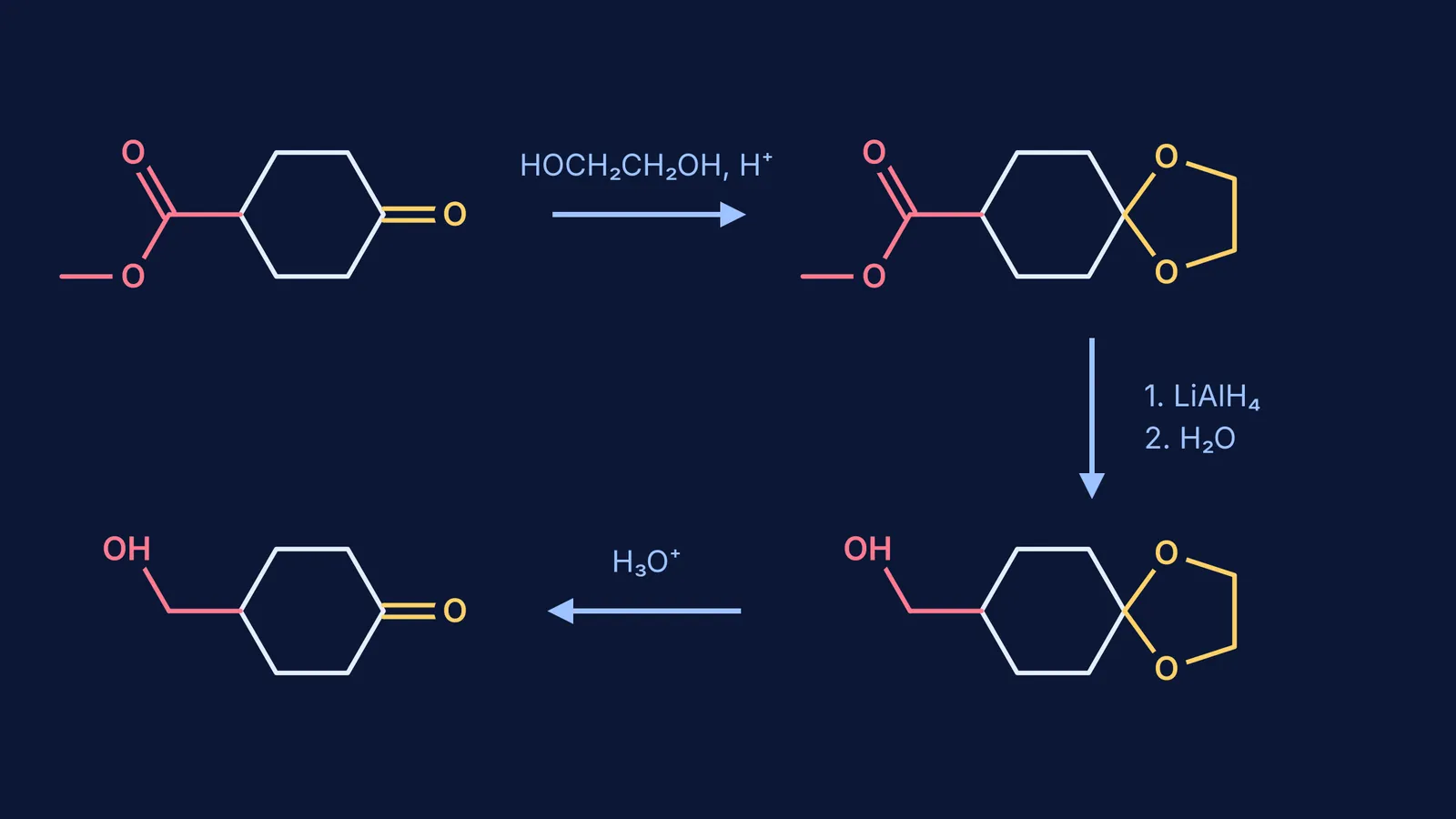
The conversion is methyl 4-oxocyclohexanecarboxylate to 4-(hydroxymethyl)cyclohexanone, the example given on the dioxolane page. The diagram at the top of this post shows each structure.
You cannot do it in one step. LiAlH4 reduces the ester to a primary alcohol, but it would reduce the ketone to a secondary alcohol at the same time.
Protect. Treat with ethylene glycol and an acid catalyst, removing water. Only the ketone reacts, becoming a spiro dioxolane; the ester is left as it was.
React. Add LiAlH4 in dry ether, then work up with water. The ester becomes CH2OH. The acetal survives because it has no C=O.
Deprotect. Dilute aqueous acid hydrolyses the acetal, releasing ethylene glycol and giving back the ketone.
The same plan works with a Grignard reagent. LibreTexts shows a ketone protected as an acetal so that the Grignard reagent reacts only at the ester, with the ketone returning in the aqueous acid workup (LibreTexts/19:_Aldehydes_and_Ketones-_Nucleophilic_Addition_Reactions/19.10:_Nucleophilic_Addition_of_Alcohols-_Acetal_Formation)). See our guide to Grignard reagent reactions for what it does to each carbonyl compound.
A checklist for any protection question
List every group the reagent can attack. If one of them must survive, you need protection.
Check whether that group is an aldehyde or ketone and whether the reagent is basic or nucleophilic (LiAlH4, NaBH4, RMgX, RLi). If both are true, an acetal fits.
Write three arrows with a reagent on each: HOCH2CH2OH with H+, the main reagent, then H3O+.
Confirm the last step gives back exactly the starting carbonyl, with ethylene glycol as the by-product.
If the middle step needs aqueous acid, an acetal is the wrong protecting group.
Practise protection inside longer chains with our roadmap for organic conversions. If you get stuck deciding which group reacts first, the Fermi Problem Library has worked problems with a step-by-step solver that explains the reasoning rather than printing an answer. To revise hemiacetals and nucleophilic addition before you start, each idea has its own lesson in the Fermi Concept Library.


