

On this page
In salt analysis, dilute acid on a mixture of carbonate and sulphite gives off CO₂ and SO₂ together, and both turn limewater milky. In 1909 E. R. Marle of Hartley University College, Southampton, tested a way round this: boil the sample with potassium dichromate instead of acid. Carbonates gave up all their CO₂, while sulphites and sulphides gave no gas at all. The reason is a neat pairing of two Class 12 ideas, the chromate–dichromate equilibrium and dichromate as an oxidant.
What did Marle test, and why?
The paper is E. R. Marle, "The Estimation of Carbonates in Presence of Nitrites, Sulphides, or Sulphites by means of Potassium Dichromate", J. Chem. Soc. Trans. 95 (1909) 1491–1497. We read it in the scanned 1909 volume and checked the tables against the page images.
Marle opens by noting that Chapman Jones's Qualitative Chemical Analysis (1906) recommended dichromate in place of dilute acid to detect carbonates in the presence of nitrites, sulphides or sulphites, "none of which effervesce with dichromate". Marle wanted to know whether the reaction was quantitative, and whether it could be used to estimate carbonates. He thanks Chapman Jones for suggesting the problem.
His set-up boiled about 1 g of carbonate with 5 per cent aqueous potassium dichromate under a reflux condenser and absorbed the CO₂ in weighed potash bulbs. This is history, not a practical to copy: dichromates are toxic and carcinogenic.
How does dichromate release CO₂ from a carbonate?
Dichromate in water is slightly acidic, because of this equilibrium, which balances in atoms and charge:
Cr₂O₇²⁻ + H₂O ⇌ 2CrO₄²⁻ + 2H⁺
Carbonate removes the H⁺ (CO₃²⁻ + 2H⁺ → CO₂ + H₂O), so the equilibrium keeps shifting right, exactly as Le Chatelier predicts. Boiling drives the CO₂ out. Added together, the modern reading is:
Cr₂O₇²⁻ + CO₃²⁻ → 2CrO₄²⁻ + CO₂
As a full equation: K₂Cr₂O₇ + Na₂CO₃ → K₂CrO₄ + Na₂CrO₄ + CO₂. Marle wrote no equations; these are ours. He cites Moissan for the related fact that potassium chromate can be made by neutralising the dichromate with potassium carbonate. For the colour side of this equilibrium, see how pH changes chromate and dichromate.
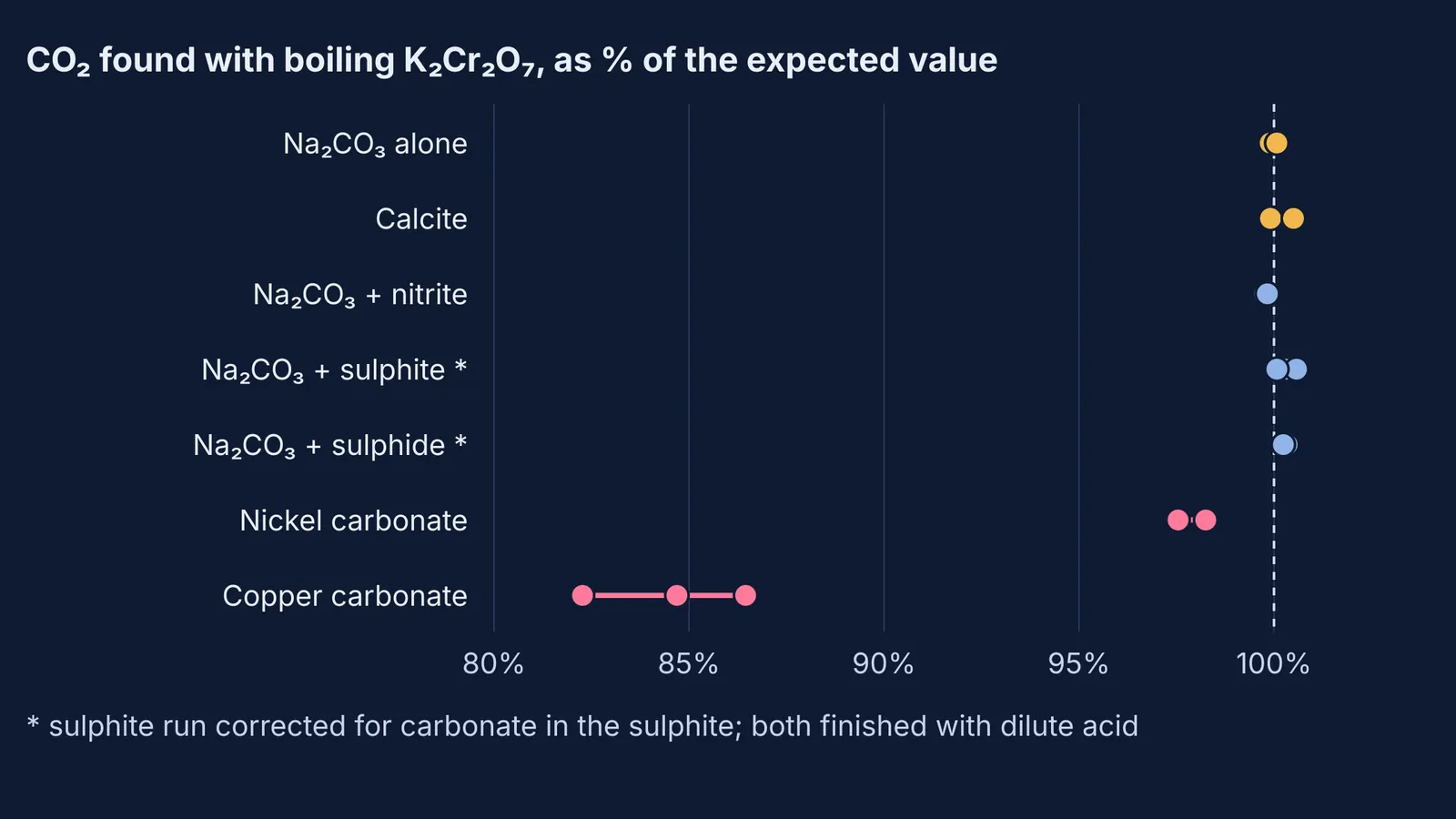
Marle found that soluble carbonates were decomposed quantitatively, and finely divided insoluble ones too, "provided that the resulting chromate is soluble". Barium carbonate was only partly decomposed. Copper carbonate gave 7.47 to 7.85 per cent CO₂ with dichromate against 9.05 and 9.11 per cent with acid. He notes the chromates of nickel, copper and barium are sparingly soluble or insoluble, which fits his rule that decomposition is incomplete when the chromate is insoluble.
Worked example: checking Marle's carbonate numbers
Theory for Na₂CO₃. M(CO₂) = 44.01 and M(Na₂CO₃) = 105.99 g/mol, so CO₂ is 44.01 ÷ 105.99 = 41.52% of the mass. Marle used 41.51 (atomic weights of 1909). For calcite, 44.01 ÷ 100.09 = 43.97% (he printed 43.96).
His pure Na₂CO₃. 1.0895 g gave 0.4519 g CO₂: 0.4519 ÷ 1.0895 = 41.48%. Two more runs gave 41.55% each. Mean 41.53%, within 0.1% of theory.
His calcite. 0.3187 g gave 0.1400 g, which is 43.93%; 0.4365 g gave 0.1929 g, which is 44.19%.
With sulphite present. His sodium sulphite itself held 1.23% CO₂ as carbonate impurity. Each 25 mL portion held 0.75339 g Na₂CO₃ and 1.00076 g sulphite, so 1.00076 × 0.0123 = 0.0123 g of CO₂ came from the sulphite. Total CO₂ found was 0.3261 g, so the carbonate gave 0.3261 − 0.0123 = 0.3138 g, and 0.3138 ÷ 0.75339 = 41.65%. The other two runs gave 41.76% and 41.55%.
With sulphide present. 0.7534 g Na₂CO₃ gave 0.3139 g, or 41.66%; 1.3740 g gave 0.5719 g, or 41.62%.
Dichromate needed. One Cr₂O₇²⁻ per CO₃²⁻, so 294.18 ÷ 105.99 = 2.78 g of K₂Cr₂O₇ per gram of Na₂CO₃.
With sulphite or sulphide present, a basic chromium carbonate formed that dichromate alone did not fully break up, so Marle added dilute sulphuric acid at the end. "No sulphur dioxide is liberated."
Why do sulphites and sulphides give no gas?
Because they are oxidised instead. Carbon in CO₃²⁻ is already +4, its highest state, so carbonate can only act as a base. Sulphur in SO₃²⁻ is +4 and in S²⁻ is −2, so both are reducing agents, and Cr(VI) is a strong oxidant.
Marle saw that alkali sulphites "reduce potassium dichromate slowly in the cold and rapidly on boiling; no gas is evolved." In neutral solution the balanced reaction is:
Cr₂O₇²⁻ + 3SO₃²⁻ + 4H₂O → 2Cr(OH)₃ + 3SO₄²⁻ + 2OH⁻
Check it: Cr goes from +6 to +3, gaining 3 electrons each, 6 in all; S goes from +4 to +6, losing 2 each, 6 in all. Charge is −8 on both sides. The reaction makes OH⁻, so the solution gets more basic, not more acidic, and there is no acid left to push out SO₂.
For sodium sulphide he reports that it "reduces dichromate at once, no gas is evolved, a precipitate of sulphur and chromium hydroxide forms, and the solution is yellow":
Cr₂O₇²⁻ + 3S²⁻ + 7H₂O → 2Cr(OH)₃ + 3S + 8OH⁻
The OH⁻ explains the yellow colour: excess dichromate turns to chromate, Cr₂O₇²⁻ + 2OH⁻ → 2CrO₄²⁻ + H₂O. On distillation he found sulphur but "no hydrogen sulphide".
Nitrites behaved differently again. They did not reduce dichromate unless boiling was prolonged; instead nitrous acid distilled over, which in our reading is the same acid–base shift: Cr₂O₇²⁻ + 2NO₂⁻ + H₂O → 2CrO₄²⁻ + 2HNO₂. Marle measured nitric oxide equal to about 3 and 5 per cent of the nitrite in two severe tests, small enough that a reflux condenser allowed CO₂ to be estimated with nitrite present. His two Na₂CO₃ runs with nitrite gave 41.42% and 41.45%.
Where does this help in salt analysis?
The dilute acid group in Class 11 and 12 practicals covers CO₃²⁻, SO₃²⁻, S²⁻ and NO₂⁻. With acid, CO₂ and SO₂ both turn limewater milky, which is why you need tests beyond limewater to tell CO₂ from SO₂. The usual acid tests for each anion are in preliminary tests for carbonate, sulphide and sulphite.
Marle's result gives you the reason a carbonate can still be detected in such a mixture: dichromate offers carbonate an acid, and offers sulphite and sulphide an oxidant. For practice on redox balancing in neutral and basic media and on practical-chemistry questions, Fermi Test Prep covers JEE Main and Advanced preparation with an AI tutor. If you want the chromium chemistry built up from the start, the Concept Library covers it concept by concept.
Quick checklist
Cr₂O₇²⁻ + H₂O ⇌ 2CrO₄²⁻ + 2H⁺: dichromate solution is weakly acidic.
Carbonate takes the H⁺: Cr₂O₇²⁻ + CO₃²⁻ → 2CrO₄²⁻ + CO₂.
Sulphite and sulphide are oxidised, not protonated, so no SO₂ or H₂S escapes.
Insoluble chromates (Ba, Ni, Cu) stop the carbonate reaction early.
CO₂ in Na₂CO₃ is 41.52%; Marle found 41.48–41.55% for pure Na₂CO₃ and 41.55–41.76% with sulphite or sulphide present.
Balance redox in basic medium with H₂O and OH⁻, then check electrons and charge.


