

On this page
If you have ever done a qualitative analysis practical, you have likely seen this striking colour change: a bright yellow solution turns deep orange when you add a few drops of acid, and turns yellow again when you add a base.
This is the interconversion of chromate (CrO₄²⁻) and dichromate (Cr₂O₇²⁻) ions. It is not just a beautiful visual trick for the lab; it is one of the clearest ways to see Le Chatelier's principle in action.
What is the chromate and dichromate equilibrium equation?
The two ions exist in a delicate, pH-dependent balance in aqueous solutions. The overall equilibrium equation is:
2 CrO₄²⁻ (aq) + 2 H⁺ (aq) ⇌ Cr₂O₇²⁻ (aq) + H₂O (l)
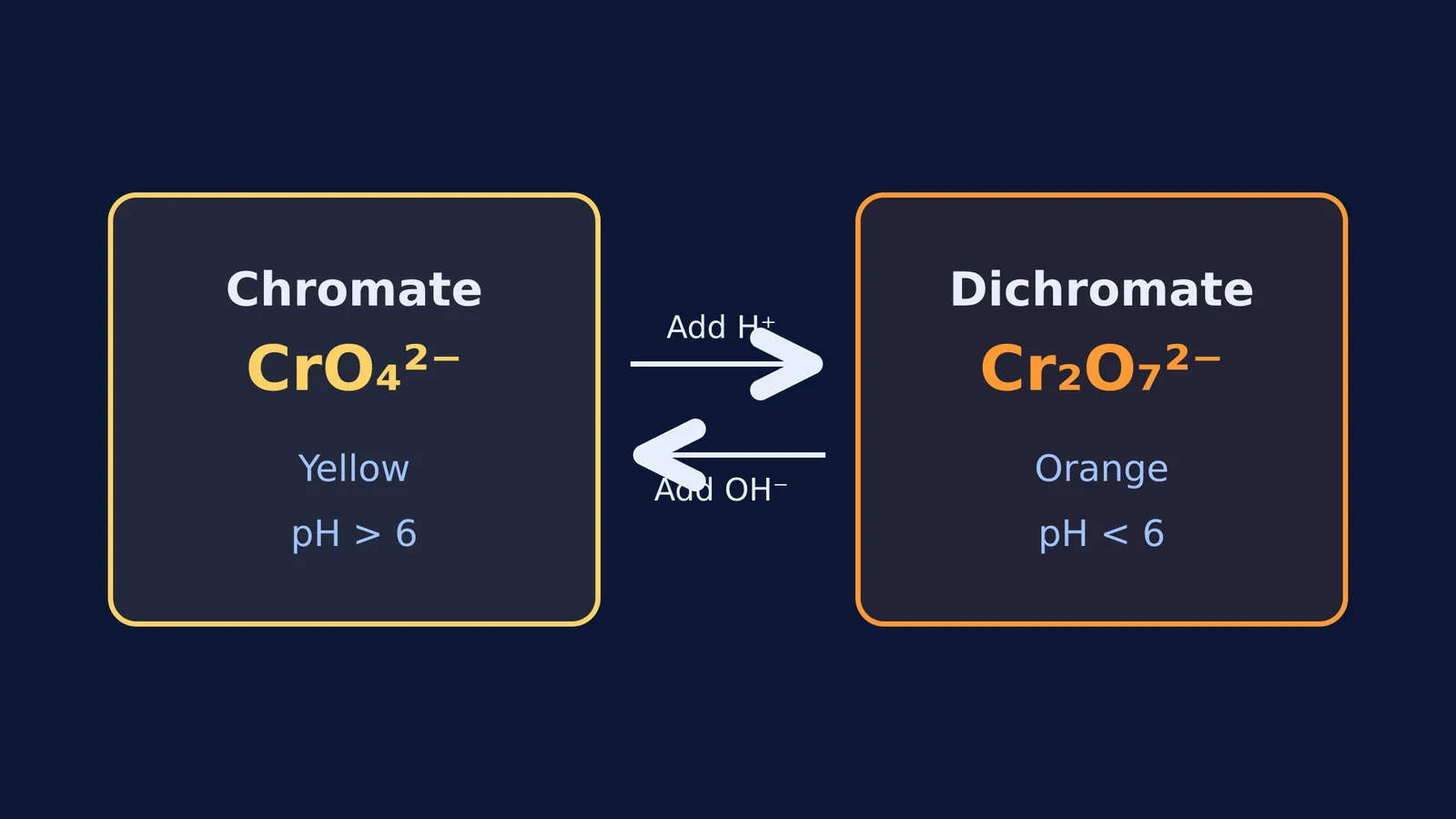
On the left is the chromate ion, which is yellow. On the right is the dichromate ion, which is orange.
The interconversion does not actually happen in a single leap. It is a two-step process. First, a chromate ion picks up a hydrogen ion to form a hydrogen chromate ion (HCrO₄⁻), which has a pKa of approximately 5.9. Then, two hydrogen chromate ions condense—joining together and releasing a molecule of water—to form the dichromate ion. Because hydrogen ions (H⁺) are a reactant in this overall equation, the pH of the solution directly controls which ion dominates.
How does pH change the colour?
The colour change is a direct result of Le Chatelier's principle, which states that a system at equilibrium will shift to counteract any change made to it.
Adding acid (pH < 6): When you add a strong acid like HCl, you increase the concentration of H⁺ ions in the water. The system tries to consume this excess H⁺ by shifting the equilibrium to the right. The yellow chromate condenses into orange dichromate.
Adding base (pH > 6): When you add a strong base like NaOH, the OH⁻ ions react with the free H⁺ ions to form water, effectively removing H⁺ from the system. To replace the lost H⁺, the equilibrium shifts to the left. The orange dichromate breaks apart to reform the yellow chromate.
The transition between the two forms typically occurs around a pH of 6, matching the pKa of the intermediate hydrogen chromate ion. Above pH 6, the solution is alkaline enough for yellow chromate to be the main species. Below pH 6, the solution is acidic enough to favour orange dichromate.
Is this a redox reaction?
No. A common trap in exams such as JEE and NEET is to assume that because the colour changes so drastically, a redox reaction must have taken place.
If you calculate the oxidation state of chromium in both ions, you will find it remains exactly the same:
In the chromate ion (CrO₄²⁻), the four oxygen atoms contribute an oxidation state of -8. For the overall ion to have a -2 charge, the central chromium atom must be +6.
In the dichromate ion (Cr₂O₇²⁻), the seven oxygen atoms contribute -14. For the ion to have a -2 charge, the two chromium atoms must provide +12 together, meaning each chromium atom is still +6.
The reaction is a condensation (joining two molecules together and losing a water molecule) rather than a transfer of electrons. If you want to review the rules for assigning these states, you can read our guide on how oxidation numbers are found from structure.
How do you use this in your exam prep?
When a chemistry question asks you to predict the direction of a shift in an aqueous equilibrium, always look for how the H⁺ or OH⁻ concentrations are changing.
If you are getting tangled in how concentration changes affect equilibrium equations, the Fermi Problem Library has worked problems with a step-by-step solver that explains the reasoning rather than printing an answer. It helps you see the mechanism behind the shift, whether you are dealing with aqueous ions or shifting an equilibrium by adding an inert gas.
How can you trace the cause and effect?
To keep the facts straight during a test, you can use this simple framework:
Reagent added: Acid (H⁺)
Equilibrium shifts: Right
Dominant species: Cr₂O₇²⁻
Observed colour: Orange
Reagent added: Base (OH⁻)
Equilibrium shifts: Left
Dominant species: CrO₄²⁻
Observed colour: Yellow
By linking the colour directly to the pH and remembering that the oxidation state stays at +6, you can answer both chemical equilibrium and qualitative analysis questions without hesitation.


