

On this page
In senior secondary practical chemistry examinations under the CBSE Senior School Curriculum, qualitative salt analysis carries 8 marks out of the 30 practical marks, representing a 26.7% share of the assessment. The entire identification workflow begins with the preliminary examination of anions using dilute acids. When an unknown salt enters the analysis sequence, deciding which tests to run first saves time, conserves reagents, and eliminates confusion before cation analysis begins.
Which gases evolve when dilute sulphuric acid reacts with anions?
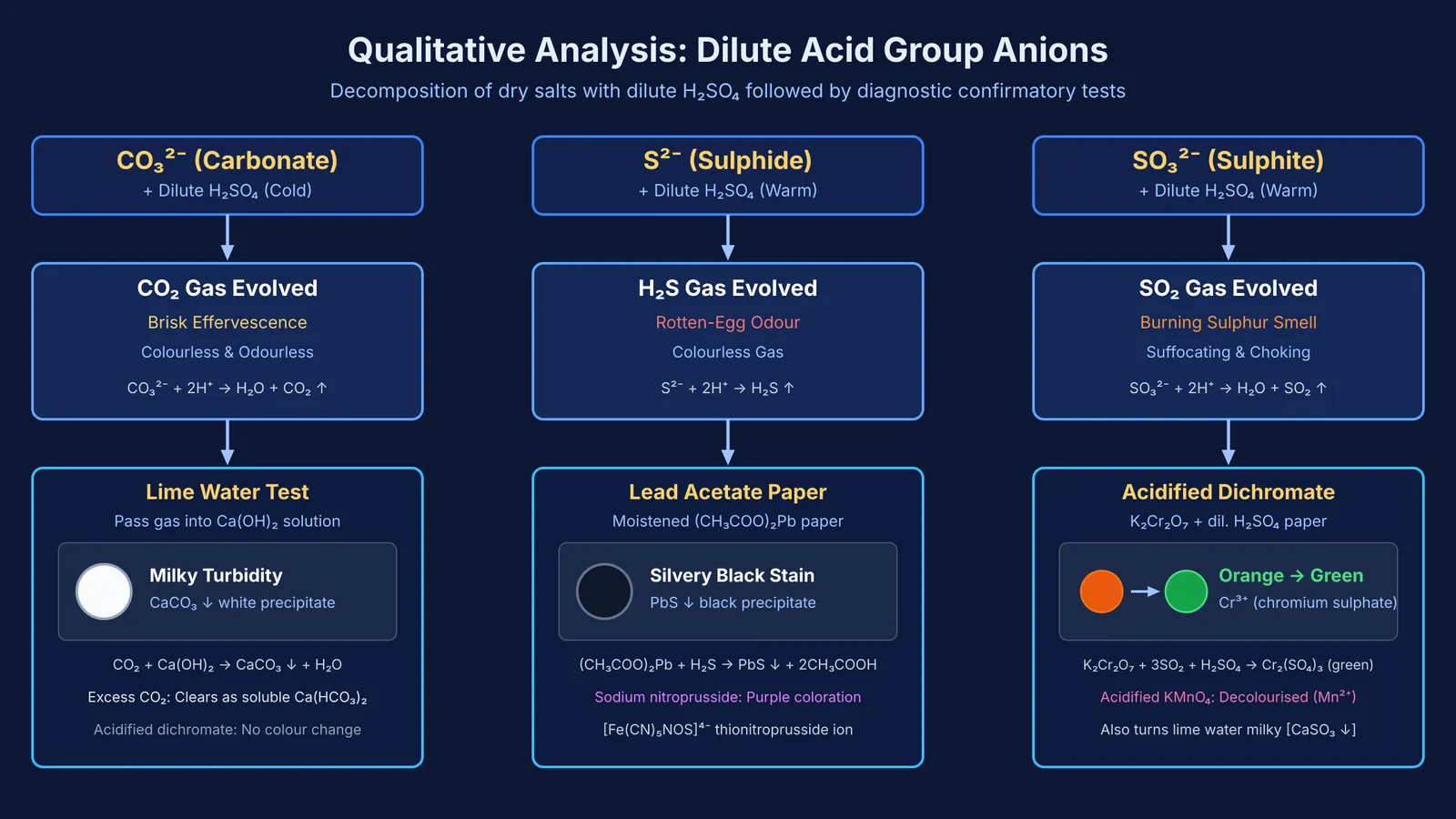
In the systematic qualitative procedure documented in the NCERT Chemistry Laboratory Manual, you begin by taking approximately 0.1 g of dry salt in a clean test tube and adding 1 to 2 mL of dilute sulphuric acid (H₂SO₄). Anions whose conjugate acids are volatile or unstable decompose immediately, liberating diagnostic gases. These anions form the dilute acid analytical group:
Carbonate (CO₃²⁻): Reacts vigorously in the cold to produce carbon dioxide gas with brisk effervescence: CO₃²⁻ + 2H⁺ → H₂O + CO₂ ↑. The gas is colourless and odourless.
Sulphide (S²⁻): Reacts upon mild heating to liberate hydrogen sulphide gas: S²⁻ + 2H⁺ → H₂S ↑. The gas is colourless but carries an unmistakable, pungent rotten-egg odour.
Sulphite (SO₃²⁻): Decomposes on warming to liberate sulphur dioxide gas: SO₃²⁻ + 2H⁺ → H₂O + SO₂ ↑. The gas is colourless and emits the suffocating, choking stench of burning sulphur.
To understand how protonation and structural stability govern these decomposition reactions, review how oxoacids of sulphur determine acid strength and molecular equilibria.
How do you distinguish between carbon dioxide and sulphur dioxide?
A frequent source of errors during practical exams is confusing carbon dioxide with sulphur dioxide. Both gases turn clear lime water (calcium hydroxide, Ca(OH)₂) milky by forming insoluble precipitates:
CO₂ + Ca(OH)₂ → CaCO₃ ↓ (white precipitate) + H₂O
SO₂ + Ca(OH)₂ → CaSO₃ ↓ (white precipitate) + H₂O
In both reactions, continuing to bubble excess gas eventually clears the milkiness because insoluble precipitates transform into soluble hydrogen salts, Ca(HCO₃)₂ and Ca(HSO₃)₂. Relying solely on lime water can therefore lead to a misidentification.
You can resolve this ambiguity by testing the redox properties of the evolved gas. Carbon in CO₂ has already reached its maximum oxidation state (+4) and cannot undergo further oxidation under mild bench conditions. By contrast, sulphur in SO₂ sits at a +4 oxidation state, which readily oxidises to +6.
When you bring a filter paper moistened with orange acidified potassium dichromate (K₂Cr₂O₇ and H₂SO₄) to the test tube mouth, sulphur dioxide reduces orange dichromate ions (Cr₂O₇²⁻) to green chromium(III) ions (Cr³⁺):
K₂Cr₂O₇ + 3SO₂ + H₂SO₄ → K₂SO₄ + Cr₂(SO₄)₃ (green) + H₂O
Carbon dioxide produces no colour change on acidified dichromate paper. Similarly, sulphur dioxide decolourises acidified potassium permanganate solution through redox reduction, comparable to the electron-transfer mechanics seen in the KMnO₄ redox titration practical.
How does lead acetate confirm the presence of sulphide?
When dilute sulphuric acid reacts with a metal sulphide, the escaping hydrogen sulphide gas reacts readily with heavy metal ions. To confirm sulphide, moisten a strip of filter paper with lead acetate solution ((CH₃COO)₂Pb) and hold it above the test tube mouth. The paper turns shiny, silvery black almost instantaneously:
(CH₃COO)₂Pb + H₂S → PbS ↓ (black precipitate) + 2CH₃COOH
Lead sulphide (PbS) has an extremely low solubility product, which drives precipitation even with trace concentrations of gaseous H₂S.
A secondary confirmation involves the sodium nitroprusside test. When you add a few drops of freshly prepared sodium nitroprusside (Na₂[Fe(CN)₅NO]) solution to an alkaline extract of the salt, the solution develops an intense, fleeting purple or violet coloration:
Na₂S + Na₂[Fe(CN)₅NO] → Na₄[Fe(CN)₅NOS]
In modern chemical pedagogy, green chemistry initiatives documented by Indu Tucker Sidhwani and Sushmita Chowdhury in the Journal of Chemical Education highlight greener qualitative schemes that eliminate hazardous hydrogen sulphide fumes and reduce chemical waste in teaching laboratories.
To master how redox states and coordination complexes behave across practical chemistry problems, the Fermi Concept Library arranges every concept in chemistry with its own lesson and its place in the map.
What systematic diagnostic protocol should you follow in the laboratory?
To achieve reliable results under exam conditions, execute this systematic diagnostic protocol based on the NCERT Chemistry Laboratory Manual:
Treat 0.1 g of dry salt with 1 to 2 mL of dilute H₂SO₄ in the cold. If you observe brisk, vigorous effervescence of a colourless, odourless gas, pass it through lime water. A milky white turbidity that dissolves with excess gas confirms carbonate (CO₃²⁻).
If no reaction occurs at room temperature, warm the test tube gently over a low flame.
Check the odour of any evolving gas by gentle wafting. A rotten-egg smell points to sulphide; a choking sulphur odour points to sulphite.
Apply specific confirmatory test papers to the vapour stream: lead acetate paper turning silvery black confirms sulphide (S²⁻), while acidified potassium dichromate paper turning emerald green confirms sulphite (SO₃²⁻).
Integrating these preliminary tests into your complete laboratory routine is covered step by step in our guide to the systematic salt analysis workflow.
When multi-step qualitative deductions involve overlapping precipitates and competing equilibria, the Fermi Problem Library provides worked problems with a step-by-step solver that explains the reasoning rather than printing an answer.


