

On this page
In 1911 William Arthur Knight and Elizabeth Mary Rich, of the Chemical Department at the University of Bristol, looked at a colour puzzle. A solution of chromous chloride, CrCl₂, is blue when cold or dilute but green when hot, concentrated and acid. They showed that the two colours are two different species, and they used freezing points to count the particles. The blue form behaved like three ions per formula unit. The green form gave fewer. Their data make a ready-made Class 12 van 't Hoff factor problem.
What did Knight and Rich publish in 1911?
The paper is W. A. Knight and E. M. Rich, "Isomeric Chromous Chlorides", J. Chem. Soc. Trans. 99 (1911) 87–95. We read it in the scanned 1911 volume and checked every number we quote against the page images.
They credit Prud'homme (1889) with first suggesting two forms, and J. W. McBain, who suggested the work, with isolating a dark green solid. Knight and Rich made pure CrCl₂ by dissolving chromous acetate in concentrated HCl in a vacuum and boiling the solution to dryness. They listed five solids:
dark blue CrCl₂·4H₂O;
dark green CrCl₂·4H₂O, the same formula as the blue one;
pale blue CrCl₂·3H₂O;
light green CrCl₂·2H₂O;
white anhydrous CrCl₂.
In contact with solution, the dark blue tetrahydrate changed into the dark green one at 38 °C, or into the trihydrate at 51 °C if the green one did not appear. The trihydrate became the dihydrate at 84–85 °C, and that became anhydrous CrCl₂ at 113–115 °C.
They showed the dark green solid has the same water content by turning it into the dark blue form in a closed flask and back again. Later, "all attempts" to make it again failed, so they made the green solution by heating the blue salt at 95 °C for three days with a little water and a few drops of concentrated HCl.
How do you find water of crystallisation from mass loss?
This is the Class 11 calculation they used to identify the lower hydrates. The molar mass of CrCl₂·4H₂O is 51.996 + 2 × 35.45 + 4 × 18.015 = 194.96 g mol⁻¹.
Percentage per water lost. One H₂O is 18.015 ÷ 194.96 × 100 = 9.24% (they printed 9.23). Two is 18.48% and four is 36.96%.
Their dihydrate. One specimen of the tetrahydrate weighing 22.354 lost 4.165 (the masses are printed without units, and only the ratio matters). That is 4.165 ÷ 22.354 × 100 = 18.63%.
Moles of water per CrCl₂. (4.165 ÷ 18.015) ÷ (22.354 ÷ 194.96) = 2.02. So two waters left, and CrCl₂·2H₂O remained.
The same specimen at 180 °C. It had lost 8.340 in all, which is 37.31%, or 4.04 waters. Everything was gone, leaving CrCl₂.
Chlorine analyses of the white solid (55.2 and 55.6%, against 57.6% printed for CrCl₂) showed that very little HCl was lost. For more practice on this method, see how to find x in a hydrate from heating mass-loss data.
How does a freezing point count ions?
The freezing-point lowering is ΔTf = i Kf m, where m is molality and i is the van 't Hoff factor. For a salt that can give n ions, i = 1 + α(n − 1), so α = (i − 1) ÷ (n − 1). The paper does not print its Kf. We use 1.86 K kg mol⁻¹ for water, which reproduces their percentages.
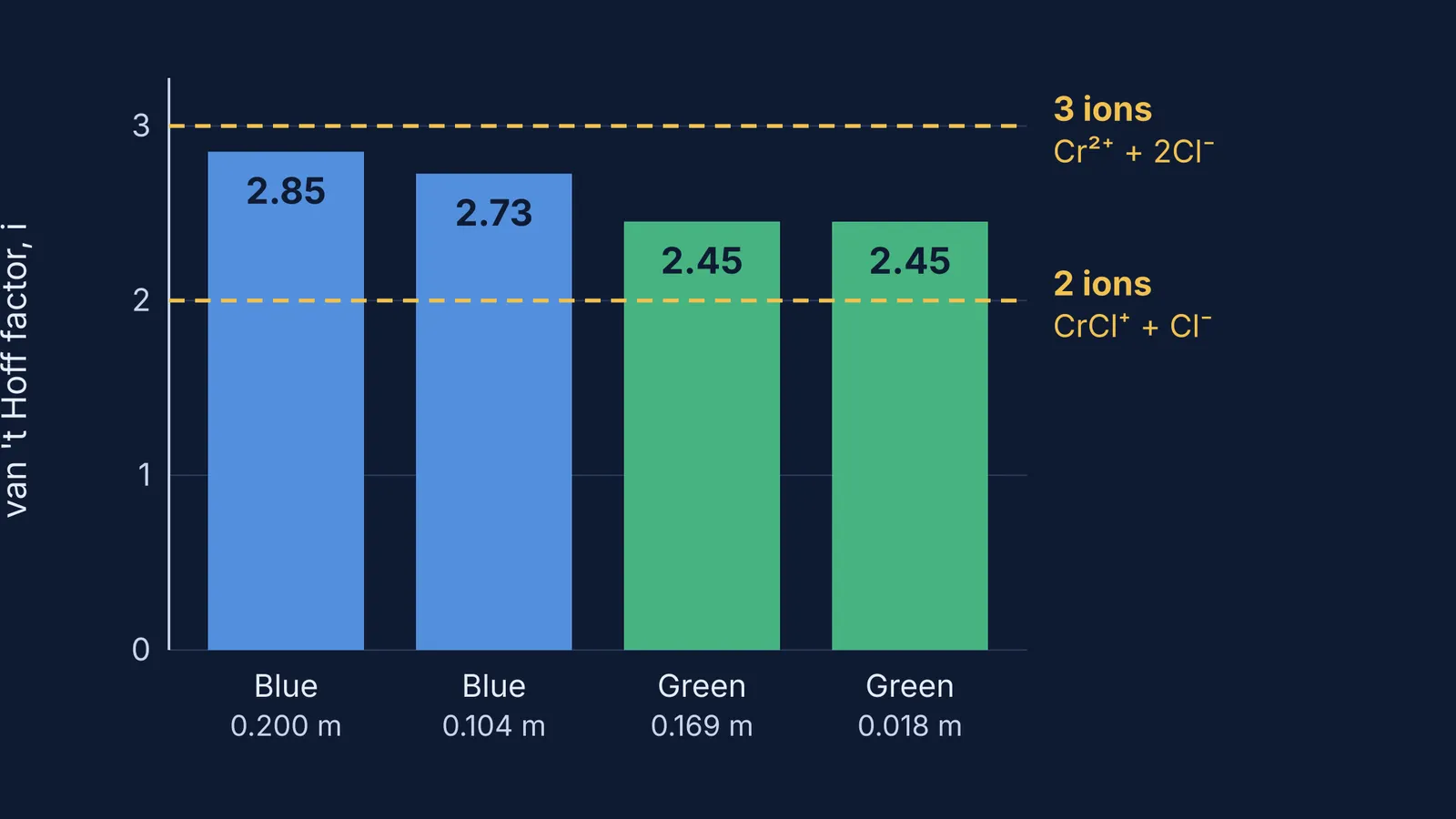
Worked example: the blue solution. They measured a lowering of 1.059 °C at 0.1996 mol per kg of water.
i = 1.059 ÷ (1.86 × 0.1996) = 1.059 ÷ 0.3713 = 2.85.
Blue CrCl₂ gives Cr²⁺ + 2Cl⁻, so n = 3.
α = (2.85 − 1) ÷ 2 = 0.93, or 93%. The paper prints 93.
At 0.1037 mol kg⁻¹ the lowering was 0.526 °C. That gives i = 2.73 and α = 0.86 (the paper prints 87; with Kf = 1.853 you get 0.87). The stronger solution looking more dissociated is, in their words, "usual where the lowering is so great", so treat these α values as approximate.
What does i = 2.45 say about the green form?
The green solution contained HCl as well. So they measured the freezing point of an HCl solution of the same strength and subtracted it. The lowering due to CrCl₂ alone was 0.771 °C at 0.1690 mol kg⁻¹.
i = 0.771 ÷ (1.86 × 0.1690) = 2.45.
Compare the ideal lowerings at this molality: 0.943 °C for three ions and 0.629 °C for two. The measured 0.771 °C lies between them.
The paper's "73 per cent" is (2.45 − 1) ÷ 2, worked out as if the salt gave three ions.
That 73% does not mean the green form is a weaker three-ion salt. The authors' point is that the green isomer, which they wrote as CrCl·Cl, splits into only two ions: CrCl⁺ and Cl⁻. At almost the same molality, the green solution gives a clearly smaller i than the blue one, so it holds fewer particles.
Why is i above 2, then? A pure two-ion salt cannot exceed i = 2. The authors answer this: it is "certain from the method of preparation that the solutions contained blue chromous chloride in addition to the green isomeride". A second green run (0.0182 mol kg⁻¹, 0.083 °C) also gave i = 2.45, and they called that agreement "fortuitous".
Why is the green colour not hydrolysis?
The paper weighed two explanations. One was hydrolysis to a green CrOH⁺ ion:
Cr²⁺ + H₂O ⇌ CrOH⁺ + H⁺
The other was a green complex ion formed with chloride:
Cr²⁺ + Cl⁻ ⇌ CrCl⁺
Both balance in atoms and charge. Concentrated HCl favours green, but by Le Chatelier's principle extra H⁺ should push the hydrolysis to the left, so hydrolysis is ruled out. Adding much potassium chloride to a hot solution also turned it green, as the chloride complex predicts. They called this "analogous to corresponding cases in the chromic salts": the CrCl₃·6H₂O isomers that differ in how many Cl⁻ sit on the metal, covered in our post on ionisation and hydrate isomers.
The paper writes the green form only as CrCl·Cl. It does not say how many water molecules sit on the chromium, so we do not write a modern formula.
Where does this come up in JEE and NEET?
Class 12, Solutions: finding i and the degree of dissociation from ΔTf, and spotting when i does not fit the formula you assumed.
Class 12, Coordination compounds: chloride inside or outside the coordination sphere changes the number of ions, and so changes i.
Class 11, Some basic concepts: water of crystallisation from percentage mass loss.
Class 12, d- and f-block: Cr²⁺ is a strong reducing agent; the authors checked purity from the oxygen their samples absorbed. For why Cr²⁺ is reducing, see why Cr²⁺ is reducing and Mn³⁺ is oxidising.
If you want more colligative-property problems where you must decide how many particles a solute gives, the Fermi Problem Library has a step-by-step solver that explains the reasoning.
Quick checklist
ΔTf = i Kf m, and α = (i − 1) ÷ (n − 1).
Blue CrCl₂ at 0.1996 mol kg⁻¹: i = 2.85, α = 0.93 for three ions.
Green CrCl₂ at 0.1690 mol kg⁻¹: i = 2.45, fewer particles than the blue form.
An i above the n you assumed means a mixture or a wrong formula.
Water lost ÷ molar mass, then compare with moles of salt, gives x in a hydrate.
Acid favouring the green colour rules out hydrolysis; added chloride favouring it points to CrCl⁺.


