

On this page
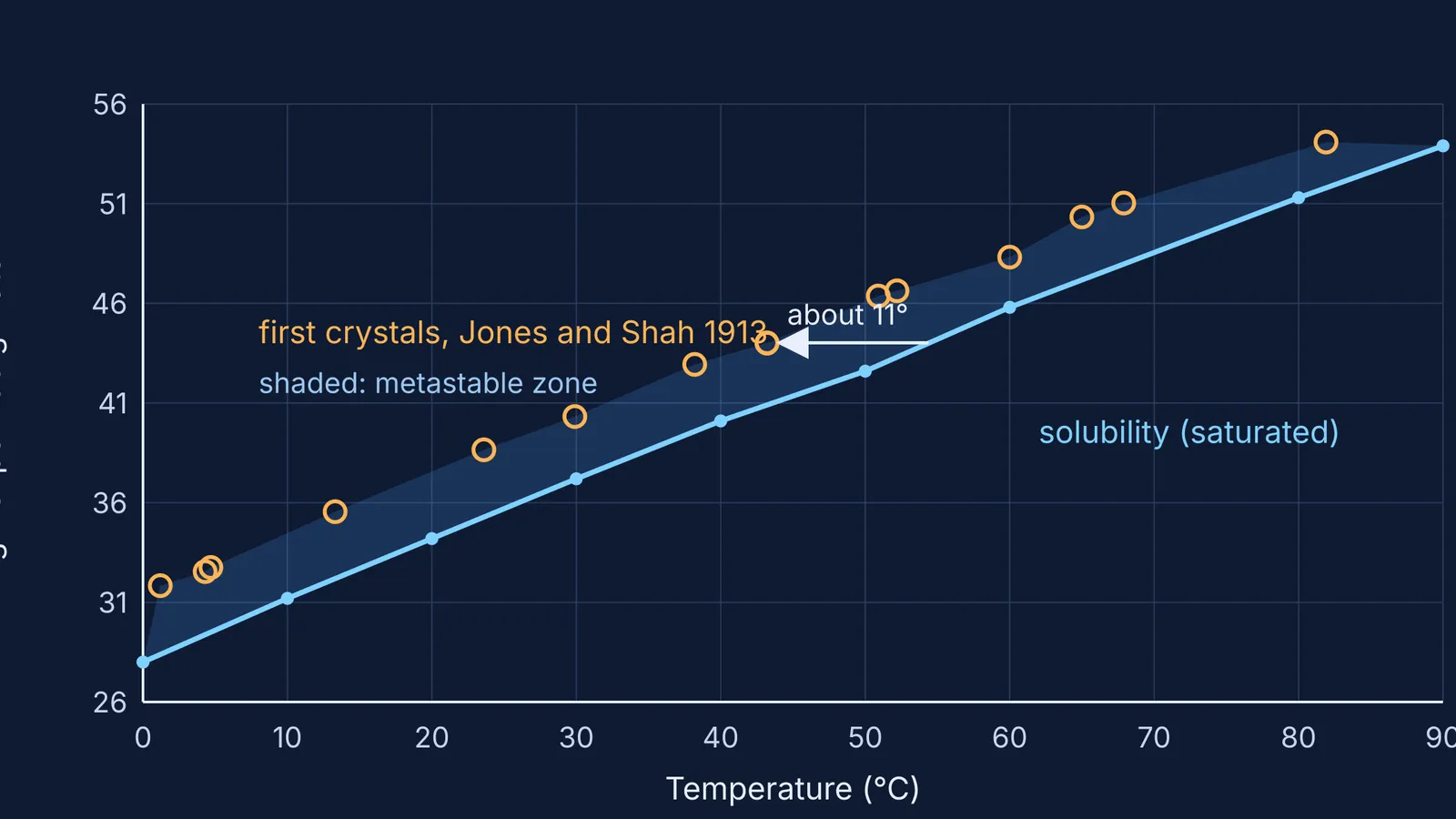
Cool a hot, saturated solution of potassium chloride and you might expect crystals the moment it passes its saturation temperature. They do not come. In 1913, two chemists working in Lahore sealed KCl solutions in glass tubes, shook them as they cooled, and wrote down the temperature at which the first tiny crystal appeared. For KCl that was about 10° below saturation, for KBr about 12° and for KI only about 3°. The gap they mapped is what your textbook calls the metastable zone of a supersaturated solution.
Who were Jones and Shah, and where was the work done?
The paper is Bernard Mouat Jones and Popatlal Govindlal Shah, "The Spontaneous Crystallisation of Solutions of Potassium Chloride, Bromide, and Iodide", Journal of the Chemical Society, Transactions, volume 103 (1913), pages 1043–1052 (DOI 10.1039/CT9130301043; scan on the Internet Archive). The address printed under the paper is the Imperial College of Science and Technology, London, but the last line says: "The work was done in the laboratories of the Government and Forman Christian Colleges, Lahore, India."
We have not checked the authors' biographies, so this post sticks to what they printed. Jones had earlier measured the same kind of gap for the nitrates of potassium, rubidium and caesium in 1908; this study tried salts sharing the cation K⁺. The numbers below were checked against the page images.
How do you catch the first crystal?
Their method, from earlier work by Hartley, Jones and Hutchinson:
Seal a tube. A solution of known strength (grams of salt per 100 g of water) was sealed in a thin glass bulb with small garnet chips, about 2 mm across, to give friction when shaken.
Destroy every nucleus. Each tube was heated in boiling water for at least 10–15 minutes so that no trace of solid survived.
Cool slowly while shaking. The bath cooled at about 1° every fifteen minutes.
Watch with a lens. One or two crystals, "often visible only through a pocket lens", marked the crystallisation temperature.
Successive runs on KCl agreed "often within one-tenth, and always within three or four tenths, of a degree". Two KCl tubes crystallised at 38.2° and 29.5° when freshly made, and at 38.2° and 29.9° four months later.
Why does KCl crystallise about 10° below saturation?
For each salt, the crystallisation points fell on a smooth "supersolubility curve" running "practically parallel to the solubility curve". The average gaps they reported were 10° for KCl, 12° for KBr and 3° for KI. Between the two curves the solution is supersaturated, yet with moderate shaking and no seed it stays clear. Cross the supersolubility curve and crystals appear quickly.
The paper does not explain why the gap differs. That was the puzzle: for "such closely similar salts" the gaps are 10°, 12° and 3°, and for the three nitrates Jones had found 4°, 1° and zero. They suggested factors other than mechanical shock were at work, and left the cause open.
Is the metastable gap a fixed property of the salt?
Not quite, and the authors say so. In 1911, Young had argued that there is no true "metastable limit": the temperature of crystallisation depends on how hard you shock the solution. Jones and Shah accepted that "no specifically metastable region exists" in which spontaneous crystallisation cannot happen. But they varied the shaking on purpose, by hand, with an electric-bell shaker and with a machine driven by a hot-air motor, and found that "the manner and vigour of the shaking seemed to have little or no effect". So they kept the curves as a sharp practical boundary.
One wording trap if you read the original: their sentence attaches "labile" to the state where crystallisation does not occur without violent stimulus, and "metastable" to the state where it does. Most textbooks today use the words the other way round. In current usage, and in our post on saturated, unsaturated and supersaturated solutions, the region between the two curves is the metastable zone.
Worked example: how supersaturated was a KCl tube?
Their Table I lists a tube holding 44.02 g KCl per 100 g water that first gave crystals at 43.2 °C. To compare, we need KCl's true solubility. A compiled solubility table gives 40.1 g at 40 °C and 42.6 g at 50 °C (per 100 g water).
Solubility at 43.2 °C. Interpolate: 40.1 + (42.6 − 40.1) × 3.2/10 = 40.90 g per 100 g water.
Excess dissolved salt. 44.02 − 40.90 = 3.12 g of KCl per 100 g water was held in solution with no crystal.
Supersaturation ratio. 44.02/40.90 = 1.076, so the solution held about 7.6% more salt than saturation.
Where it was saturated. The same table puts 44.02 g at about 54.4 °C (between 42.6 g at 50 °C and 45.8 g at 60 °C).
The gap. 54.4 − 43.2 = 11.2°. Repeating this for all fifteen KCl rows above 0 °C gives gaps of 8.9° to 12.9°, mean 10.9°, close to their 10°.
Seeded at 43.2 °C, about 3.1 g per 100 g water would have come out, the same subtraction as in reading a solubility curve to find crystal mass.
Can you use their ice temperatures as freezing points?
No, and this is the trap. They also cooled dilute solutions until ice appeared. Pure water in their tubes first froze at −0.6 °C, not 0 °C, so these are supercooling points. Test one with ΔTf = iKfm, using Kf = 1.86 K kg mol⁻¹ and M(KCl) = 74.55 g mol⁻¹:
2.00 g KCl per 100 g water: m = 2.00/74.55 × 10 = 0.268 mol kg⁻¹.
Predicted freezing point with i = 2: ΔTf = 2 × 1.86 × 0.268 = 1.00 K, so about −1.0 °C.
Their first ice: −2.4 °C. Even after subtracting the −0.6 °C offset of pure water, the "apparent i" is (2.4 − 0.6)/(1.86 × 0.268) = 3.6.
KCl gives two ions, so i cannot exceed 2. For 7.99 g the same sum gives 2.7: supercooling is not even a constant offset. The "hypertectic point" at −15.7 °C, where their ice and KCl curves cross, is likewise a supercooling crossing, not the eutectic.
Where does this show up in JEE and NEET?
Class 9 and Class 11, solutions: saturated, unsaturated and supersaturated solutions, solubility curves, and why a seed crystal starts crystallisation.
Class 12, Solutions: depression of freezing point and the van't Hoff factor. Revise the method in finding molar mass from depression in freezing point.
To see how solubility, supersaturation and nucleation fit together, the Fermi Concept Library gives each concept in chemistry its own lesson and its place in the map. For exam practice on colligative properties, Fermi Test Prep covers JEE Main and Advanced preparation with an AI tutor.
Quick checklist
Jones and Shah, J. Chem. Soc. Trans. 1913: work done at Government and Forman Christian Colleges, Lahore.
Sealed tubes with garnet chips, heated, then cooled slowly with shaking.
First crystals: KCl about 10°, KBr about 12°, KI about 3° below saturation.
Our check for KCl at 43.2 °C: 3.12 g excess per 100 g water, ratio 1.076, gap about 11°.
The gap depends on stimulus; they called it a sharp practical boundary, not an absolute limit.
Their ice temperatures are supercooling points; do not put them into ΔTf = iKfm.


