

On this page
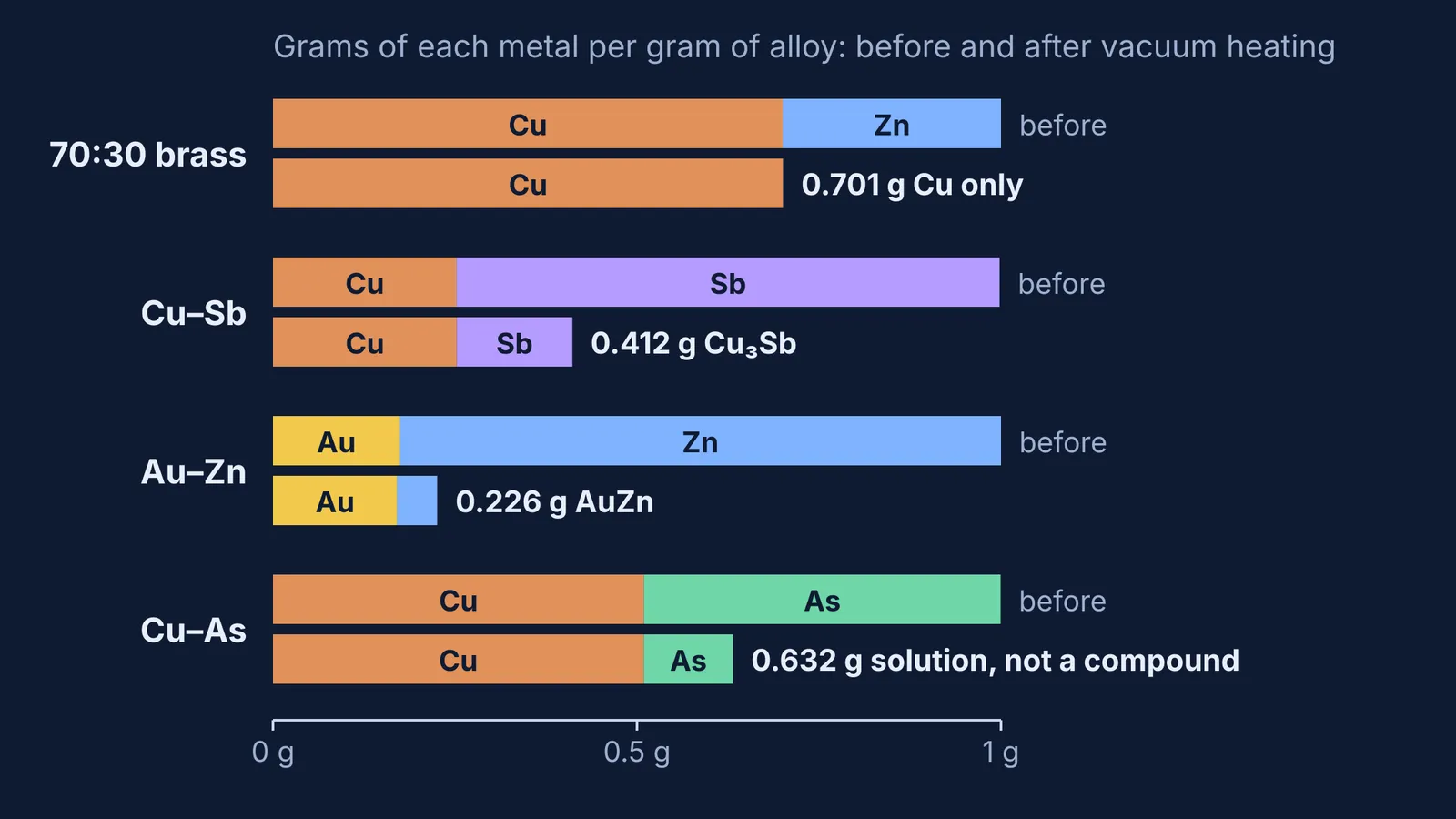
Put a piece of brass in a tube, pump the air out, and heat it. The zinc leaves as vapour and pure copper stays in the boat. In 1912 Clarence Richard Groves and Thomas Turner, at the University of Birmingham, did this with a range of alloys and weighed what was left. Sometimes the volatile metal went completely. Sometimes it stopped at a fixed ratio, and the residue's mass told them the formula of a compound, such as Cu₃Sb or AuZn.
What did Groves and Turner do in 1912?
The paper is C. R. Groves and T. Turner, "The Behaviour of Alloys when Heated in a Vacuum", J. Chem. Soc. Trans. 101 (1912) 585–591. We read it in the scanned 1912 volume and checked the numbers against the page images. The paper prints only their names and "The University, Birmingham"; we have not checked other biographical details.
Weighed alloy sat in a porcelain boat inside a porcelain tube in an electric tube furnace, pumped to below 1 mm of mercury. They worked between about 350 and 1200 °C. Metal vapour would attack the thermocouple, so it sat outside the inner tube, and the temperatures are readings just outside the sample. The work continued Turner's January 1912 paper to the Institute of Metals, which had already shown that brass loses all its zinc in a vacuum. They cited Heycock and Neville, who had made AuCd by heating gold with excess cadmium in an exhausted tube.
They sorted alloys into five groups:
Nothing lost. Cu–Al, cupronickel and Cu–Sn kept their weight.
Volatile metal completely removed. Brass, Cu–Bi and Cu–Pb left copper; iron and zinc separated at about 500 °C.
Excess removed, a compound left. Au–Zn and Cu–Sb.
Excess removed, but not a compound. Cu–As.
Both metals go together. Ag–Zn, Ag–Pb and Pb–Zn.
Why does zinc leave brass while copper stays?
Volatility. Zinc boils at about 907 °C, while copper melts at about 1085 °C and boils at about 2562 °C (PubChem periodic table). At 1100 °C zinc is far above its boiling point and copper is far below its own. This is why textbooks list zinc and mercury as metals refined by distillation; our post on liquation, poling and distillation covers that matching.
The vacuum adds two things. There is no air, so hot zinc vapour cannot burn back to ZnO. And with almost no gas pressure above it, a metal evaporates well below its normal boiling point. Bismuth (about 1564 °C), lead (about 1749 °C) and antimony (about 1587 °C) all boil above 1100 °C at 1 atm (PubChem), yet all three evaporated from copper at 1100 °C here. What matters in a vacuum is how much vapour a metal gives off, not its boiling point at 1 atm.
Worked example 1: the brass mass balance. The alloy was exactly 70% copper and 30% zinc. Five grams were heated for thirty minutes at 1100 °C.
Copper present = 5 × 0.70 = 3.5000 g.
Residue = 3.5029 g, which is 3.5029 ÷ 5 × 100 = 70.06% of the alloy.
Mass lost = 5 − 3.5029 = 1.4971 g, or 29.94%: the zinc.
The residue was tested for zinc "with negative results". All the copper stayed and all the zinc left.
How does the residue give the formula Cu₃Sb?
A copper–antimony alloy with Cu 25.20% and Sb 74.60% was heated: 1 g left 0.4120 g, so 0.588 g of antimony had gone. The white, crystalline residue analysed as Cu 61.26% and Sb 38.56%.
Worked example 2: empirical formula from % composition.
Take 100 g of residue: 61.26 g Cu and 38.56 g Sb.
Moles: Cu = 61.26 ÷ 63.546 = 0.9640; Sb = 38.56 ÷ 121.76 = 0.3167.
Divide by the smaller: 0.9640 ÷ 0.3167 = 3.04 : 1.
Formula: Cu₃Sb. Check: Cu₃Sb is 3 × 63.546 ÷ (3 × 63.546 + 121.76) × 100 = 61.02% Cu. Cu₂Sb would be 51.07% and Cu₄Sb 67.61%.
Mass check. The 1 g of alloy held 0.2520 g of Cu. Turned entirely into Cu₃Sb, that is 0.2520 × 312.40 ÷ 190.64 = 0.4130 g. The residue weighed 0.4120 g. So all the copper stayed and only the antimony in excess of Cu₃Sb boiled off.
This explains their first Cu–Sb run too. A copper-rich alloy (Cu 74.70%) lost only 1% of its weight. Taking Sb by difference (25.30%), its Cu : Sb mole ratio is 5.66 : 1, above 3, so the antimony could all be held as Cu₃Sb and there was no free antimony to lose.
Was AuZn really left from the gold–zinc alloy?
They made an alloy of about one-sixth gold (Au 17.41%) to imitate the gold–zinc residues of the cyanide process (see the redox steps of the cyanide process). Heated at 500 °C, 0.5 g left 0.1128 g containing 0.0852 g of gold.
Au in residue = 0.0852 ÷ 0.1128 × 100 = 75.53% (paper 75.50).
AuZn: 196.97 ÷ (196.97 + 65.38) × 100 = 75.08% (paper 75.1).
Mole ratio Au : Zn = 1.02 : 1.
Heating for ninety minutes instead of thirty gave "almost identical results". The gold balance is not perfect: the alloy held about 0.0870 g of gold, and 0.0852 g was found, about 2% short.
When is the residue not a compound?
Copper–arsenic. After thirty minutes the residue was Cu 80.60%; after two hours, Cu 80.50%. The ratio was fixed, but Cu : As = (80.5 ÷ 63.546) ÷ (19.5 ÷ 74.922) = 4.87 : 1, which is no simple formula. The arsenic-richest known compound, Cu₃As, would be 71.79% Cu. Under the microscope the residue showed two constituents, so they proposed that Cu₃As stays dissolved in copper at high temperature.
Silver–zinc. This alloy imitated the silver–zinc scum of the Parkes process for removing silver from lead (not in the syllabus). After two hours at 600 °C the residue was 0.5040 g of silver in 0.6052 g, or 83.28% Ag. The paper compares this with "83·29 required for Ag₃Zn"; we checked the page, and that is what it prints. Our calculation gives 3 × 107.868 ÷ (3 × 107.868 + 65.38) × 100 = 83.19% (83.20 with 1912 atomic weights), so the printed 83.29 looks like a slip, but the match is close either way. They still called the compound "not proved". Hotter runs lost some silver along with the zinc.
Where does this come up in JEE and NEET?
Refining of metals: distillation of zinc and mercury, and why volatility decides it. This sat in the NCERT Class 12 unit on isolation of elements; check whether your year's syllabus still includes it.
Class 11, Basic concepts: empirical formula from % composition, and mass balance.
Class 12, d-block: alloys can be solid solutions or fixed-composition compounds.
For more empirical-formula practice, the Fermi Problem Library has a step-by-step solver that explains the reasoning. If vapour pressure is the gap, the Concept Library gives each concept its own lesson.
Quick checklist
Zn boils near 907 °C, Cu near 2562 °C: zinc distils off and copper stays.
A vacuum lets metals evaporate below their 1 atm boiling points and stops reoxidation.
Cu–Sb residue: 3.04 : 1, Cu₃Sb (61.02% Cu); the 0.4130 g predicted matches 0.4120 g found.
Au–Zn residue: 75.53% Au, AuZn (75.08%).
A fixed ratio that is not a simple formula (Cu–As) points to a solution, not a compound.


