

On this page
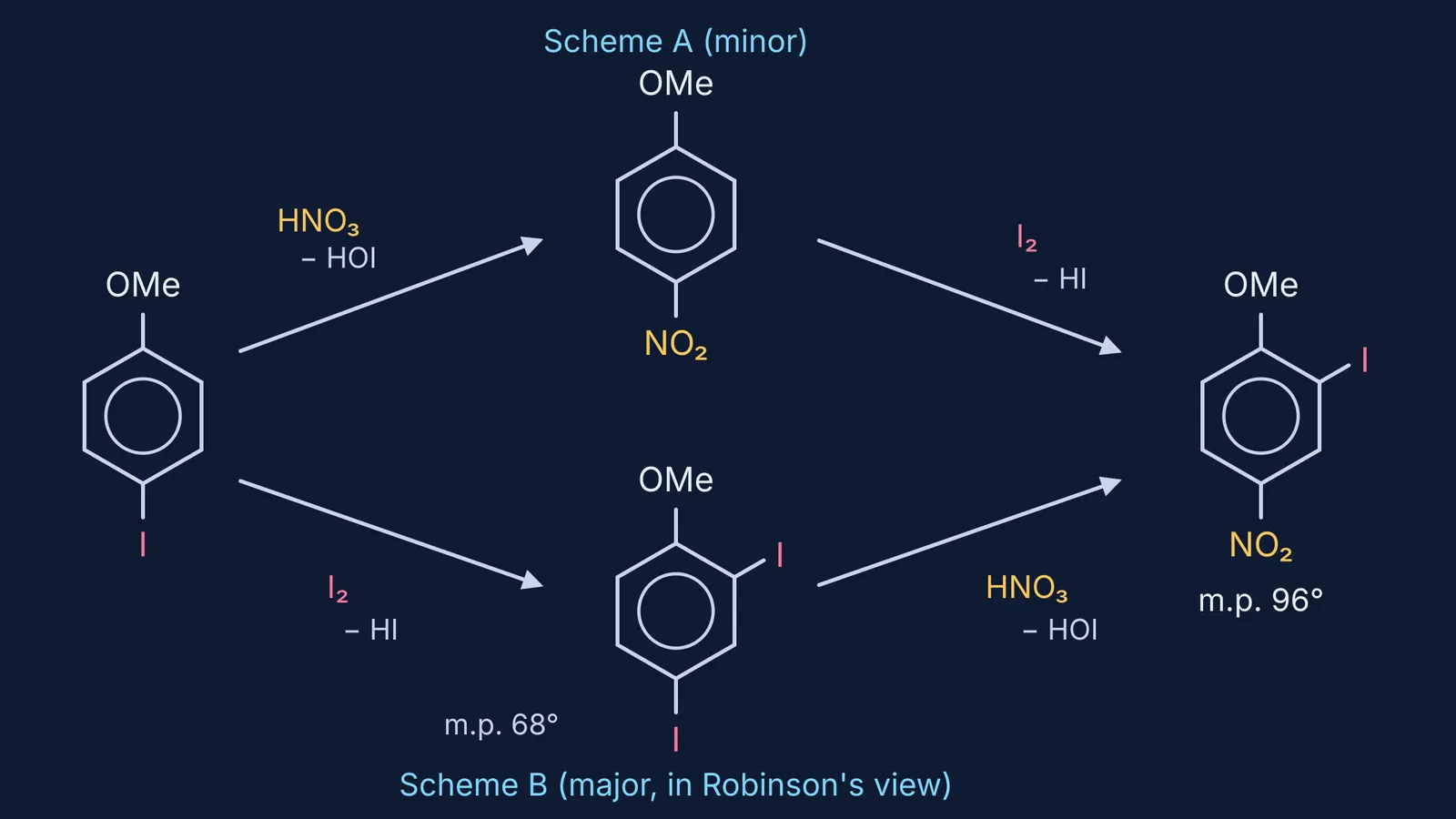
In 1896 Reverdin nitrated p-iodoanisole and got a strange product. The nitro group took the place where the iodine had been, para to the methoxy group, and the iodine turned up next door, ortho to methoxy. The product was 2-iodo-4-nitroanisole. It looked as if the iodine atom had walked round the ring. Twenty years later Gertrude Maud Robinson, writing from the Universities of Sydney and Liverpool, set out to show that it had done nothing of the kind (G. M. Robinson, J. Chem. Soc. Trans. 1916, 109, 1078). Her answer: the iodine is knocked off the ring as free iodine, and then it attacks the ring again in a new place.
What did Reverdin see, and why did it look like migration?
Robinson credits the discovery to Reverdin (Ber., 1896, 29, 1003), "who found that on nitrating p-iodoanisole the nitro-group displaces the iodine atom, which is apparently moved round to the ortho-position with respect to the methoxyl group".
A two-step route looked unlikely. First, nitric acid would replace iodine to give p-nitroanisole. Then the freed iodine would iodinate it. Robinson admits the second step seemed improbable "on the surface". p-Nitroanisole carries a deactivating nitro group and "is not very readily converted into derivatives by further substitution", and iodine "is well known to be a somewhat inactive agent".
She had a model. Orton and Jones had shown in 1909 that the "migration" of chlorine from nitrogen to the ring in N-chloroacetanilides goes through free chlorine (the background is in Chattaway and Orton's 1899 work on N-chloroacetanilide). Robinson wanted to extend this "theory of successive reactions, the rational explanation of migration".
How did Robinson show the iodine leaves and comes back?
She tested each step on its own.
Step 2 works after all. Iodine does react with p-nitroanisole in nitric acid. The product melted at 96°, and "the melting point was not lowered" when it was mixed with 2-iodo-4-nitroanisole made by either of Reverdin's methods. Same compound.
It works on the other isomer too. o-Nitroanisole with iodine in nitric acid gave 4-iodo-2-nitroanisole: pale yellow prisms melting at 98°. A mixture of this with the 96° compound "showed a depressed melting point". Different compound.
Step 1 is the normal reaction. With iodo ethers such as 4,5-di-iodoveratrole, nitric acid displaces an iodine that sits ortho or para to a methoxy group, giving free iodine and a nitro compound. Iodic acid was proved to be among the products.
An intermediate turned up. She could never isolate p-nitroanisole from p-iodoanisole and nitric acid. What she did isolate, after a very short reaction, was a solid that melted at 68° "alone or mixed with 2:4-di-iodoanisole". With more nitric acid it lost its para iodine and gave the 96° product plus free iodine.
An old compound was not real. Reverdin had reported a second substance melting at 73°. Robinson made it and found it "appears to be a mixture", most probably of 2-iodo-4-nitroanisole with di-iodoanisole.
Scheme A or scheme B: which route did she favour?
Robinson drew two routes.
Scheme A (nitrate first, iodinate second):
C₇H₇IO + HNO₃ → C₇H₇NO₃ + HOI (p-iodoanisole to p-nitroanisole; iodine leaves as hypoiodous acid)
HOI + HI → I₂ + H₂O
C₇H₇NO₃ + I₂ → C₇H₆INO₃ + HI (p-nitroanisole to 2-iodo-4-nitroanisole)
Scheme B (iodinate first, nitrate second):
C₇H₇IO + I₂ → C₇H₆I₂O + HI (p-iodoanisole to 2,4-di-iodoanisole)
C₇H₆I₂O + HNO₃ → C₇H₆INO₃ + HOI (the para iodine is displaced)
She said Scheme A "must occur to some extent", but it was her opinion "that the major proportion of the iodonitroanisole" comes by Scheme B, because di-iodoanisole can actually be isolated.
Add either scheme up and the iodine species cancel: C₇H₇IO + HNO₃ → C₇H₆INO₃ + H₂O. The overall equation looks exactly like a nitration with a moving iodine. Iodine is a carrier that leaves and returns, not an atom that slides.
Why does nitric acid knock iodine off the ring?
Robinson called it "displacement". Today it is called ipso substitution, attack at the ring carbon that already carries a substituent. The modern explanation, which is not in her paper, goes like this.
The OMe group makes C-4 a good target. Its lone pair feeds electron density to the ortho and para carbons, as in electrophilic substitution of anisole. In p-iodoanisole, the para carbon is the one holding iodine.
The σ-complex is stabilised. When NO₂⁺ adds at C-4, the positive charge spreads onto C-1, where the oxygen lone pair can share it.
Iodine leaves more easily than hydrogen would. The C–I bond is weak, and iodine can depart as an I⁺ equivalent, picked up by water as HOI. This is the reverse of iodination, the same reversibility explained in why iodination of benzene needs nitric acid.
Iodination is reversible and needs an oxidant to remove HI and supply electrophilic iodine. Here the same nitric acid that removes the iodine also makes re-iodination possible. Robinson saw this condition herself: "The substituting action of iodine is not observed unless the nitric acid is of a sufficient concentration."
Why does the iodine come back ortho to OMe? In p-nitroanisole, C-2 is ortho to OMe (an o/p director) and meta to NO₂ (a meta director). Both groups point to the same carbon. In o-nitroanisole the same logic picks C-4: para to OMe, meta to NO₂.
To revise activating and directing groups, the Concept Library covers each idea in chemistry one at a time.
How does a mixed melting point prove which compound you have?
Here is a worked example using Robinson's own data.
Combustion analysis first. 0.1482 g of 4-iodo-2-nitroanisole gave 0.1653 g CO₂ and 0.0260 g H₂O.
Carbon. 0.1653 × 12.011 ÷ 44.009 = 0.04511 g C. Divide by 0.1482 g: 30.4% C. The paper gives 30.4.
Hydrogen. 0.0260 × 2.016 ÷ 18.015 = 0.00291 g H, which is 1.96% H. The paper prints 1.9.
Theory for C₇H₆INO₃. M = 279.03 g/mol, so C = 84.08 ÷ 279.03 = 30.1% and H = 2.2%. The paper's 30.2 and 2.1 used 1916 atomic masses.
The catch. 2-Iodo-4-nitroanisole has the same formula, so the same percentages. Analysis cannot tell the two isomers apart.
Mixed melting point. The 96° compound plus Reverdin's product: no depression, so they are identical. The 98° compound plus the 96° compound: depressed, so they are different. The method itself is explained in the mixed melting point test.
Where does this show up in JEE and NEET?
Class 12 Haloarenes and EAS: OMe is an activating o/p director; NO₂ is a deactivating meta director. When both point at the same carbon, that is where the next group goes.
Iodination needs an oxidant: HNO₃ removes HI; here it also removes iodine from the ring.
Class 11 practical: a sharp, unlowered mixed melting point confirms identity; a lowered, broadened one shows two different compounds.
For exam practice on substitution and directing groups, Fermi Test Prep offers JEE Main and Advanced preparation with an AI tutor.
Quick checklist
Reverdin, 1896: nitrating p-iodoanisole gives 2-iodo-4-nitroanisole.
Robinson, 1916: the iodine leaves and re-enters; it does not migrate.
Scheme B (via 2,4-di-iodoanisole, m.p. 68°) was her main route; Scheme A also occurs.
Net change: C₇H₇IO + HNO₃ → C₇H₆INO₃ + H₂O.
Isomers give the same combustion analysis; mixed melting point separates them (96° vs 98°).


