

On this page
Your product melts at 121 °C, close to benzoic acid. A good examiner will still ask: how do you know it isn't a different compound that melts at the same temperature? The mixed melting point test answers that with one extra capillary.
Why isn't a matching melting point enough?
Many different compounds melt at nearly the same temperature. The Athabasca University organic chemistry lab manual notes that there are probably hundreds of organic compounds that melt between 118 and 121 °C. The same manual says most pure organic compounds melt over a narrow range of one or two degrees Celsius, while an impure compound melts lower and over a range wider than 3 °C.
Here is a real pair. A West Virginia University lab handout lists benzoic acid at 122 °C and 2-naphthol at 123 °C. A thermometer reading alone cannot tell these two apart. The LibreTexts organic lab textbook puts it this way: it is not uncommon for two different compounds to have coincidentally similar or identical melting points.
How does the mixed melting point test work?
The method from the LibreTexts chapter on mixed melting points/06%3A_Miscellaneous_Techniques/6.01%3A_Melting_Point/6.1E%3A_Mixed_Melting_Points) and the WVU handout comes down to four steps:
Take roughly equal amounts of your unknown and a pure, authentic sample of the compound you suspect.
Grind them together well, with a mortar and pestle or on a watch glass.
Fill a fresh capillary and find the melting range in the usual way.
Compare the mixture's range with the unknown's own range.
To read the result:
Same compound: the mixture is still a pure solid, so it melts sharply at the same temperature. Mixing benzoic acid with benzoic acid changes nothing.
Different compound: the known sample is now an impurity in your unknown, so the mixture melts lower and over a broader range.
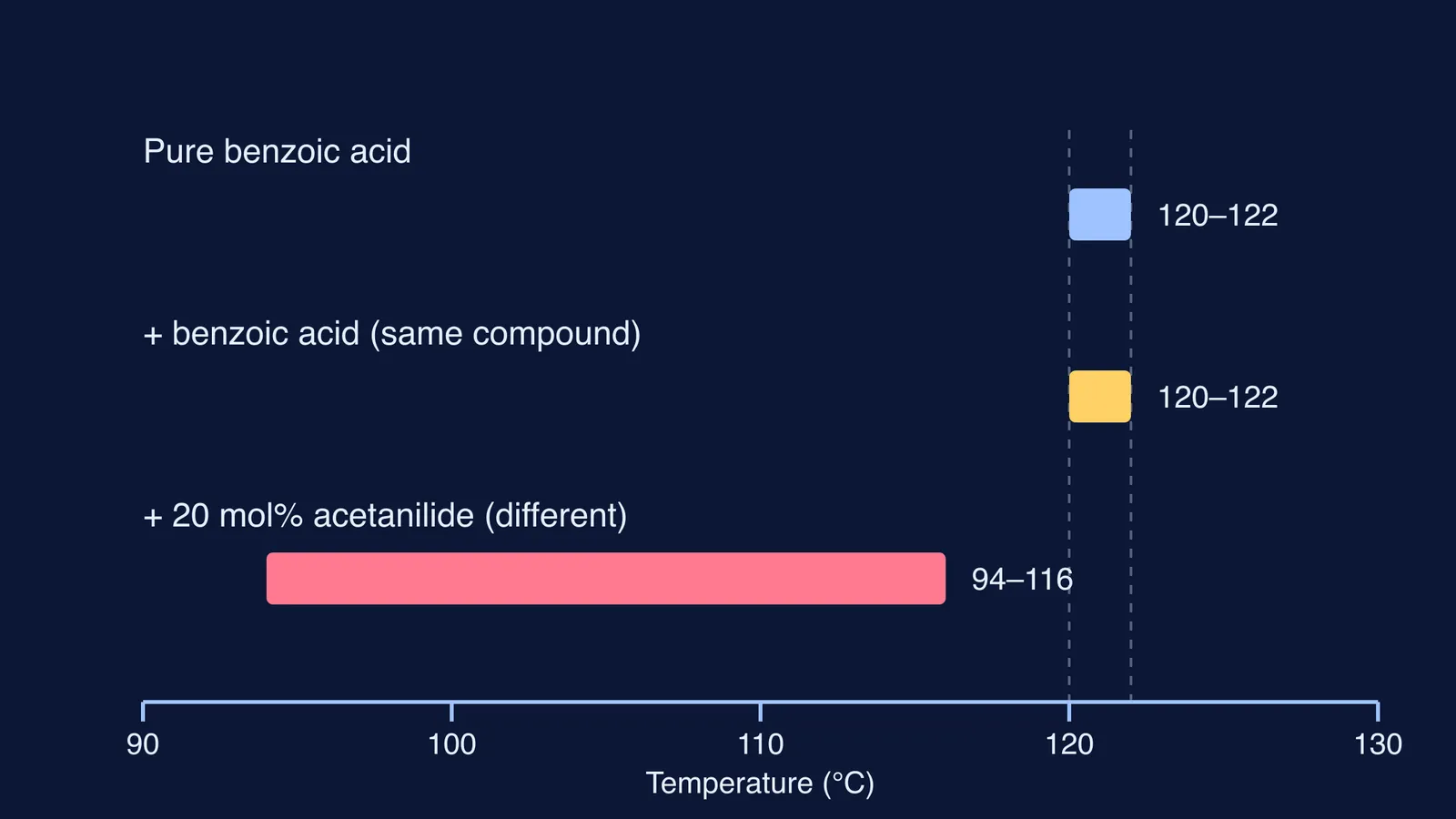
How big is the drop? The LibreTexts textbook gives a measured example: pure benzoic acid melts at 120–122 °C, but benzoic acid containing 20 mol% acetanilide melts across 94–116 °C.
This is the same idea as freezing point depression; see our post on finding molar mass from depression in freezing point. If melting point depression or colligative properties still feel shaky, the Fermi Concept Library has a lesson for every chemistry concept and shows where each one sits in the map.
Worked example: benzoic acid or 2-naphthol?
Suppose your recrystallised unknown melts at 121–122 °C. Both benzoic acid (122 °C) and 2-naphthol (123 °C) fit, going by the WVU handout's values. The results below are imagined, to show the reasoning.
Make mixture A: unknown plus pure benzoic acid, about 1:1, ground together.
Make mixture B: unknown plus pure 2-naphthol, about 1:1, ground together.
Melt both in fresh capillaries on the same apparatus.
Say A melts at 121–122 °C and B starts softening well below 120 °C, liquefying over many degrees.
Conclusion: A shows no depression, so the unknown is benzoic acid. In B, the 2-naphthol behaved as an impurity.
What if the mixture melts sharply but at a lower temperature?
That is the one trap. The WVU handout explains that a particular ratio of two different compounds, called the eutectic mixture, melts sharply at a temperature below the melting point of either pure compound. A sharp melt therefore only counts as a match if it also happens at the unknown's original temperature.
The handout gives two safeguards. Prepare at least two mixed samples with different ratios of known to unknown. If the melting point stays the same in both, the compounds are identical. Exceptions to this rule are rare but do exist, and the handout adds that spectroscopic methods are needed to confirm the conclusion.
Checklist for the practical and the viva
The Athabasca and WVU manuals give these habits:
Use only a little sample, packed well. The WVU handout uses 2–3 mm in the tube. Overfilled or loose samples heat unevenly and give a broad range even when the sample is pure.
Heat slowly near the melting point. Athabasca advises not more than 1 °C per minute.
Never re-melt a sample. Use a fresh capillary each time, because the sample may have decomposed or changed form.
Record two temperatures: when the first crystal melts and when the last crystal disappears.
If the examiner asks why you did the test, you could say: "Many compounds melt near this temperature, so I mixed my sample with authentic benzoic acid. The mixture melted sharply at the same temperature, so the reference did not act as an impurity, which means they are the same compound."
For the basic method, see how to find the melting point of an organic compound, and for purification, why crystallisation beats evaporation for purifying a salt. If you get stuck on a lab-based question, the Fermi Problem Library has a step-by-step solver that explains the reasoning rather than printing an answer.


