

On this page
You have a beaker of salty, slightly dirty water and you want the salt back, clean. Boiling the water away until the dish is dry looks like the obvious answer. Crystallising is the better method. Here is why.
What is the difference between evaporation and crystallisation?
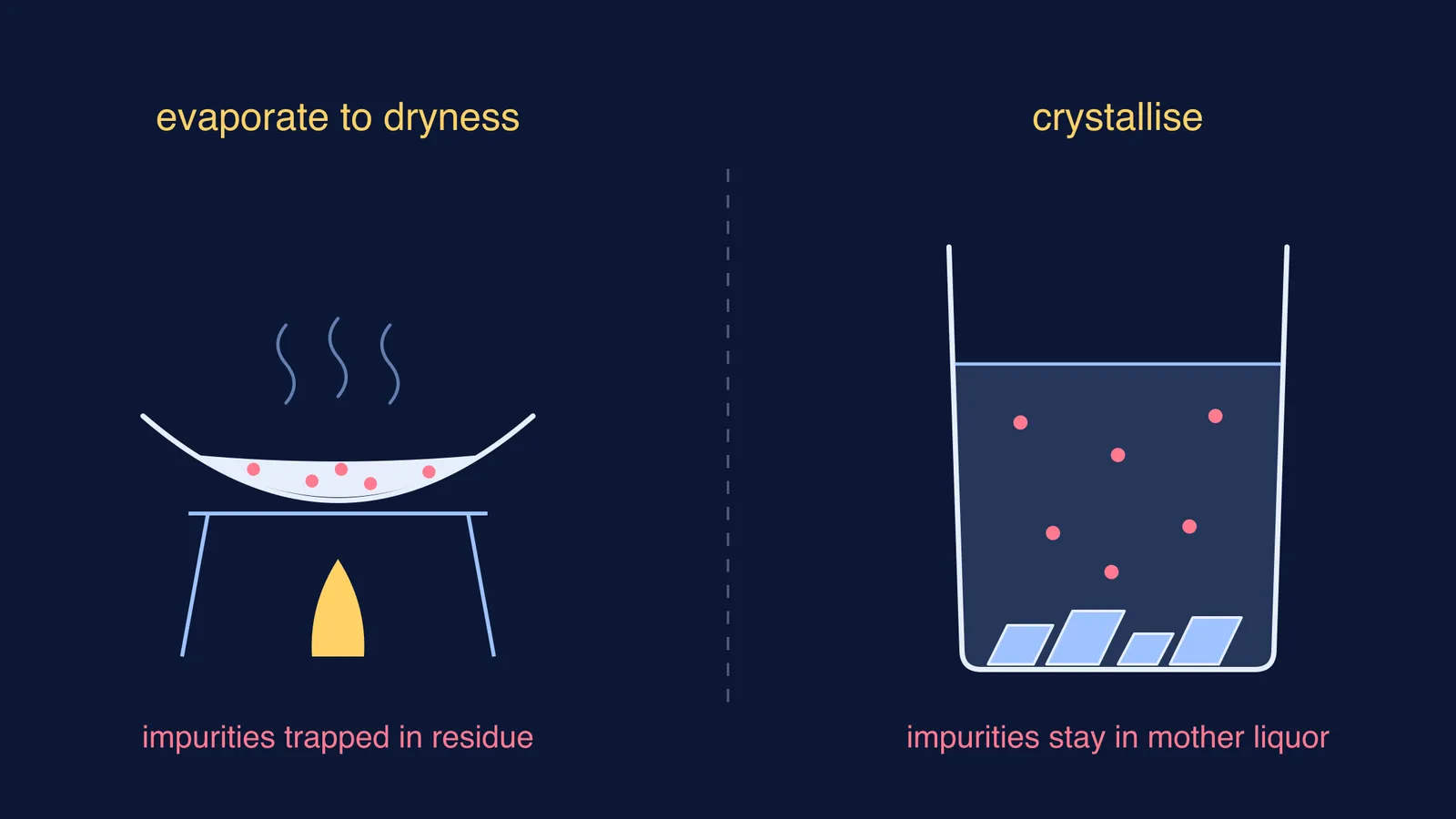
Evaporation to dryness means heating a solution until all the solvent is gone, so everything that was dissolved is left behind as a solid.
Crystallisation means concentrating a solution until it is nearly saturated, then letting the pure compound come out as crystals while some liquid is still left. The NCERT Class 11 chemistry text says crystallisation is based on the difference in the solubilities of the compound and the impurities in a suitable solvent (NCERT Chemistry Part II, Unit 8, section 8.8.2).
The leftover liquid has a name. NCERT calls it the mother liquor and says it "contains impurities and small quantity of the compound" (same NCERT section).
Why is crystallisation better than evaporation?
There are two reasons.
Soluble impurities stay in the liquid. Filtering removes sand and dust, but anything that dissolved along with your salt goes straight through the filter paper. If you boil to dryness, those impurities have nowhere to go, so they end up mixed into your solid. In crystallisation, the impurities stay dissolved in the mother liquor, which you filter off.
Heat can change the solid itself. While water is left, the boiling liquid stays near 100 °C; once the dish is dry, the solid can get much hotter. Sucrose (table sugar) decomposes at 186 °C and gives off acrid smoke, according to PubChem's sucrose record. Blue copper sulphate crystals lose their water of crystallisation when heated, most of it by about 110 °C, and the dehydrated solid is white (PubChem, copper(II) sulfate pentahydrate). Crystals grown from a solution are dried gently instead.
NCERT adds two refinements: coloured impurities can be removed by adsorbing them on activated charcoal, and repeated crystallisation is needed when an impurity has a solubility close to that of the compound (NCERT, section 8.8.2).
What about common salt, which is barely more soluble when hot?
Cooling a hot solution only gives you crystals if the solid dissolves much better hot than cold. Common salt does not. One gram of sodium chloride dissolves in about 2.8 mL of water at 25 °C and in about 2.6 mL of boiling water, according to the Merck Index figures on PubChem's sodium chloride page. Cooling a hot, saturated salt solution gives back very little salt.
So for salt, you heat to drive off most of the water, and the crystals form while the solution is still hot. The key is to stop before the dish is dry. Filter off the crystals while some liquid remains, and the soluble impurities stay in that liquid. It still counts as crystallisation, because the separation happens between the crystals and the solution. For salt made on a large scale, read how salt is made from sea water in salt pans.
How do you purify impure copper sulphate by crystallisation?
Say you have copper sulphate mixed with dust and a little of a soluble impurity.
Dissolve the sample in the smallest amount of hot water that takes it all up.
Filter while hot. The dust stays on the paper; the copper sulphate and the soluble impurity pass through.
Heat the filtrate gently to concentrate it. Every so often, dip in a glass rod: when the drop on it forms tiny crystals as it cools, the solution is nearly saturated. Stop heating.
Let it cool slowly and undisturbed. Blue crystals grow, while the small amount of impurity stays dissolved.
Filter off the crystals. The filtrate is the mother liquor, and it holds the impurity.
Rinse the crystals with a few drops of cold water and dry them between filter papers, not on a hot plate, because heating drives off their water of crystallisation (see the PubChem record above).
Had you boiled the step 2 filtrate to dryness, the impurity would be in your product and overheated patches would turn white.
When is plain evaporation good enough?
Evaporation is fine only when all three are true:
You want everything that is dissolved, not one pure substance, such as when measuring the total dissolved solids in a water sample.
The solid does not decompose or lose water of crystallisation at the temperatures involved.
There are no soluble impurities you care about.
If any one fails, crystallise. To practise choosing a method for a given mixture, try our guide on asking AI which method separates each mixture, then checking it. If the word pure itself feels slippery, read what pure means in chemistry versus everyday life.
If you can list the steps but not say why each one is there, the Fermi Concept Library has a lesson on every chemistry concept and shows its place in the map. The Fermi Problem Library has worked problems with a step-by-step solver that explains the reasoning rather than printing an answer.


