

On this page
Have you ever bought a packet of "100% pure milk" or a jar of "pure honey" and wondered what makes it pure? In everyday language, we use the word pure to mean something very specific: that a product is natural and unadulterated. However, when you step into a chemistry class, the rules change entirely. The definition of a pure substance in chemistry is completely different from the way we use it at the supermarket. Understanding this difference is one of the first and most important lessons in the NCERT Class 9 Science syllabus, and it forms the foundation for everything you will learn about elements and compounds.
What does pure mean in everyday life?
When you go to the dairy or the grocery shop and ask for pure milk, pure ghee or pure spices, you are simply asking for something that has not been tampered with. In our daily lives, "pure" means that nothing cheaper or harmful has been mixed in to lower the quality of the product.
Pure milk came straight from the cow or buffalo, without the milkman adding extra water to increase the volume. Pure ghee has not been cut with cheaper vegetable oils. Pure honey does not contain added sugar syrup. If a shopkeeper sells you milk that has been diluted with water, you would correctly call it impure or adulterated. In this context, purity is about quality, safety and honesty. It has nothing to do with the types of molecules inside the food.
What does pure mean in chemistry?
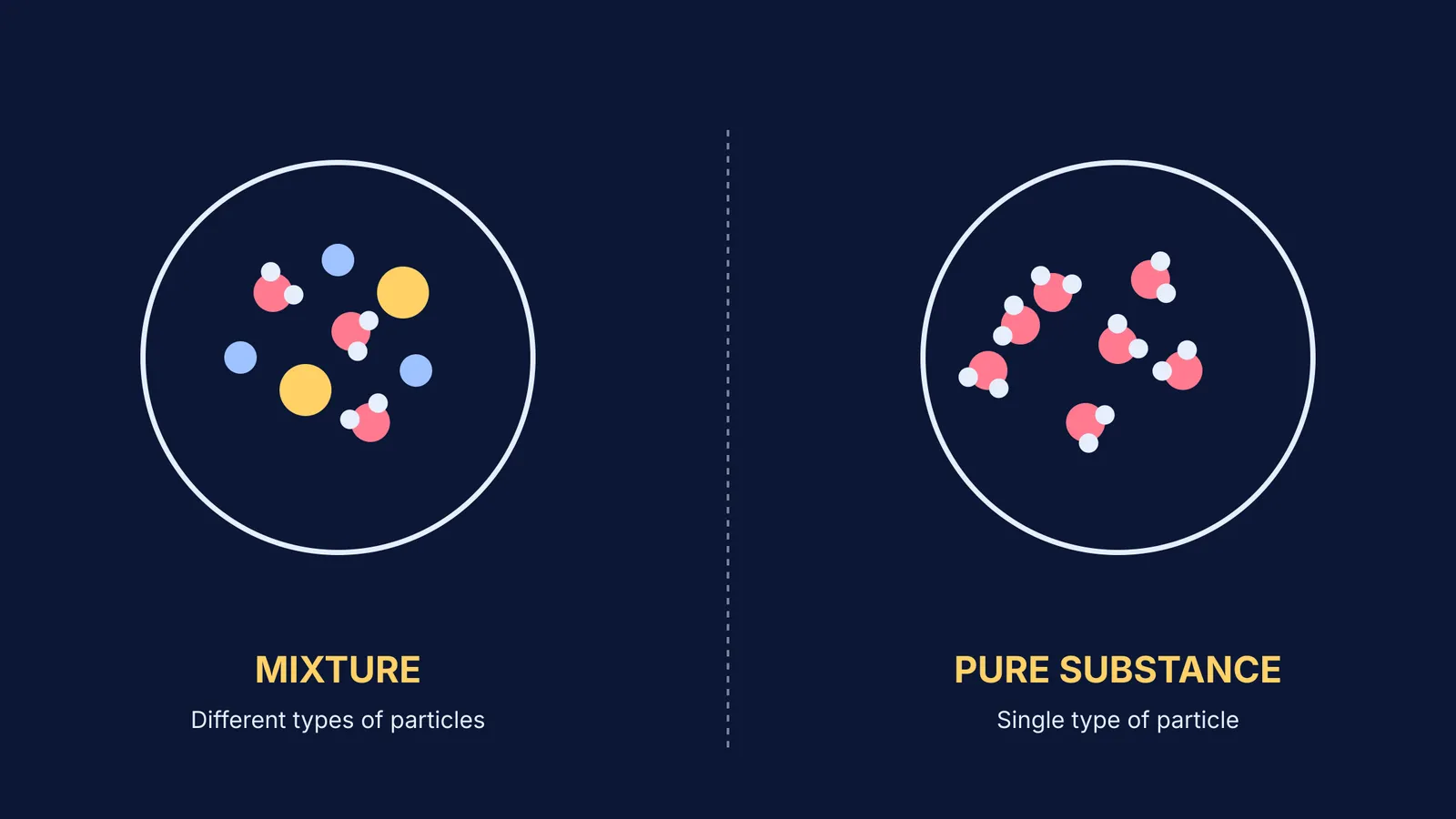
Chemists look at the world differently. They zoom in past the liquid in the beaker to look at the individual atoms and molecules. According to the National Council of Educational Research and Training (NCERT) Class 9 Science textbook, a pure substance consists of a single type of particle.
If you take a sample of a pure substance and examine it under an impossibly powerful microscope, every single particle in it would be exactly the same in its chemical nature. There are two categories of pure substances in chemistry:
Elements: These are the simplest form of matter and are made of only one kind of atom. For example, a pure iron nail contains nothing but iron atoms.
Compounds: These are made of two or more elements that are chemically bonded together in a fixed, exact proportion. For example, pure water (H₂O) contains only water molecules. Even though water is built from both hydrogen and oxygen atoms, every single molecule is identical, making the water a pure substance. Once you know something is a pure compound, you might need to know how its atoms share electrons; you can review ionic vs covalent compounds for that.
Why is milk not a pure substance in chemistry?
The NCERT syllabus explicitly uses milk as the classic example to show the gap between everyday language and scientific language (NCERT Class 9 Science Chapter 2).
Even if the milkman adds absolutely nothing to the bucket, milk is not chemically pure. It is a complex blend of water, liquid fats, proteins and carbohydrates. Because milk contains several different types of particles that are only physically mixed together, a chemist classifies it as a mixture, specifically a type of mixture called a colloid.
The same scientific rule applies to the soil in your garden, the sea water at the beach, and the air we breathe. They are all mixtures composed of different pure substances thrown together.
How do you identify a pure substance in exams?
If you are preparing for school exams or competitive tests like JEE and NEET, knowing the scientific difference is essential for scoring marks. When you get a multiple-choice question asking you to classify a material, use this simple three-point checklist:
Does it have a fixed chemical formula? Pure water is always H₂O and table salt is always NaCl. Milk, on the other hand, has no chemical formula because the ratio of fat to water can change. If a substance has a strict chemical formula, it is a pure substance. Knowing that you are starting with pure substances also helps you figure out what a balanced chemical equation gives.
Can it be separated by physical methods? You can separate the butterfat from milk simply by churning it. However, you cannot separate the hydrogen from the oxygen in water by churning, filtering or boiling it. If physical methods can split it apart, it is a mixture.
Does it have a sharp melting and boiling point? Pure water boils at exactly 100 °C at sea level. Mixtures do not have a single, sharp boiling point; they melt and boil over a range of temperatures.
If you struggle to remember the difference between elements, compounds and mixtures during your revision, the Fermi Concept Library maps out every chemistry concept, each with its own lesson and its place in the map. And when you are stuck on a tough classification problem in a past paper, the Fermi Problem Library has worked problems with a step-by-step solver that explains the reasoning rather than printing an answer.
Can you tell a pure substance from a mixture?
To make sure you understand the chemist's definition, try classifying these everyday items before your next test:
Baking soda: Pure substance (it is a single compound known as sodium bicarbonate).
Lemonade: Mixture (it contains water, lemon juice and sugar physically mixed together).
24-carat gold: Pure substance (it is an element made entirely of gold atoms).
Steel: Mixture (it is an alloy made by mixing iron and carbon).
Understanding this fundamental difference is your very first step in mastering chemistry. Once you see that almost everything around us is actually a mixture, you will understand why chemists spend so much time learning how to separate and purify them.


