

On this page
Finding a melting point is a standard Class 11 chemistry practical that is easy to get wrong, usually by heating too fast. Here is the NCERT method, a timing rule from a university lab guide, and how to judge purity.
How do you determine the melting point of an organic compound?
The NCERT Class 11 Laboratory Manual (Unit 3, Experiment 3.2) defines the melting point as the temperature at which a solid begins to change into a liquid when the pressure is one atmosphere. It lists naphthalene, p-dichlorobenzene and p-toluidine as sample compounds. Its procedure, in short:
Seal one end of a capillary tube about 8 cm long in a Bunsen flame, rotating it as you go.
Crush about 100 mg of the solid finely, push the open end into it and tap until the powder packs tightly at the sealed end, to a length of nearly 1 cm.
Wet the capillary with liquid paraffin so it sticks to the thermometer, its bottom level with the bulb.
Fill the Thiele tube with 50 to 60 mL of liquid paraffin, enough to cover the bent part.
Fit the thermometer through a cork with a side groove for air and vapours. Keep the capillary's open end above the paraffin and nothing touching the glass.
Heat the side arm with a low flame and note the temperature when the solid starts to melt.
The manual adds that liquid paraffin is safe up to 220 °C; above that, it calls silicone oils the most satisfactory liquids.
Why should you heat slowly near the melting point?
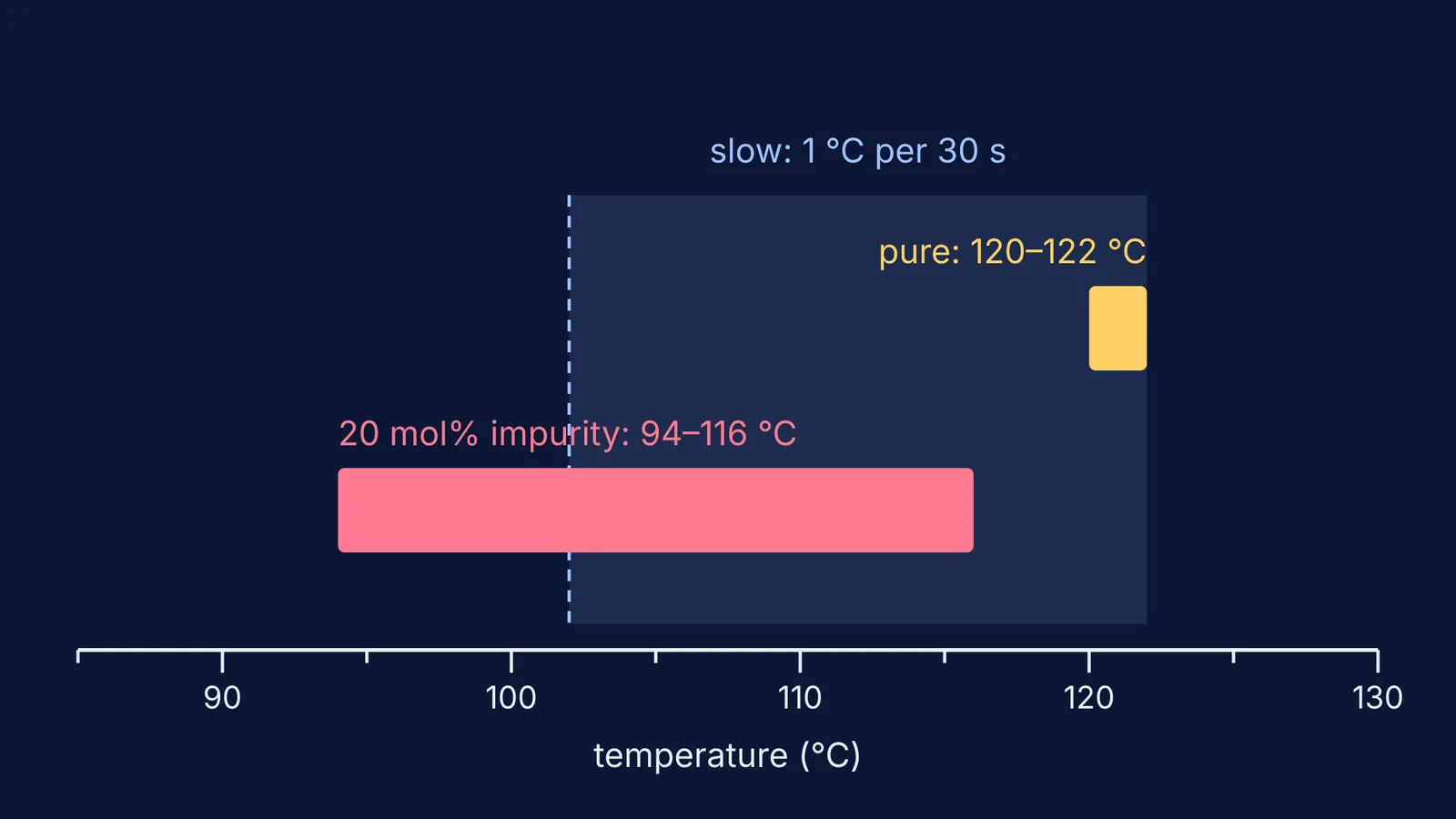
The thermometer reads the oil, not the solid. The Chemistry LibreTexts guide to melting point procedures/06%3A_Miscellaneous_Techniques/6.01%3A_Melting_Point/6.1D%3A__Step-by-Step_Procedures_for_Melting_Point_Determination) says the temperature must rise slowly near the melting point so the thermometer accurately reflects the solid's temperature. Its rule: heat at a medium rate until you are 20 °C below the expected melting point, then slow down so the temperature rises by no more than 1 °C every 30 seconds.
Why heat the side arm? Warm oil is less dense and rises up the triangular part of the tube while cooler oil sinks, setting up a current that heats the sample gradually. The guide also says to record two temperatures: one when the first drop of liquid appears, and one when the whole sample has just melted. Those two numbers are your melting range.
What does a sharp melting range say about purity?
The NCERT manual says that pure solid compounds have sharp melting points, which is why the melting point can be used as a criterion of purity. The LibreTexts page on uses of melting points/06%3A_Miscellaneous_Techniques/6.01%3A_Melting_Point/6.1B%3A_Uses_of_Melting_Points) puts the rule simply: impurities lower and broaden the melting range.
In that page's example, pure benzoic acid melted at 120–122 °C, a range of 2 °C. Benzoic acid containing 20 mol% acetanilide melted at 94–116 °C, a range of 22 °C. The impure sample had melted completely before the pure one even started.
One caution from the LibreTexts procedure page/06%3A_Miscellaneous_Techniques/6.01%3A_Melting_Point/6.1D%3A__Step-by-Step_Procedures_for_Melting_Point_Determination): it recommends a sample 2–3 mm tall and warns that a taller one can give a broad range because it heats unevenly. NCERT asks for nearly 1 cm, so follow your lab's instruction. Either way, a wide range can mean poor technique: pack the powder evenly, with no big air gaps.
Worked example: reading two naphthalene results
PubChem lists naphthalene's melting point at about 80 °C. Using the 20 °C rule, you heat at a medium rate to 60 °C, then slow to 1 °C every 30 seconds. At that rate, 60 °C to 80 °C takes about 10 minutes, so plan your time.
Now imagine two students note these readings:
Student A: first drop at 79 °C, fully liquid at 80 °C. Narrow and at the expected value, so the sample is likely pure.
Student B: first drop at 74 °C, fully liquid at 78 °C. Wider and lower, which fits an impure sample. Check the packing and heating rate, then repeat with a fresh capillary.
Write the result as a range ("79–80 °C"), not a single number.
Related reading: why the temperature stays constant while a solid melts, the naphthalene cooling curve practical and choosing a solvent for crystallisation.
Checklist for the practical and the viva
Capillary fully sealed; powder fine, packed, no big air gaps.
Capillary bottom level with the bulb; nothing touching the glass.
Low flame on the side arm; grooved cork.
Heating slowed from 20 °C below the expected value.
Two temperatures noted: first drop and fully liquid.
If you can follow the steps but still cannot say why impurities lower a melting point, the Fermi Concept Library has a lesson on every chemistry concept. For practice questions, the Fermi Problem Library has a step-by-step solver that explains the reasoning rather than just printing an answer.


