

On this page
Recrystallisation is one of the most powerful purification techniques in organic chemistry. It leverages the self-assembly of molecules into a highly ordered crystal lattice, leaving impurities behind in the solution. But the success of this method depends entirely on one decision: choosing the right solvent.
What makes a good solvent for crystallisation?
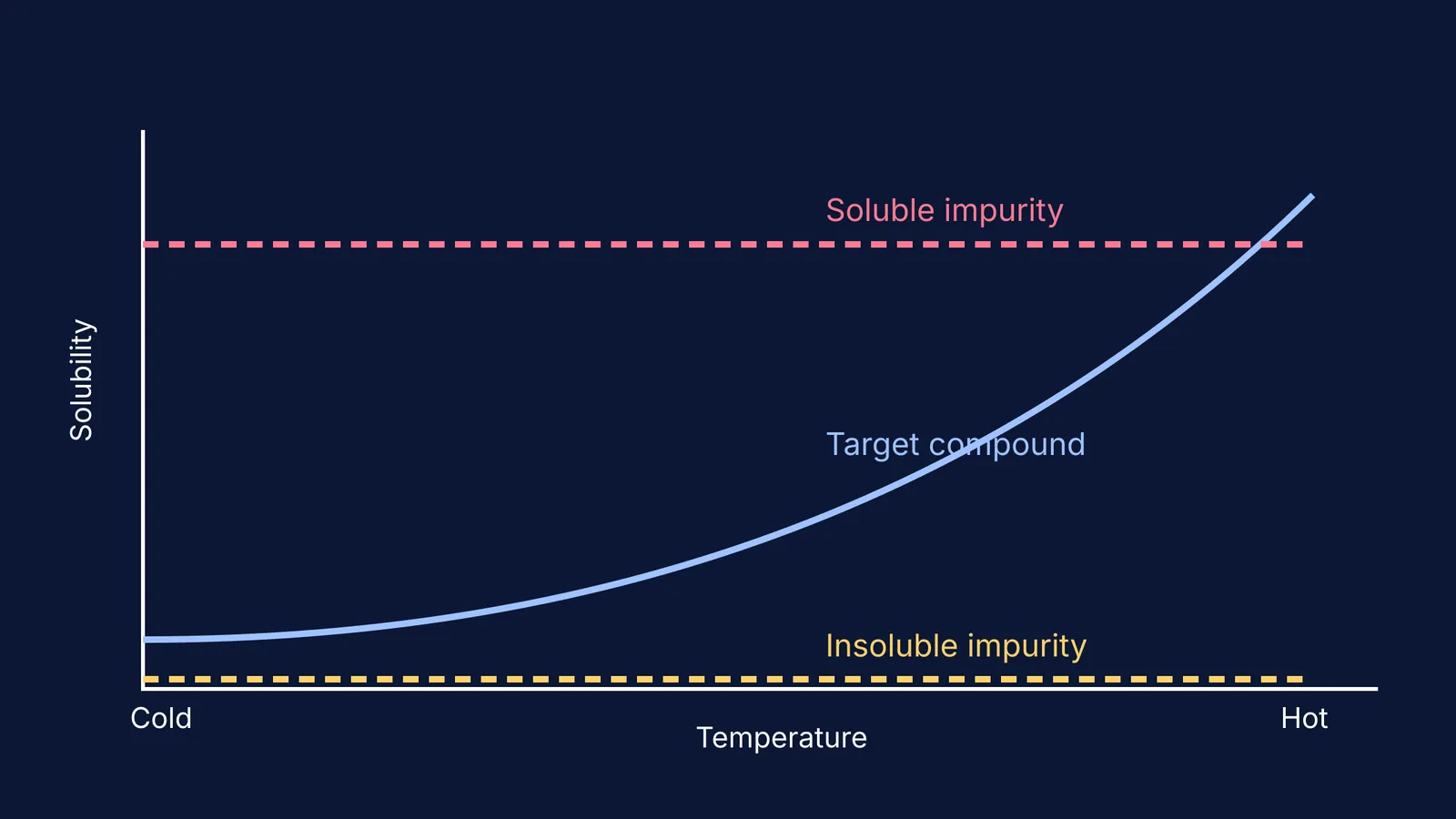
The primary requirement for a crystallisation solvent is a steep temperature-solubility curve. The solvent must dissolve a large amount of your target compound at its boiling point, but almost none of it at room temperature or in an ice bath (Wikipedia)). This ensures that when the hot solution cools, it becomes supersaturated and the compound is forced out as pure crystals.
The solvent should also be unreactive with your compound. Furthermore, it must be volatile enough to evaporate easily when drying the final crystals, meaning its boiling point should ideally be between 50 °C and 100 °C.
How do you deal with impurities?
A good solvent must handle impurities differently than the target compound. Impurities generally fall into two categories, and the solvent must isolate both effectively (Wikipedia)):
Insoluble impurities: These do not dissolve in the hot solvent at all. Because they remain solid, you can remove them by filtering the hot solution before it is allowed to cool.
Highly soluble impurities: These dissolve so well that they remain dissolved in the solvent (often called the "mother liquor") even when the solution is cooled down to room temperature. When your target compound crystallises, these impurities stay behind in the liquid and are washed away during the final filtration.
If you find the underlying chemistry of polarity or intermolecular forces hard to picture, you can explore these topics in the Fermi Concept Library. Fermi's AI tutor can walk you through why polar and nonpolar molecules behave the way they do, running simulations and checking understanding as it goes.
What if no single solvent works?
If you cannot find one solvent that fits the hot-and-cold rule, you can use a mixed solvent system. This involves finding a solvent that dissolves your compound very well, and a miscible "antisolvent" that does not dissolve it at all (Wikipedia)).
To do this, dissolve the crude solid in a minimum amount of the hot good solvent. Then, slowly add the hot antisolvent drop by drop until the mixture just turns cloudy (a state called incipient precipitation). Cooling this perfectly balanced mixture will yield pure crystals.
Why choose crystallisation over distillation?
Crystallisation is often preferred for solid compounds that might break down at high temperatures. Because it operates at lower temperatures, the thermal stress on the product is very low. Additionally, the latent heat of solidification is 3 to 6 times lower than the heat of evaporation, meaning crystallisation uses significantly less energy than distillation (Wikipedia)).
If you are reviewing organic chemistry lab techniques, you might also need to calculate the Rf value in paper chromatography or identify methyl ketones with the iodoform test. For reaction mechanisms, see the step-by-step breakdown of the Fischer esterification mechanism.
How do you test a solvent in the lab?
Before scaling up your purification, you should test a solvent on a small scale. Follow this checklist to find the ideal match:
Place a few milligrams of the crude solid in a small test tube.
Add a few drops of cold solvent. If the solid dissolves immediately at room temperature, this solvent is too good; it will not yield crystals upon cooling.
If the solid remains undissolved, heat the tube in a hot water bath to the solvent's boiling point.
If the solid still does not dissolve, the solvent is too poor. (If only a tiny amount remains, it might be an insoluble impurity; you can check this by adding slightly more solvent).
If the solid dissolves completely when hot, remove the tube from the heat and let it cool slowly to room temperature.
If crystals form as the solution cools (or after placing it in an ice bath), you have successfully found your crystallisation solvent.


