

On this page
In 1911 David Borar, at University College, Cardiff, shook liquid mercury with solutions of oxidising agents and measured what happened. Permanganate was reduced in plain water. Dichromate and iron alum were not touched until he added hydrochloric acid, and then the reduction went to completion. Every time it worked with HCl, the mercury ended up as white calomel, Hg₂Cl₂. That detail explains the result, and it is a neat Class 12 lesson in how a precipitate shifts an electrode potential.
The paper is "Some Reducing Actions of Mercury", Journal of the Chemical Society, Transactions, volume 99, pages 1414 to 1416. The scanned 1911 volume is on the Internet Archive. It gives only Borar's college and his thanks to E. P. Perman, who suggested the work; we know nothing else about Borar. Perman has his own story: measuring vapour-pressure lowering at the boiling point. Mercury and its salts are toxic. This is history and arithmetic, not a lab or home activity.
What did Borar find when he shook mercury with oxidants?
Potassium permanganate: no action when dry, but reduced "readily" in water. With excess mercury the reduction was complete, and the solution held potassium hydroxide, which he titrated. Mean of three runs: 1 g of mercury reduced 0.519 g of KMnO₄.
Potassium dichromate: no action in neutral solution "to any extent measurable by ordinary analytical methods". With HCl, reduction was complete to chromium(III) chloride. Mean of five runs: 1 g of mercury reduced 0.2452 g of dichromate. The precipitate was "mercurous chloride only".
Iron(III): ferric chloride in water was "readily reduced". Iron alum, a sulphate, was not reduced "to any extent" without HCl.
Others: copper sulphate with HCl gave cuprous chloride. Nitrate, chlorate and sodium peroxide did nothing.
He then used mercury to reduce iron before a dichromate titration. Iron alum gave 11.61% iron against a theoretical 11.59%. A haematite sample gave 91.30% by the mercury route and 91.16% by the usual stannous chloride route.
Do Borar's equations balance?
He wrote permanganate as K₂Mn₂O₈, an old way of writing two KMnO₄. In modern form:
2KMnO₄ + 3Hg + H₂O → 2KOH + 2MnO₂ + 3HgO
Atoms: K 2, Mn 2, O 9, H 2, Hg 3 on each side. Electrons: each Mn goes +7 → +4, so two Mn gain 6 e⁻; each Hg goes 0 → +2, so three Hg lose 6 e⁻. Balanced. As ions: 2MnO₄⁻ + 3Hg + H₂O → 2MnO₂ + 3HgO + 2OH⁻, with charge −2 on both sides. This is the neutral-medium behaviour of permanganate, n-factor 3, covered in KMnO₄ in neutral or alkaline medium.
For dichromate he wrote Cr₂Cl₆; today we write 2CrCl₃:
K₂Cr₂O₇ + 6Hg + 14HCl → 2KCl + 2CrCl₃ + 3Hg₂Cl₂ + 7H₂O
Chlorine: 14 on the left, 2 + 6 + 6 = 14 on the right. As ions: Cr₂O₇²⁻ + 14H⁺ + 6Hg + 6Cl⁻ → 2Cr³⁺ + 3Hg₂Cl₂ + 7H₂O, charge +6 on both sides. Two Cr gain 6 e⁻ (+6 → +3); six Hg lose 6 e⁻ (0 → +1).
For iron: 2FeCl₃ + 2Hg → 2FeCl₂ + Hg₂Cl₂.
How much oxidant should 1 g of mercury reduce?
Worked example. Use M(Hg) = 200.59, M(KMnO₄) = 158.03, M(K₂Cr₂O₇) = 294.18 g mol⁻¹.
Permanganate. 3 mol Hg reduce 2 mol KMnO₄. Mass ratio = (2 × 158.03) ÷ (3 × 200.59) = 316.06 ÷ 601.77 = 0.525 g per g Hg. Borar found 0.519, 1.2% low. He suggested some KOH stays on the MnO₂ as "adsorption compounds or unstable manganites".
Dichromate. 6 mol Hg reduce 1 mol K₂Cr₂O₇. Mass ratio = 294.18 ÷ (6 × 200.59) = 294.18 ÷ 1203.54 = 0.2444 g per g Hg. Borar found 0.2452. His own theoretical figure was 0.2456; we could not reproduce it from modern atomic masses, so it probably rests on older values he does not state.
Iron alum. NH₄Fe(SO₄)₂·12H₂O has M = 482.18 g mol⁻¹, so Fe = 55.845 ÷ 482.18 × 100 = 11.58%. He printed 11.59% as theory and found 11.61%.
In n-factors: Hg → Hg²⁺ is 2, Hg → Hg₂²⁺ is 1 per atom, KMnO₄ → MnO₂ is 3, K₂Cr₂O₇ → Cr³⁺ is 6.
Why does chloride let mercury reduce iron(III)?
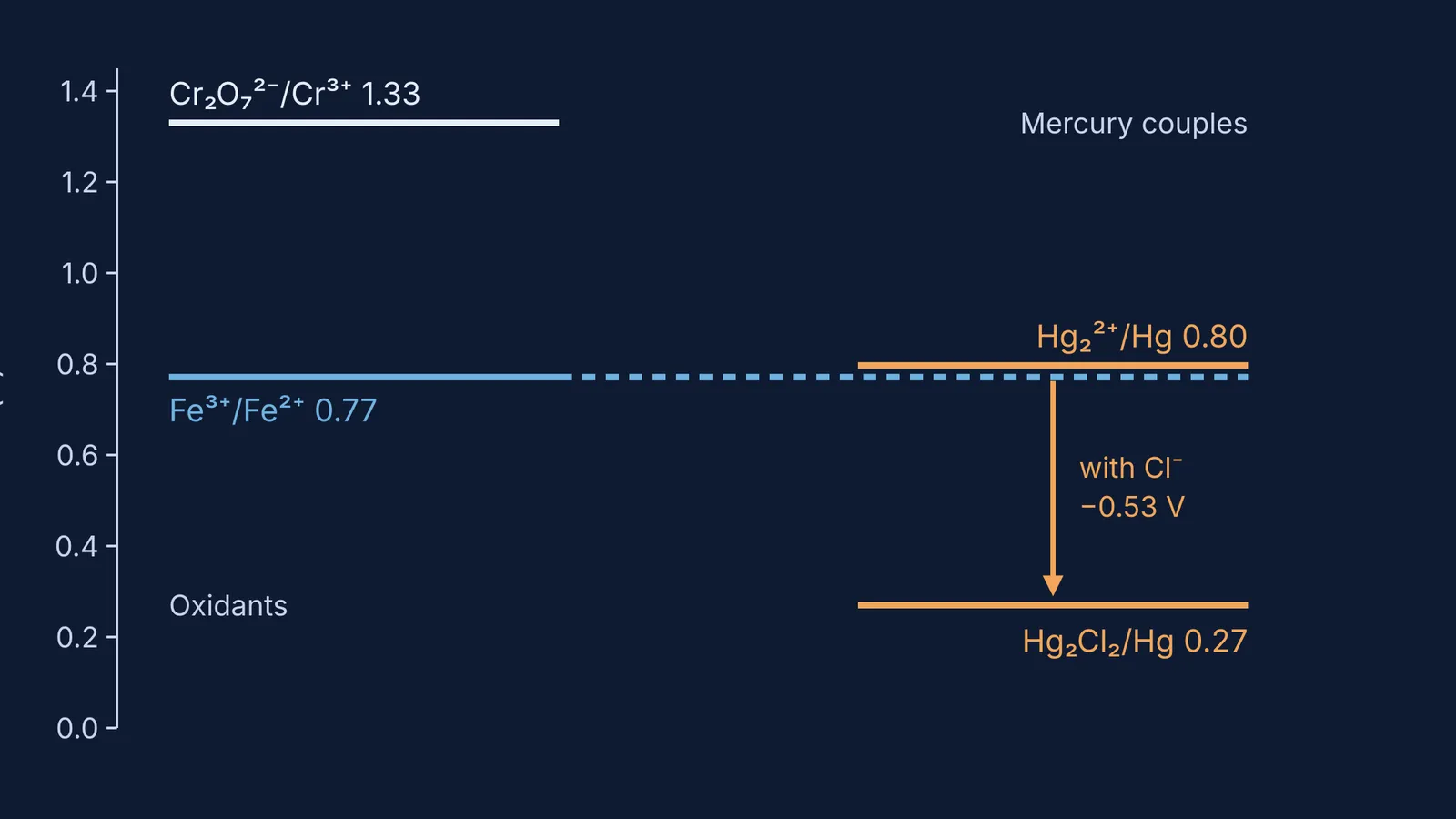
Borar gave no potentials. The values below are standard reduction potentials from the standard electrode potential data page); tables differ slightly, so treat them as approximate.
Hg₂²⁺ + 2e⁻ → 2Hg: about +0.80 V (0.797)
Fe³⁺ + e⁻ → Fe²⁺: about +0.77 V (0.771)
Hg₂Cl₂ + 2e⁻ → 2Hg + 2Cl⁻: about +0.27 V
Without chloride, the cell 2Fe³⁺ + 2Hg → 2Fe²⁺ + Hg₂²⁺ has E°cell = 0.771 − 0.797 = −0.026 V. Slightly negative: iron(III) sulphate is not reduced. That matches the iron alum.
With chloride, the mercury(I) is pulled out as solid calomel. The reaction becomes 2Fe³⁺ + 2Hg + 2Cl⁻ → 2Fe²⁺ + Hg₂Cl₂, with E°cell = 0.771 − 0.27 = +0.50 V. For n = 2, log K = 2 × 0.50 ÷ 0.0592 ≈ 16.9, so K ≈ 10¹⁷. The reaction now goes to completion, as it did for ferric chloride.
Why is the calomel couple so much lower? The Nernst equation for Hg₂²⁺/Hg depends on [Hg₂²⁺]. Calomel is so insoluble that, with Cl⁻ around, [Hg₂²⁺] is tiny, and the mercury couple drops by about 0.53 V. Run the numbers backwards and the two potentials imply Ksp of Hg₂Cl₂ near 10⁻¹⁸. The same fixed-chloride idea is what makes the calomel reference electrode steady.
Why did dichromate need the acid as well as the chloride?
Here chloride is only half the story. The dichromate half-reaction, Cr₂O₇²⁻ + 14H⁺ + 6e⁻ → 2Cr³⁺ + 7H₂O, has E° ≈ +1.33 V at 1 M H⁺, but it uses 14 H⁺ for 6 electrons. The Nernst term is −(0.0592 × 14 ÷ 6) × pH ≈ −0.138 V per pH unit. At pH 7 that is roughly 1.33 − 0.97 ≈ 0.36 V, below either mercury couple. Add HCl and two things happen: H⁺ lifts the dichromate potential back towards 1.33 V, and Cl⁻ drops mercury's to 0.27 V. Both help. These are rough standard-state estimates, not measured values for his solutions.
Permanganate in water is different. Its couple to MnO₂ is about 1.15 V at pH 7 (from E° = 0.595 V for MnO₄⁻ + 2H₂O + 3e⁻ → MnO₂ + 4OH⁻), while HgO/Hg is only about 0.51 V at pH 7. So mercury reduces it without any acid, as Borar saw.
To see how E° and the Nernst equation connect across these cases, the Fermi Concept Library covers electrochemistry concept by concept.
Where does this show up in JEE and NEET?
Class 12, Electrochemistry: E°cell, log K = nE°/0.0592, and the Nernst equation with H⁺ terms.
Class 12, d- and f-block: KMnO₄ to MnO₂ in neutral medium (n = 3), acidified dichromate (n = 6), and Hg₂²⁺ as a dimer.
For JEE Main and Advanced practice on these chapters, Fermi Test Prep comes with an AI tutor.
Quick checklist
Hg reduces KMnO₄ in water: 0.525 g per g Hg in theory, 0.519 found.
Dichromate and iron alum needed HCl; the precipitate was calomel only.
0.2444 g dichromate per g Hg (modern masses); 0.2452 found.
Hg₂²⁺/Hg ≈ 0.80 V, Hg₂Cl₂/Hg ≈ 0.27 V: chloride drops mercury's potential.
With Fe³⁺: −0.03 V without Cl⁻, +0.50 V with it.
For dichromate, H⁺ and Cl⁻ both matter.


