

On this page
Hydrazine, H₂N–NH₂, looks like two ammonia molecules joined at the nitrogen. Each nitrogen has a lone pair, so you might expect it to take two protons as easily as two NH₃ molecules would. It does not. It takes the first proton readily and the second only in very strong acid. In 1916 Bawa Kartar Singh, writing from Dacca College in East Bengal, tried to explain this with a three-dimensional model of nitrogen. His reason was steric crowding. Today the accepted reason is charge repulsion. His observation was right, and his explanation was not.
Who was Bawa Kartar Singh and what did he publish in 1916?
The paper is Bawa Kartar Singh, "The Valency of Two Directly Linked Nitrogen Atoms. Part I", J. Chem. Soc. Trans. 109 (1916) 780–791. We read it in the scanned 1916 volume and checked the quoted lines against the page images. It is signed from "The Chemical Laboratory, Dacca College, Dacca, E. Bengal, India" and was received on 10 April 1916. We have not checked anything else about his life or career.
He was following up his own 1913 paper, where he had suggested "that it is not possible for both the nitrogen atoms to become quinquevalent at the same time owing to steric interference or hindrance".
"Quinquevalent" needs translating. In 1916 the nitrogen in NH₄Cl was counted as having five valencies: four to hydrogen and one to chlorine. Today we write NH₄⁺Cl⁻. The nitrogen in NH₄⁺ has four bonds, no lone pair and a positive charge, and Cl⁻ is a separate ion. So "both nitrogens quinquevalent" means, in modern terms, both nitrogens protonated: the N₂H₆²⁺ ion in a salt such as N₂H₄·2HCl.
What did he observe about hydrazine salts?
Hydrazine, methylhydrazine, ethylhydrazine and as-dimethylhydrazine do form dihydrochlorides. But "even in the case of these bases the monohydrochlorides are much more stable than the dihydrochlorides".
With bigger groups, as in as-diethylhydrazine and the phenylalkylhydrazines, no dihydrochloride could be made. These "behave as monacidic bases" and take only one molecule of acid.
Methyl, ethyl and benzyl iodides did not react with the hydrochlorides of phenylalkylhydrazines, although the free bases gave quaternary salts. He concluded that "although each of the α- and β-nitrogen atoms can become quinquevalent, both of them cannot be made so at the same time".
When the two nitrogens were separated by a chain of CH₂ groups, both could be made quaternary at once. He cited such compounds from other workers.
Hydrazine and its derivatives are toxic, so this post covers the principle and the numbers only.
How did his "pyramid" model explain it?
This section is history, not structure. Do not use this model in an exam.
Singh used Bischoff's "pyramid" picture of five-valent nitrogen. Nitrogen sits at the apex. Four "negative" valencies run to the corners of a square base, and one "positive" valency, the bond to the halogen, points the other way. With all five bonds equal, his footnote gives cos A = 1/9, so A = 83°37′ between neighbouring negative bonds, and cos B = −1/3, so B = 109°28′ between the positive bond and each negative bond. Our python check gives 83.62° and 109.47°.
His argument: join two such nitrogens through negative valencies, and the remaining bonds on each atom lean towards the other atom. That causes steric hindrance, which small groups can just tolerate and large groups cannot.
Note that NH₄⁺ is a regular tetrahedron with every H–N–H angle 109.47°, and there is no fifth bond. His 109°28′ is the same tetrahedral angle you learn, cos⁻¹(−1/3). Interestingly, for a different case, "diammonium" with the two nitrogens joined through positive valencies, Singh himself rejected sterics and blamed "an electrical influence".
Why does hydrazine really resist a second proton?
The modern explanation is electrostatic. After the first protonation you have N₂H₅⁺, that is H₃N⁺–NH₂. The remaining lone pair sits on a nitrogen bonded directly to a positive nitrogen.
Charge repulsion. A second proton would put two positive charges on neighbouring atoms. That costs a great deal of energy.
Induction. The –NH₃⁺ group pulls electron density away from the next nitrogen, so its lone pair is held more tightly and is less available to a proton.
Size cannot be the main cause, because H⁺ is tiny and hydrazine itself carries only hydrogen atoms. Bulky alkyl groups may add some crowding, but the charge effect dominates. The further apart the two nitrogens are, the weaker this effect, which is the modern reading of Singh's CH₂-chain result.
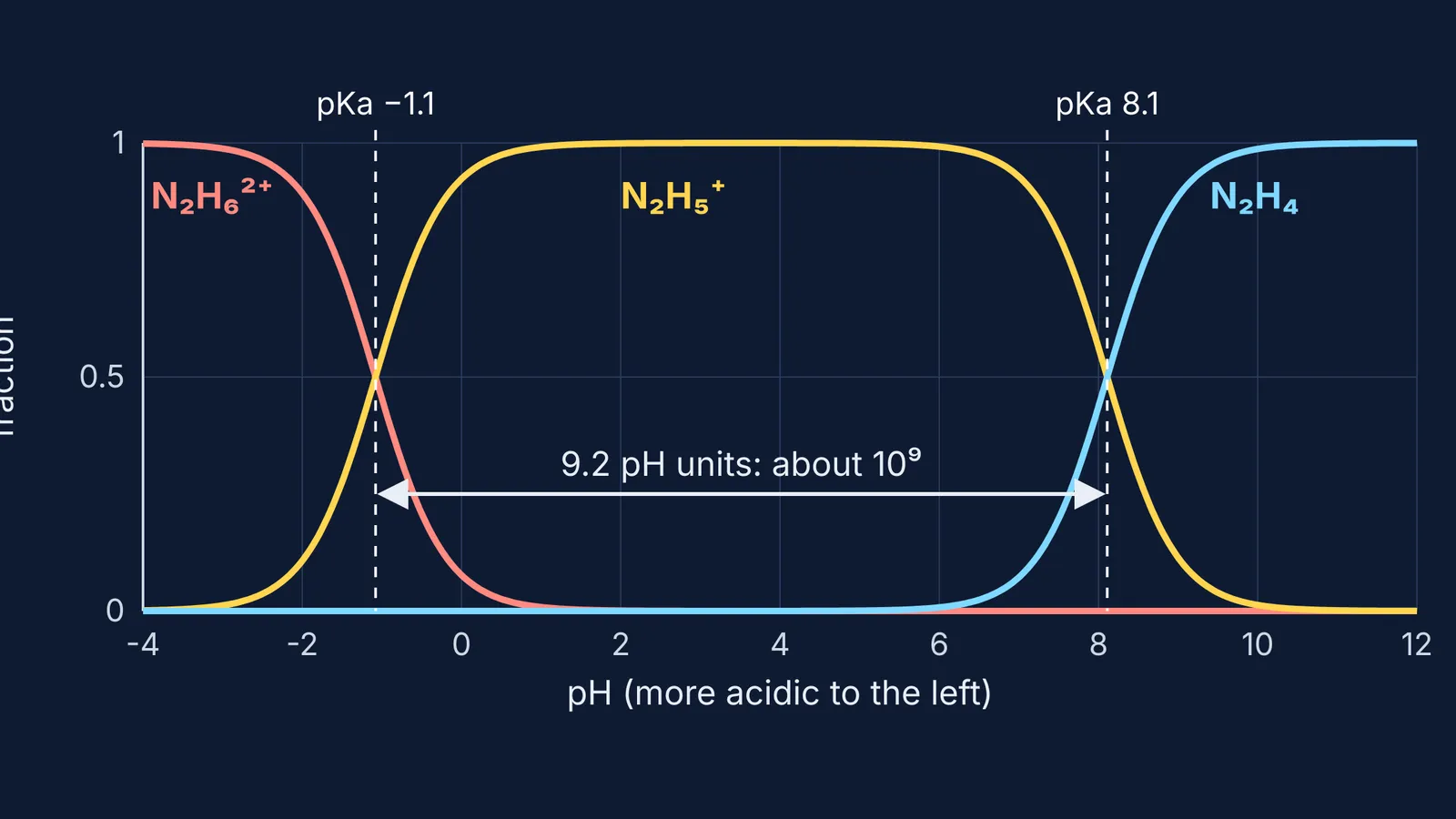
The first base constant, Kb1, is 1.3 × 10⁻⁶ (CRC data via LibreTexts). For the second, Wikipedia's hydrazine article gives Kb2 = 8.4 × 10⁻¹⁶, citing Holleman and Wiberg's Inorganic Chemistry. We could not check that value in a data book ourselves, and tables differ, so treat Kb2 as roughly 10⁻¹⁵. Either way, the ratio is about a billion.
Worked example: Kb1, Kb2 and the pH of 0.10 M hydrazine
Write both steps. N₂H₄ + H₂O ⇌ N₂H₅⁺ + OH⁻, Kb1 = 1.3 × 10⁻⁶. Then N₂H₅⁺ + H₂O ⇌ N₂H₆²⁺ + OH⁻, Kb2 ≈ 8.4 × 10⁻¹⁶. Both balance in atoms and charge.
Compare them. Kb1/Kb2 = 1.3 × 10⁻⁶ ÷ 8.4 × 10⁻¹⁶ ≈ 1.5 × 10⁹. Only the first step decides the pH.
First step. [OH⁻] ≈ √(Kb1·c) = √(1.3 × 10⁻⁶ × 0.10) = 3.6 × 10⁻⁴ M. That is 0.36% reaction, well under 5%, so the shortcut is fine. The quadratic gives the same 3.6 × 10⁻⁴ M.
pH. pOH = 3.44, so pH = 14 − 3.44 = 10.56.
Second step. [N₂H₆²⁺] = Kb2 × [N₂H₅⁺]/[OH⁻]. Since [N₂H₅⁺] ≈ [OH⁻], [N₂H₆²⁺] ≈ Kb2 ≈ 8 × 10⁻¹⁶ M. This is the same trick as [S²⁻] ≈ Ka2 in the pH of a diprotic acid like H₂S.
Compare with ammonia. NH₃ has Kb = 1.8 × 10⁻⁵, about 14 times larger, and 0.10 M NH₃ has pH 11.13 (method in finding the pH of a weak base like ammonia).
How much acid makes N₂H₆²⁺? Its pKa = 14 − pKb2 = 14 − 15.08 = −1.08, so Ka ≈ 12. Even at [H⁺] = 1 M, ignoring activity effects, [N₂H₆²⁺]/[N₂H₅⁺] = 1/12 = 0.084. Only about 8% is doubly protonated. That fits Singh's remark that the monohydrochloride is the more stable salt.
Where does this come up in JEE and NEET?
Class 11 Equilibrium: step constants of a base that takes two protons, the pH of a weak base.
Class 12 Amines and the p-block: hydrazine is a weaker base than ammonia. See also why hydrazine fails Lassaigne's test for nitrogen.
Class 11 Bonding: the tetrahedral angle 109.47° = cos⁻¹(−1/3) in NH₄⁺ and CH₄.
To see how step constants, conjugate pairs and electrostatics connect, the Concept Library covers every concept in chemistry. For exam practice, Fermi Test Prep covers JEE Main and Advanced preparation with an AI tutor.
Quick checklist
N₂H₄ takes one proton easily: Kb1 = 1.3 × 10⁻⁶, pKb 5.9.
The second step is about a billion times weaker: Kb2 is roughly 10⁻¹⁵ (8.4 × 10⁻¹⁶ in one source).
0.10 M hydrazine: [OH⁻] = 3.6 × 10⁻⁴ M, pH 10.56.
Modern reason: charge repulsion and the pull of the –NH₃⁺ group, not crowding.
Singh's 1916 steric argument used an obsolete five-bond pyramid; history only.
109°28′ = cos⁻¹(−1/3), the tetrahedral angle.


