

On this page
Eight original NEET-style work, energy and power questions, easy to hard. Take g = 10 m/s².
Which topics do these questions test?
All eight sit in Unit 4 of the NMC syllabus for NEET (UG)-2026, checked against NCERT Class 11 Physics, Chapter 5. Start with how to prepare work, energy and power for NEET.
Statement I/II options: (1) Both correct (2) Both incorrect (3) Only I correct (4) Only II correct.
Statement questions
Q1 (easy, statements). Statement I: A body moving in the negative x-direction has negative kinetic energy. Statement II: The normal force on a block sliding along a level floor does no work.
Answer: (4). I is incorrect: K = ½mv² is never negative. II is correct: the normal force is perpendicular to the displacement, so W = Fd cos 90° = 0.
Trap: (1), because velocity can be negative.
Q2 (medium, statements). Which statements are correct?
A. Work done by a conservative force depends only on the end points.
B. Friction is a conservative force.
C. Mechanical energy is conserved when only conservative forces do work.
D. After a completely inelastic collision, the bodies move together.
E. A block sliding to rest on a rough level floor keeps its mechanical energy.
(1) A and C only (2) A, B and D only (3) C, D and E only (4) A, C and D only
Answer: (4). A: NCERT's definition of a conservative force. B is false: friction's work round a closed path is not zero. C: NCERT's conservation of mechanical energy. D: the definition. E is false: friction removes kinetic energy.
Trap: (1) misses D; "completely inelastic" means the bodies stick together.
Q3 (medium, statements). A 0.5 kg block at 2 m/s on a smooth floor hits a light 200 N/m spring. Statement I: The greatest compression is 10 cm. Statement II: At double the speed, it would be four times as large.
Answer: (3). I is correct: ½mv² = ½kx² gives 1 = 100x², so x = 0.1 m. II is incorrect: x = v√(m/k) only doubles.
Trap: (1); energy quadruples, compression does not.
Q4 (hard, statements). A 1 kg ball at 4 m/s hits a 3 kg ball at rest, elastically and head-on. Which are correct?
A. The 1 kg ball rebounds at 2 m/s.
B. The 3 kg ball moves at 2 m/s.
C. The 3 kg ball gets three-quarters of the kinetic energy.
D. The total momentum afterwards is 2 kg m/s.
E. At greatest compression, both balls move at 1 m/s.
(1) A, B and D only (2) A, B, C and E only (3) B, C and E only (4) A, C, D and E only
Answer: (2). A: v₁ = (m₁ − m₂)u/(m₁ + m₂) = −2 m/s. B: v₂ = 2m₁u/(m₁ + m₂) = 2 m/s. C: 6 J of 8 J. D is false: momentum stays 4 kg m/s. E: at greatest compression they share one velocity, 4/4 = 1 m/s.
Trap: (3) drops A, but a lighter ball hitting a heavier one bounces back.
Match-the-list questions
Q5 (easy, match). Match List-I with List-II.
List-I: (A) Kinetic energy (B) Power (C) Spring constant (D) Linear momentum
List-II: (I) [ML²T⁻³] (II) [MT⁻²] (III) [MLT⁻¹] (IV) [ML²T⁻²]
(1) A-I, B-IV, C-II, D-III (2) A-IV, B-I, C-II, D-III (3) A-IV, B-I, C-III, D-II (4) A-IV, B-II, C-I, D-III
Answer: (2). A-IV: energy, like work. B-I: work per second. C-II: k = F/x. D-III: p = mv.
Trap: (1) swaps energy and power.
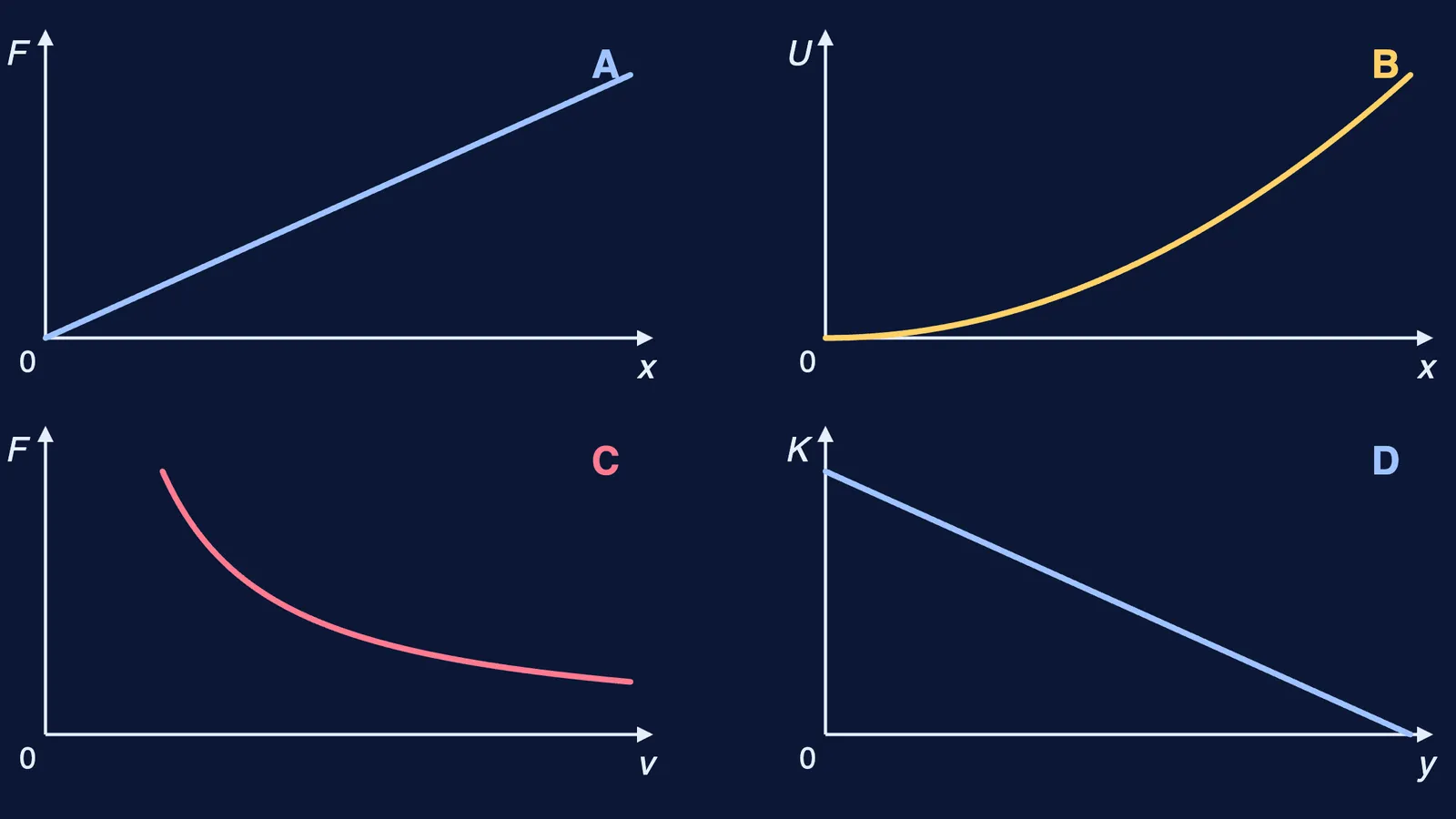
Q6 (medium, match). Match each relation with its graph.
List-I: (A) Spring force against extension (B) Spring potential energy against extension (C) Driving force against speed at constant power (D) Kinetic energy of a ball falling freely against its height
List-II: (I) Rising straight line through the origin (II) Rectangular hyperbola (III) Parabola, vertex at the origin (IV) Falling straight line
(1) A-I, B-III, C-II, D-IV (2) A-III, B-I, C-II, D-IV (3) A-I, B-III, C-IV, D-II (4) A-I, B-II, C-III, D-IV
Answer: (1). A-I: F = kx. B-III: U = ½kx². C-II: F = P/v. D-IV: K = mg(H − y).
Trap: (3) draws "force falls as speed rises" as a line.
Q7 (medium, match). Match each case with its energy.
List-I: (A) Kinetic energy, 4 kg at 3 m/s (B) Energy in a 400 N/m spring compressed 10 cm (C) Gravity's work on 0.5 kg falling 0.8 m (D) Work by F = 4x N from x = 1 m to 2 m
List-II: (I) 18 J (II) 6 J (III) 2 J (IV) 4 J
(1) A-I, B-IV, C-III, D-II (2) A-II, B-III, C-IV, D-I (3) A-I, B-III, C-IV, D-II (4) A-I, B-III, C-II, D-IV
Answer: (3). A-I: ½ × 4 × 9 = 18 J. B-III: ½ × 400 × 0.01 = 2 J. C-IV: 0.5 × 10 × 0.8 = 4 J. D-II: area under F-x, 2x² from 1 to 2, is 6 J.
Trap: (1) drops the ½ in ½kx² (B = 4 J).
Q8 (hard, match). A 0.2 kg ball is dropped from rest. Match each power.
List-I: (A) Force (2î + 3ĵ) N, velocity (4î − 2ĵ) m/s (B) Least power to lift 50 kg at a steady 0.4 m/s (C) Gravity on the ball 2 s after release (D) Gravity's average over the first 2 s
List-II: (I) 2 W (II) 20 W (III) 40 W (IV) 200 W
(1) A-I, B-IV, C-II, D-III (2) A-II, B-IV, C-III, D-I (3) A-III, B-IV, C-I, D-II (4) A-I, B-IV, C-III, D-II
Answer: (4). A-I: F·v = 8 − 6 = 2 W. B-IV: 500 N × 0.4 m/s = 200 W. C-III: v = 20 m/s, mgv = 40 W. D-II: a 20 m fall gives 40 J in 2 s, or 20 W.
Trap: (1) swaps instantaneous and average power.
How do you work these questions faster?
Read the options first; in Q5, B-I leaves only (2) and (3).
Then find the pair that splits the rest.
Give each statement a one-line reason: formula, sign or definition.
Check proportionality first: compression goes as v, energy as v².
Same slip twice? The Fermi Problem Library has worked problems with a step-by-step solver that explains the reasoning rather than printing an answer.
For technique, read how to answer NEET match-the-list questions, then try set 1 of our NEET work, energy and power questions.


