

On this page
Statement and match-the-list questions appear in recent JEE Main papers. Take g = 10 m/s².
Which topics do these questions cover?
All eight sit in Unit 4 of the NTA syllabus for JEE (Main) 2027 and Chapter 5 of NCERT Class 11 Physics. New? Read how to prepare work, energy and power for JEE Main.
Statement I/II options: (1) Both correct (2) Both incorrect (3) I correct, II incorrect (4) I incorrect, II correct.
Statement questions
Q1 (easy, statements). A 3 kg crate rides without slipping on a level truck that speeds up from rest to 4 m/s. Statement I: In the ground frame, static friction does 24 J of work on it. Statement II: Static friction does no work without slipping.
Answer: (3). I: friction alone accelerates it, so W = ½ × 3 × 4² = 24 J. II is false: the crate moves relative to the ground.
Trap: (2), "static friction never does work".
Q2 (easy, statements). Bodies of 1 kg and 4 kg each have 50 J of kinetic energy. Statement I: The 4 kg body has half the momentum. Statement II: Under equal braking forces, they stop in equal distances, the 4 kg body in twice the time.
Answer: (4). I is false: p = √(2mK) gives 10 and 20 kg m/s. II: distance K/F is equal; time p/F doubles.
Trap: (1), "heavier means less momentum".
Q3 (medium, statements). F₁ = (2y î + 2x ĵ) N and F₂ = (y î − x ĵ) N, x, y in metres. Which are correct?
A. F₁ is conservative.
B. F₁ does 4 J from (0, 0) to (1, 2) m, by any path.
C. F₂ does no work on the straight line between them.
D. F₂ does no work on the path via (1, 0).
E. F₂ is conservative.
(1) A, B and C only (2) A, B, C and E only (3) A, C and D only (4) B, D and E only
Answer: (1). A: F₁ = −∇U with U = −2xy. B: W = U(0, 0) − U(1, 2) = 4 J. C: on y = 2x, F₂ · dr = 2x dx − 2x dx = 0. D is false: the legs give 0 and −2 J. E is false: C and D differ.
Trap: (2) trusts the one path that gave zero.
Q4 (hard, statements). A 1 kg ball at 10 m/s hits an identical resting ball elastically, leaving at 37° to its line (sin 37° = 0.6). Which are correct?
A. The balls separate at 90°.
B. The first ball moves at 8 m/s.
C. The second ball moves at 6 m/s.
D. The impulse on the second ball is 10 N s.
E. The second ball gains 18 J of kinetic energy.
(1) A, B and C only (2) A, B, C and E only (3) A, C, D and E only (4) B, C and D only
Answer: (2). A: u = v₁ + v₂ as vectors and u² = v₁² + v₂², so v₁ ⊥ v₂. B: u cos 37° = 8 m/s. C: u sin 37° = 6 m/s. D is false: 1 × 6 = 6 N s. E: ½ × 1 × 6² = 18 J.
Trap: (3), taking the impulse as the full 10 N s.
Match-the-list questions
Q5 (easy, match). Match each case with the work done.
List-I: (A) Gravity on a 2 kg stone rising 5 m (B) Tension, one horizontal circle (C) 60 N pull at 60° above horizontal, box moved 5 m (D) Friction stopping a 2 kg block from 5 m/s
List-II: (I) 0 (II) −100 J (III) 150 J (IV) −25 J
(1) A-IV, B-I, C-III, D-II (2) A-II, B-I, C-III, D-IV (3) A-II, B-III, C-I, D-IV (4) A-I, B-II, C-III, D-IV
Answer: (2). A-II: −mgh. B-I: tension ⊥ velocity. C-III: 60 × 5 × 0.5. D-IV: −½ × 2 × 5².
Trap: (1) swaps the negatives.
Q6 (medium, match). Match each change with its factor.
List-I: (A) Speed, kinetic energy doubled (B) Braking distance, fixed force, speed doubled (C) Cruising power, drag ∝ v², speed doubled (D) Speed at a smooth slide's foot, height quadrupled
List-II: (I) 2 (II) 4 (III) 8 (IV) √2
(1) A-I, B-II, C-III, D-IV (2) A-IV, B-III, C-II, D-I (3) A-I, B-IV, C-III, D-II (4) A-IV, B-II, C-III, D-I
Answer: (4). A-IV: v ∝ √K. B-II: d = ½mv²/F. C-III: P = Fv ∝ v³. D-I: v = √(2gh).
Trap: (2) scales the drag force, not the power.
Q7 (medium, match). A 2 kg ball at 5 m/s hits an 8 kg ball at rest, head-on. Match e with the 2 kg ball's final velocity.
List-I: (A) e = 1 (B) e = 0.5 (C) e = 0 (D) e = 0.25
List-II: (I) 1 m/s forward (II) 1 m/s backward (III) at rest (IV) 3 m/s backward
(1) A-IV, B-II, C-I, D-III (2) A-IV, B-I, C-II, D-III (3) A-III, B-II, C-I, D-IV (4) A-II, B-IV, C-I, D-III
Answer: (1). v₁ = (m₁ − em₂)u/(m₁ + m₂) = (1 − 4e) m/s, giving −3, −1, 1 and 0 m/s for A to D.
Trap: (2) drops the minus sign.
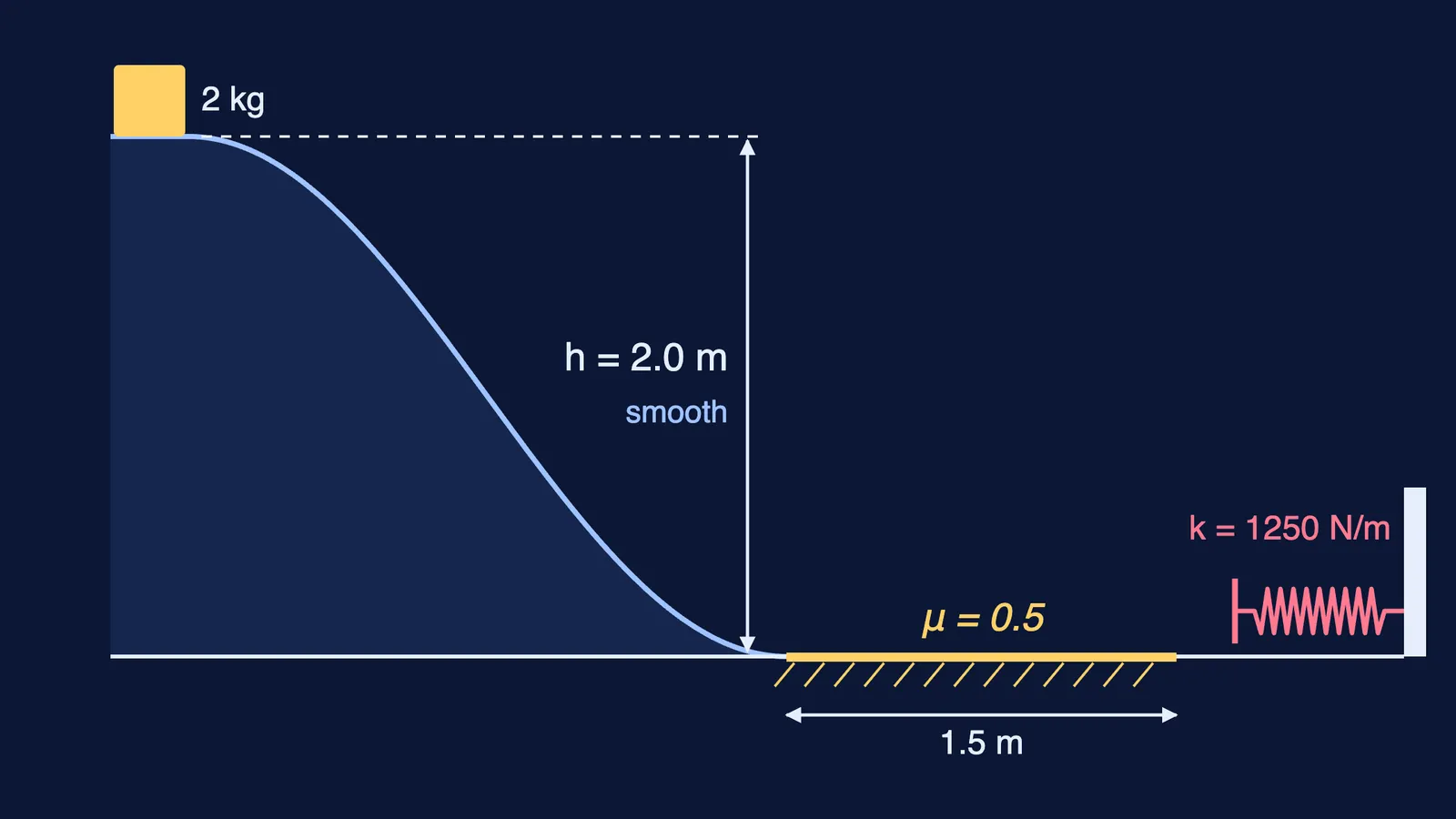
Q8 (hard, match). A 2 kg block slides from rest down a smooth ramp 2.0 m high onto a rough patch at its foot, 1.5 m long (μ = 0.5), then a smooth floor and spring (k = 1250 N/m).
List-I: (A) Height regained on the ramp (B) Greatest compression (C) Total distance on the patch (D) Final distance from the ramp foot
List-II: (I) 0.2 m (II) 0.5 m (III) 1.0 m (IV) 4.0 m
(1) A-II, B-III, C-IV, D-I (2) A-III, B-I, C-IV, D-II (3) A-II, B-I, C-IV, D-III (4) A-II, B-I, C-III, D-IV
Answer: (3). mgh = 40 J; each crossing costs 15 J. B-I: ½ × 1250 × x² = 25 J. A-II: 10 J left lifts it 0.5 m. C-IV: 40 J ÷ 10 N. D-III: 10 J ÷ 10 N, from the ramp side.
Trap: (2) measures from the spring end.
How do you work these faster?
Try the work-energy theorem before forces.
Test a force on two paths.
Write ratios as powers (v², v³, √h).
Keep collision signs; negative means rebound.
On rough patches, count crossings.
Same slip twice? Fermi's AI tutor works out what you already know and builds a plan for the session.
More practice: our JEE Main work, energy and power questions.


