

On this page
A glass fever thermometer slips and breaks, and small silver beads roll across the floor. The usual advice is to collect the beads and dust the area with sulphur powder. The reason is real chemistry: mercury is one of the few metals that reacts with sulphur at room temperature, forming mercury(II) sulphide, HgS. But the sulphur step is an aid, not a complete fix. The hazard is the vapour the beads give off, and sulphur only deals with the surface of each bead.
Why is mercury vapour the real hazard from a broken thermometer?
Touching a bead is not the main concern. The problem is that liquid mercury slowly evaporates at room temperature, and mercury vapour breathed in is absorbed by the lungs. Long or repeated exposure to the vapour can harm the nervous system and the kidneys, so the aim of any clean-up is to keep the vapour down and get the mercury out.
How much vapour can there be? That comes straight from the ideal gas equation.
Worked example. At 25 °C, data tables give the vapour pressure of mercury as about 0.0018 to 0.002 mm Hg. Take 0.0018 mm Hg. Find the mass of mercury in one cubic metre of air saturated with the vapour.
Convert the pressure to pascals. 1 mm Hg = 133.3 Pa, so p ≈ 0.0018 × 133.3 ≈ 0.24 Pa.
Use PV = nRT for one cubic metre. n/V = p/RT = 0.24 / (8.314 × 298) ≈ 9.7 × 10⁻⁵ mol m⁻³.
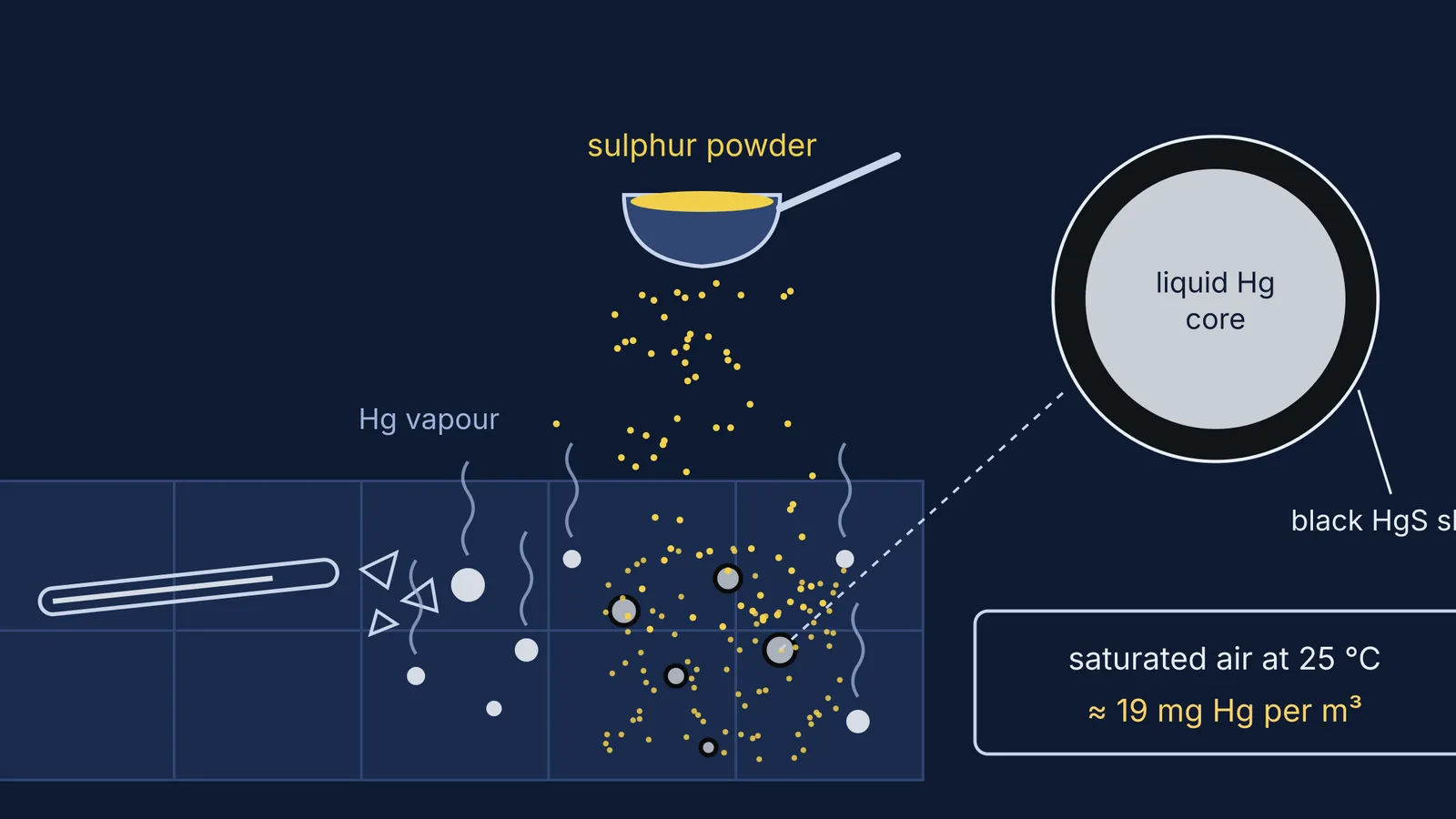
Convert to mass. The molar mass of Hg is 200.6 g mol⁻¹, so the mass is 9.7 × 10⁻⁵ × 200.6 ≈ 0.019 g, or about 19 mg per m³.
Compare that with a workplace limit. The US NIOSH Pocket Guide gives a recommended exposure limit for mercury vapour of 0.05 mg m⁻³ averaged over a working day. Saturated air at 25 °C holds about 19 ÷ 0.05 ≈ 390 times that.
Keep this in proportion. A room is almost never saturated, because mercury evaporates slowly and fresh air keeps diluting it. How much anyone actually breathes depends on how much mercury is spilled, how warm the room is, how well it is ventilated and how long people stay. The same p = (n/V)RT step appears in many ideal gas problems.
How much mercury is in a thermometer? The US EPA puts an oral, rectal or baby fever thermometer at about 0.61 g, and a basal thermometer at about 2.25 g.
How does sulphur react with mercury?
Mercury and sulphur combine directly:
Hg(l) + S(s) → HgS(s)
It balances as written. Mercury goes from 0 to +2 and sulphur from 0 to −2.
The product from a spill at room temperature is the black form, metacinnabar, not red cinnabar, which is the familiar mineral. Both are very stable. The standard Gibbs energy of formation is roughly −48 kJ mol⁻¹ for black HgS (tables differ slightly, and red HgS is a few kJ more negative), so the reaction is spontaneous. HgS is also one of the least soluble compounds you will meet, with a solubility product often quoted around 10⁻⁵² to 10⁻⁵³, and it is not volatile. Mercury locked up as HgS no longer evaporates.
Why does mercury react with sulphur at room temperature when most metals need heating? Two features help. Hg²⁺ is a large, soft cation and S²⁻ is a soft anion, so the Hg–S bond is strong and quite covalent. And mercury is a liquid, so its surface atoms are mobile and in close contact with the powder. Why mercury is a liquid at all, unlike zinc and cadmium in the same group, is explained in why mercury is a liquid at room temperature.
Why doesn't sulphur make a spill safe on its own?
Because the reaction happens only where sulphur touches mercury. Each bead gets a thin black skin of HgS, and the liquid mercury inside stays as it was. The skin slows evaporation from that bead but does not remove the mercury, and beads hidden in cracks or under furniture never meet the powder at all.
A rough second step. A thermometer's 0.61 g of mercury is 0.61 ÷ 200.6 ≈ 0.0030 mol. To turn all of it into HgS would need 0.0030 × 32.1 ≈ 0.10 g of sulphur, a pinch. Yet sprinkling far more than that does not finish the job. Suppose a bead 1 mm in radius forms a skin 1 µm thick. The skin's share of the bead's volume is about 3 × (thickness ÷ radius) = 3 × 0.001 = 0.3%. That thickness is only an assumption for illustration, but the point holds for any thin skin: almost all the mercury is still liquid inside.
So HgS formation does not make the area safe straight away. The beads still have to be collected and removed. Sulphur helps in two ways: it suppresses vapour from the surfaces it reaches, and its colour change from yellow to brown or black makes tiny beads easier to see. The EPA lists powdered sulphur as an optional step after the visible mercury has been picked up. Zinc powder, which dissolves mercury to form an amalgam, is another clean-up aid, so sulphur is not the only option.
What should you do if a mercury thermometer breaks?
Follow an official guide rather than improvising. The US EPA's page on what to do if a mercury thermometer breaks is clear and practical, and your national or local health department may have its own advice. The key points:
Get people and pets out of the area, without walking through the spill. Keep children away from the clean-up.
Ventilate. Open windows and outside doors, close doors to the rest of the home, and keep the room aired out for at least a day afterwards, as the EPA advises.
Do not vacuum. It puts mercury vapour and droplets into the air.
Do not sweep with a broom. It breaks mercury into smaller droplets and scatters them.
Do not pour mercury down a drain.
Collect beads gently with card or an eyedropper, seal everything in labelled bags, and ask your local authority how to dispose of it.
If the spill is larger than a thermometer's worth, or anyone feels unwell, contact your local health or fire authorities or a doctor.
Where does this fit in your syllabus?
Mercury sits with zinc and cadmium in group 12, with a full d¹⁰ shell, which is why the three are often not called transition elements. Its soft-cation chemistry explains the strong bond to sulphur, and the ideal gas equation turns a tiny vapour pressure into a concentration you can compare with a limit. The Concept Library covers each idea on its own.
Quick checklist
The main hazard is mercury vapour, not the liquid on the floor.
Saturated air at 25 °C holds about 19 mg m⁻³ of Hg, roughly 390 times the NIOSH limit; real rooms are usually far below saturation.
Hg + S → HgS (black metacinnabar), stable, very insoluble, non-volatile.
Sulphur coats only the surface of each bead, so the beads must still be removed.
Ventilate, keep people and pets out, never vacuum or sweep with a broom, and follow official clean-up guidance.


