

On this page
Most metals near mercury in the periodic table are hard, high-melting solids. Tungsten, in the same row, melts at 3414 °C and has the highest melting point of all metals, according to the Royal Society of Chemistry periodic table. Mercury melts at −38.829 °C, so at any ordinary room temperature it is a liquid (RSC, mercury). The difference comes down to how many electrons each atom gives to the metallic bond.
Why is mercury a liquid at room temperature?
Mercury's electron configuration is [Xe] 4f14 5d10 6s2 (RSC). Its 4f, 5d and 6s subshells are all full. In a metal, atoms are held together by electrons they release into a shared "sea". A full 5d subshell offers no unpaired d electrons to that sea. The two 6s electrons are held unusually tightly too (more on that below), so mercury atoms hold each other loosely.
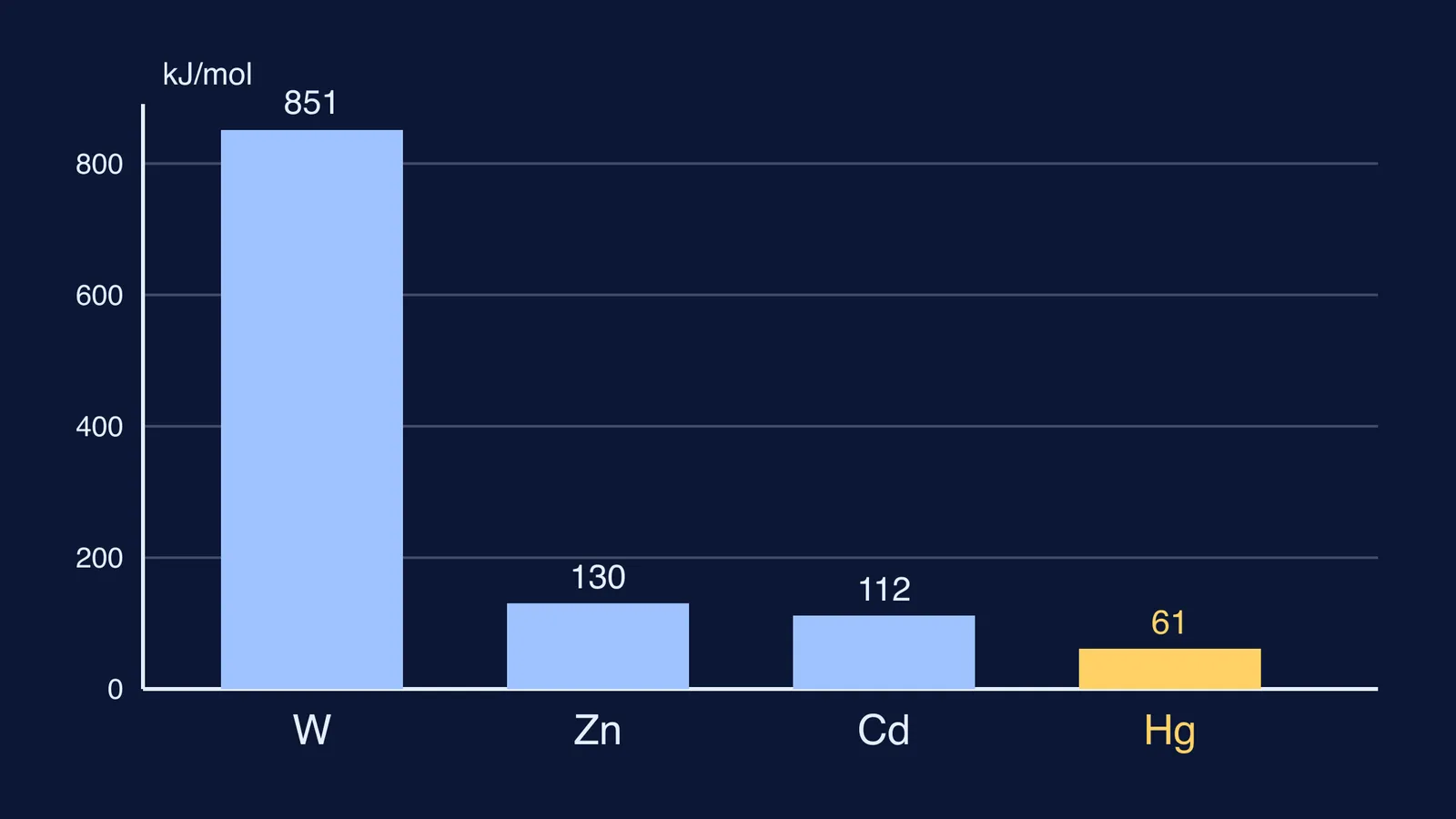
You can measure that weak hold. The enthalpy of atomisation is the energy needed to turn one mole of an element, in its standard state, into separate gaseous atoms. For mercury it is 61.38 kJ/mol, the standard enthalpy of formation of Hg gas in the NIST Chemistry WebBook. For tungsten it is 851.03 kJ/mol (NIST, tungsten), almost 14 times as much.
How do d electrons make most transition metals so hard?
Tungsten's configuration is [Xe] 4f14 5d4 6s2 (RSC). Its four 5d electrons are unpaired, and together with the 6s pair they can all join the metallic bond. More bonding electrons per atom means stronger bonds, a higher enthalpy of atomisation and a higher melting point. We walk through it in why transition metals have high melting points, but zinc doesn't.
At the end of each series (zinc, cadmium and mercury), the d subshell is full. Its electrons stay in the atom's core and contribute little to bonding. Because the d subshell stays full in the atoms and in their common ions, these three are often not counted as true transition elements, as explained in why zinc, cadmium and mercury are not called transition elements.
Why are zinc and cadmium solid when mercury is not?
All three have a d10 s2 configuration, but only mercury is a liquid. Zinc melts at 419.527 °C (RSC) and cadmium at 321.069 °C (RSC). Their enthalpies of atomisation are 130.40 kJ/mol for zinc (NIST) and 111.80 kJ/mol for cadmium (NIST). Mercury needs about half of zinc's figure.
The extra weakness comes from relativity. Mercury's nucleus has 80 protons, so its inner electrons move at a large fraction of the speed of light. Their mass rises and the s orbitals shrink. The outer 6s pair is pulled closer to the nucleus and becomes very hard to share. As the chemist Ashutosh Jogalekar puts it in Scientific American, this shrinkage makes mercury "very reluctant indeed to share its outermost electrons".
In 2013 Florent Calvo, Elke Pahl, Michael Wormit and Peter Schwerdtfeger tested this with computer simulations. They found that relativistic effects lower mercury's melting point by 105 K (Angewandte Chemie, doi:10.1002/anie.201302742). Heidelberg University's press release explains that without these effects, mercury would be solid at room temperature.
You can check the size of the effect with a rough Bohr-model estimate. It gives the same figures as the Scientific American piece (about 58% of light speed, mass 1.23 times larger):
Speed ratio: v/c ≈ Z/137 = 80/137 ≈ 0.584.
Mass factor: γ = 1/√(1 − 0.584²) = 1/√0.659 ≈ 1.23.
The Bohr radius goes as 1/m, so the 1s orbit shrinks to about 1/1.23 ≈ 0.81 of its non-relativistic size.
For zinc (Z = 30) the same steps give v/c ≈ 0.22 and γ ≈ 1.03, which is why the effect is much larger for mercury than for zinc.
The same heavy-atom effects show up in the ionisation enthalpies of 5d elements, covered in why 5d elements have higher ionisation enthalpy than 4d.
How should you write this in a board or JEE answer?
The standard textbook answer is the bonding argument, not the relativity. A complete answer covers four points:
Configuration: Hg is [Xe] 4f14 5d10 6s2. The d subshell is full.
Bonding: no unpaired d electrons take part in metallic bonding, and the 6s electrons are tightly held.
Consequence: metallic bonding is weak, so the enthalpy of atomisation is very low.
Result: little energy is needed to break the solid lattice, so Hg is a liquid at room temperature.
Check your answer against these common slips:
Writing that mercury has "no metallic bonding". It does, but it is weak.
Mixing up enthalpy of atomisation with ionisation enthalpy.
Forgetting that zinc and cadmium share the d10 s2 configuration but are still solids. Mercury is the extreme case of a group trend.
If the idea of electrons "joining" a metallic bond still feels vague, the Fermi Concept Library has a lesson for every chemistry concept, so you can revisit electron configuration and metallic bonding. For practice, the Fermi Problem Library has worked problems with a step-by-step solver that explains the reasoning rather than printing an answer.


