

On this page
It is a classic Class 12 biology question: if a mosquito can carry malaria from one person to the next, why can it not carry HIV? The short answer: a mosquito is a home for *Plasmodium* but a dead end for HIV.
Can mosquitoes spread HIV?
No. HIV.gov, the US government's HIV site, lists "insects or animals, including mosquitoes, ticks, and household animals or pets" among the things that do not transmit HIV.
The lab evidence goes back to a study by scientists at the US Centers for Disease Control. Webb and colleagues (1989, *Journal of Infectious Diseases*) injected HIV into bedbugs and into a mosquito species, *Toxorhynchites amboinensis*, and found that the virus did not replicate in either. HIV could still be detected in bedbugs up to 8 days after they fed on blood with highly concentrated virus, but it did not multiply, and in a laboratory model the team could not show bedbugs passing it on mechanically. Their conclusion: the risk of insect transmission of HIV "appears to be extremely low or nonexistent".
Why can Plasmodium use a mosquito but HIV cannot?
A mosquito can pass on a germ in two ways. It can be a true host, where the germ multiplies inside it. Or it can be a dirty needle, carrying blood on its mouthparts. HIV fails both tests.
Test 1: does the germ multiply inside the mosquito?
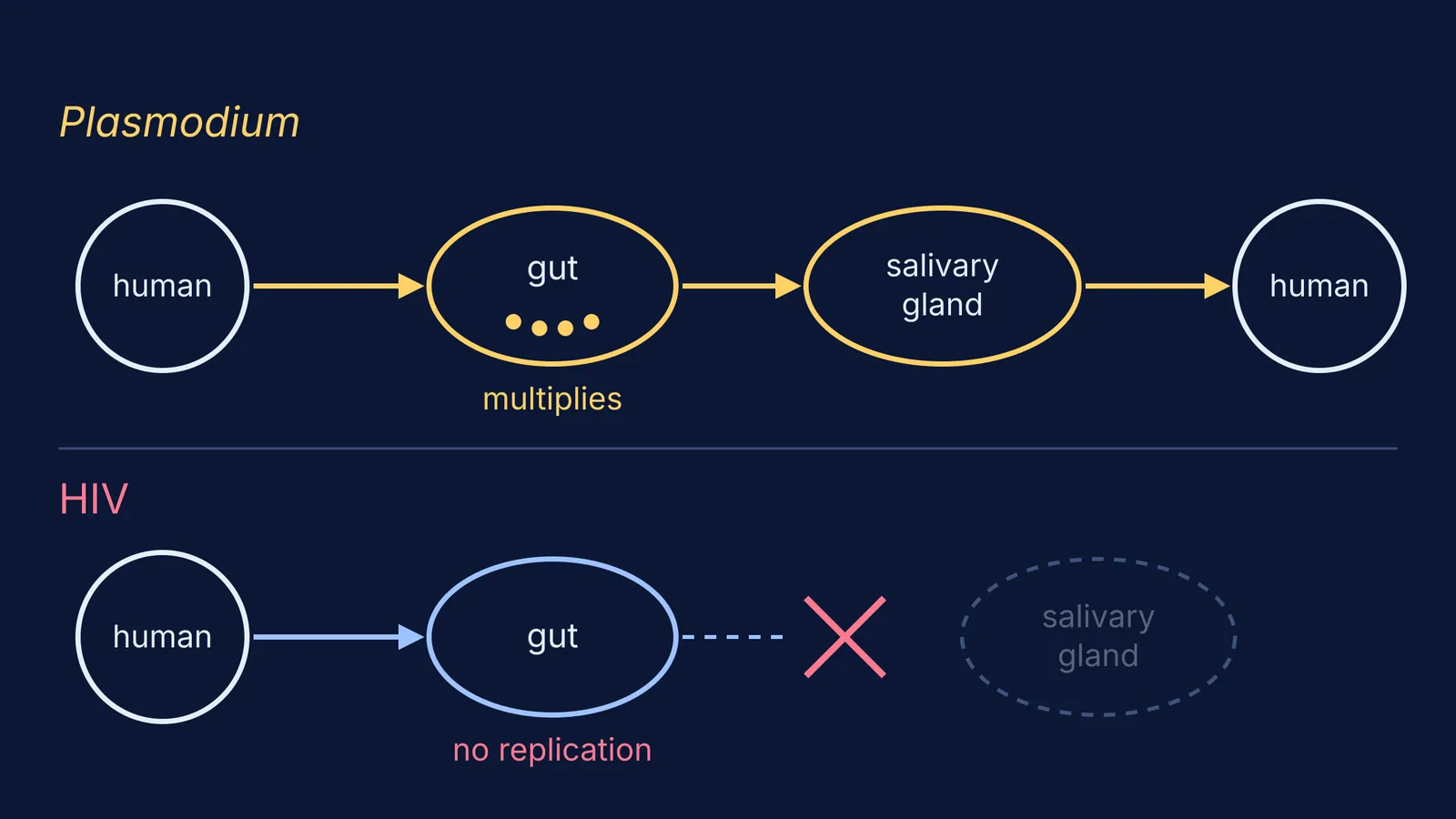
For malaria, yes. NCERT's Class 12 chapter Human Health and Disease explains that when a female *Anopheles* mosquito bites an infected person, the parasites "multiply within them to form sporozoites that are stored in their salivary glands". The next bite injects those sporozoites. NCERT notes that *Plasmodium* needs two hosts, human and mosquito, to complete its life cycle.
HIV has no such stage. It is a retrovirus that multiplies inside human immune cells, especially helper T-lymphocytes, as the same NCERT chapter describes. In the Webb study it did not replicate in mosquitoes. A virus that cannot multiply inside the insect has no way to build up there, and unlike *Plasmodium* it has no stage that collects in the salivary glands.
Test 2: can blood on the mouthparts carry it?
The dirty-needle idea fails for two reasons. First, the mosquito's mouthparts have separate channels: a food canal that sucks blood up, and a salivary duct in the hypopharynx that sends saliva down, as this University of California, Riverside medical entomology page describes. What flows down into the skin is saliva; blood travels the other way, up the food canal.
Second, there is too little virus. In a 2008 paper in *Evolutionary Applications* titled "Why is HIV not vector-borne?", Day, Mideo and Alizon write that the typical HIV viral titre in human blood "is too low for significant vector-borne transmission to occur". It notes that HIV levels are thought to be about 10 to 100 times lower than those of some hepatitis viruses.
For each side in full, read about the Plasmodium life cycle in humans and mosquitoes and how HIV replicates inside helper T cells.
What are the four ways HIV actually spreads?
NCERT lists four routes of HIV transmission:
Sexual contact with an infected person.
Transfusion of contaminated blood and blood products.
Sharing infected needles, as in the case of people who inject drugs.
From an infected mother to her child through the placenta.
The same page adds that HIV/AIDS "is not spread by mere touch or physical contact; it spreads only through body fluids". If you or someone you know is worried about a possible exposure, talk to a doctor; this post is for understanding, not diagnosis.
How do you answer this in a board exam or NEET-UG?
Use this three-step check for any "Can insect X spread disease Y?" question:
Host or dead end? Does the pathogen multiply inside the insect? (Plasmodium: yes. HIV: no.)
Route to the next person? Does it reach the salivary glands, whose saliva is what a bite injects?
Dose? Is there enough of it in a trace of blood?
Worked example, for a 3-mark question "Why can a mosquito transmit malaria but not AIDS?":
*Plasmodium* multiplies inside the female *Anopheles* mosquito; sporozoites stored in its salivary glands are injected at the next bite, so the mosquito is a vector.
HIV cannot replicate in the mosquito, so it does not build up there or collect in its salivary glands.
The mosquito injects saliva, not earlier blood, and the trace of blood on its mouthparts carries too little virus to infect. HIV spreads only through body fluids, by the four NCERT routes.
The same check works for other mosquito-borne diseases too; see how mosquitoes act as vectors for malaria and dengue.
If ideas like vector, host and retrovirus still feel like separate facts, the Fermi Concept Library gives each concept in biology its own lesson and shows its place in the map, so you can see how they connect. When you practise long answers, the Fermi Problem Library has worked problems with a step-by-step solver that explains the reasoning rather than printing an answer.


