

On this page
Counting orbitals tells you that SF₆ is sp³d² and [Ni(CN)₄]²⁻ is dsp² in a few seconds. JEE then asks the next question: which d orbital went into the mix? You do not need to memorise a table for this. One rule settles every case: a hybrid orbital has to point at the atom it bonds to, so the d orbital you mix in must have its lobes along the bond directions.
If you still need the counting step, start with how to find hybridisation from the number of orbitals.
Why does the shape decide which d orbital is used?
An s orbital has no direction, so it can join any hybrid. The three p orbitals point along x, y and z. The five d orbitals split into two kinds:
dxy, dxz and dyz have their lobes between the axes.
dx²−y² has its lobes along the x and y axes.
dz² has its two large lobes along the z axis, plus a small ring in the xy plane.
The textbook convention is to put the ligands on the axes wherever the shape allows, with z along the unique axis. Once you do that, dxy, dxz and dyz point between the ligands. They overlap poorly with anything, so they stay out of the common hybrids. The only choice left is between dz² and dx²−y², and the geometry makes it for you.
Which d orbital is used in dsp² hybridisation?
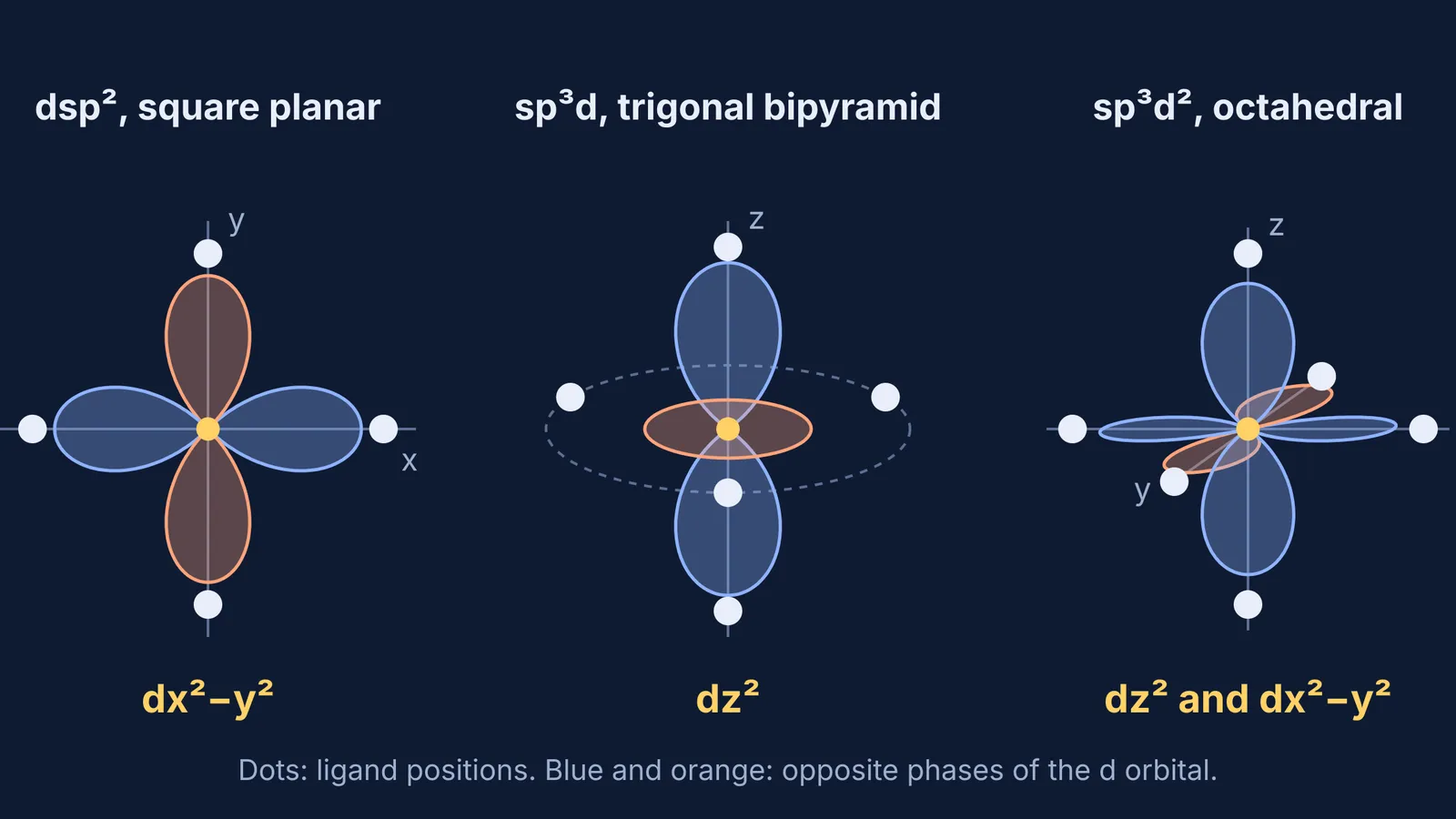
A square planar complex has its four ligands at +x, −x, +y and −y. You need four orbitals that lie in the xy plane: s, px, py and dx²−y². The pz orbital is left out, and so is dz², because its large lobes point along z, where there is no ligand.
[Ni(CN)₄]²⁻ is the standard example. Ni²⁺ is 3d⁸. The strong-field CN⁻ ligands pair the eight electrons into four of the 3d orbitals, dxy, dxz, dyz and dz². That leaves 3dx²−y² empty, and it combines with 4s, 4px and 4py. All electrons are paired, so the complex is diamagnetic.
Crystal field theory agrees. In a square planar field dx²−y² is pushed highest in energy, so it is the orbital left empty in a d⁸ ion, as explained in why d⁸ ions like Pt²⁺ form square planar complexes.
Does sp³d use dz² or dx²−y²?
It depends on the shape, which is why sp³d is a favourite trap.
Trigonal bipyramid. The two axial ligands lie along z, and the three equatorial ligands lie in the xy plane at 120°. The set is s, px, py, pz and dz². Example: PCl₅.
Square pyramid. The four basal ligands lie along ±x and ±y, and the apical ligand lies along z. The set is s, px, py, pz and dx²−y². Example: [Ni(CN)₅]³⁻ in its square pyramidal form, where the d orbital comes from the inner 3d shell, so the label is written dsp³.
The trigonal bipyramid has a useful side effect. Its five hybrids are not all alike. The two axial ones draw mainly on pz and dz², and the three equatorial ones mainly on s, px and py. That is part of why the axial bonds in PCl₅ are longer than the equatorial ones.
Which d orbitals are used in d²sp³ and sp³d²?
An octahedron puts ligands at ±x, ±y and ±z. You need s, all three p orbitals, and both d orbitals that point along axes: dz² and dx²−y². That is true for both labels. The only difference between d²sp³ (inner orbital) and sp³d² (outer orbital) is which shell the two d orbitals come from, 3d or 4d.
These are the same two orbitals that crystal field theory calls eg, the pair raised in energy by an octahedral field. In an inner orbital complex, the metal's own d electrons must therefore fit into dxy, dxz and dyz, which hold at most six. That gives a quick check:
d⁶ Co³⁺ with NH₃ can be d²sp³, because six electrons fit into three orbitals.
d⁸ Ni²⁺ in an octahedral complex is always sp³d², because eight electrons cannot fit into three orbitals.
One larger case shows up in JEE. IF₇ is a pentagonal bipyramid and is described as sp³d³. The two axial bonds lie along z and use dz². The five equatorial bonds lie in the xy plane at 72°, so they need every in-plane orbital: s, px, py, dx²−y² and dxy. Here dxy is used, because the ligands no longer sit only on the axes.
Worked example: name the d orbitals in four species
Use the same four steps each time.
Find the geometry from the electron count or the magnetic data.
Put the ligands on axes, with z along the unique axis.
List the bond directions.
Pick the d orbitals whose lobes point along those directions, then check the electron count.
PCl₅. Trigonal bipyramid. Phosphorus promotes one 3s electron to 3d, giving five half-filled orbitals. The axial bonds are along z, so the d orbital is 3dz². Hybridisation: sp³d.
[Ni(CN)₄]²⁻. Square planar and diamagnetic. Four bonds along ±x and ±y, so the d orbital is 3dx²−y². Hybridisation: dsp². Note that 4pz is the orbital left out.
[CoF₆]³⁻. Octahedral. Co³⁺ is 3d⁶, and F⁻ is a weak-field ligand, so the electrons stay spread over all five 3d orbitals with four unpaired. No 3d orbital is free, so the complex uses 4dz² and 4dx²−y². Hybridisation: sp³d², outer orbital, paramagnetic.
[Co(NH₃)₆]³⁺. Octahedral and diamagnetic. The six 3d electrons pair up in 3dxy, 3dxz and 3dyz. That empties 3dz² and 3dx²−y², which join 4s and 4p. Hybridisation: d²sp³, inner orbital.
How does JEE test this?
Two typical questions:
In [Ni(CN)₄]²⁻, which nickel orbital takes no part in hybridisation: 4s, 3dx²−y², 4pz or 4px? Answer: 4pz, because all four bonds lie in the xy plane.
Which orbital is not part of the sp³d² set in SF₆: dz², dx²−y², dxy or pz? Answer: dxy, because its lobes point between the axes where the six F atoms sit.
For more questions in this style, the Fermi Problem Library has a step-by-step solver that explains the reasoning.
Do PCl₅ and SF₆ really use d orbitals?
Not much, according to modern bonding calculations. For main-group molecules such as PCl₅, SF₆ and IF₇, the 3d orbitals are high in energy and contribute very little. Their bonding is better described with polar bonds and three-centre, four-electron bonds, with no d orbitals needed. The sp³d and sp³d² labels for these molecules are a valence bond model that NCERT and JEE use because it predicts the shapes correctly. Use it in the exam, but know it is a model.
Transition metal complexes are different. There the (n−1)d orbitals are real valence orbitals, and the d orbital choices above do describe genuine bonding.
Quick checklist
The d orbital in a hybrid must point along the bond directions.
dsp² (square planar): dx²−y², and pz is unused.
sp³d trigonal bipyramid: dz². sp³d square pyramid: dx²−y².
d²sp³ and sp³d² (octahedral): dz² and dx²−y², from 3d or 4d.
sp³d³ (IF₇): dz², dx²−y² and dxy.
dxz and dyz are not used in any of these hybrids.
For PCl₅ and SF₆, d orbital use is a model; for metal complexes it is real bonding.


