

On this page
Statement and match-the-list questions appear in recent JEE Main papers. These eight original ones, easy to hard, stay within Unit 10 of NTA's JEE (Main) 2027 Physics syllabus and Chapter 14 of NCERT Class 11 Physics. For theory, see how to prepare waves and sound for JEE Main.
Statement questions: can you judge each claim?
Options for Q1 and Q3: (1) Both correct (2) Both incorrect (3) Only I correct (4) Only II correct
Q1 (easy, statements). Statement I: Longitudinal waves travel at 5.0 km/s in a steel rod with Y = 2.0 × 10¹¹ Pa and ρ = 8.0 × 10³ kg/m³. Statement II: For air (γ = 1.4), Laplace's correction raises Newton's value of the speed of sound by about 40%.
Answer: (3). I is correct: √(Y/ρ) = 5.0 × 10³ m/s. II is incorrect: Laplace's value is √γ times Newton's, and √1.4 ≈ 1.18, about 18% higher.
Trap: (1) multiplies by γ instead of √γ.
Q2 (medium, statements). For y = 0.02 sin(0.5πx − 40πt) (SI units), which are correct? A. Its wavelength is 4.0 m. B. It moves at 80 m/s along +x. C. Its frequency is 40 Hz. D. Points 1.0 m apart differ in phase by π/2. E. Its period is 0.025 s.
(1) A, B, C and D only (2) A, B and D only (3) A, D and E only (4) B, C and E only
Answer: (2). A: λ = 2π/k = 4.0 m. B: v = ω/k = 80 m/s; opposite signs of kx and ωt mean +x. C is false: f = ω/2π = 20 Hz. D: kΔx = π/2. E is false: T = 2π/ω = 0.05 s.
Trap: (1) reads f as ω/π, dropping the 2.
Q3 (medium, statements). Two waves of amplitude a and equal frequency travel the same way on a string. Statement I: For phase difference 2π/3, the resultant amplitude is √3a. Statement II: For phase difference π/3, the resultant amplitude is √3a.
Answer: (4). Resultant amplitude is 2a cos(φ/2). I is incorrect: 2a cos(π/3) = a. II is correct: 2a cos(π/6) = √3a.
Trap: (3) uses 2a sin(φ/2), which swaps the two results.
Q4 (hard, statements). A 1.0 m string, fixed at both ends, has μ = 0.010 kg/m and tension 64 N. Which are correct? A. Its third harmonic is 120 Hz. B. In the third harmonic, it has 4 nodes, counting the ends. C. In that mode, x = 0.40 m and x = 0.60 m move in phase. D. At 100 N, the second harmonic is 125 Hz. E. The midpoint is a node in that mode.
(1) A, B and C only (2) A, B, C and D only (3) A, C and E only (4) B, D and E only
Answer: (1). v = √(64/0.010) = 80 m/s, f₁ = 40 Hz. A: 120 Hz. B: nodes at 0, 1/3, 2/3 and 1 m. C: both sit in the middle loop. D is false: v = 100 m/s, so f₂ = 100 Hz. E is false: antinode.
Trap: (2) scales frequency with tension, not √T.
Match-the-list questions: can you pair all four?
Q5 (easy, match). Match each wave with its speed formula.
List-I: A. Transverse wave on a string; B. Sound in an ideal gas; C. Longitudinal wave in a metal rod; D. Sound in a liquid.
List-II: I. √(Y/ρ); II. √(B/ρ); III. √(T/μ); IV. √(γP/ρ).
(1) A-III, B-II, C-I, D-IV (2) A-III, B-IV, C-I, D-II (3) A-I, B-IV, C-III, D-II (4) A-III, B-IV, C-II, D-I
Answer: (2). A-III: string. B-IV: in a gas, B = γP. C-I: a rod, Young's modulus. D-II: a liquid, bulk modulus.
Trap: (4) gives the rod a bulk modulus.
Q6 (medium, match). Sound travels at v₀ in an ideal gas at 27 °C. Match each change with the new speed.
List-I: A. Heated to 927 °C; B. Pressure doubled at the same temperature; C. Same γ, four times the molar mass; D. Heated to 327 °C.
List-II: I. v₀; II. 2v₀; III. v₀/2; IV. √2v₀.
(1) A-II, B-I, C-IV, D-III (2) A-II, B-III, C-I, D-IV (3) A-II, B-IV, C-III, D-I (4) A-II, B-I, C-III, D-IV
Answer: (4). v = √(γRT/M). A-II: T rises 4 times, so 2v₀. B-I: pressure drops out. C-III: √(1/4). D-IV: T doubles.
Trap: (2) lets the doubled pressure change the speed.
Q7 (medium, match). A 384 Hz fork and an open pipe P sound together. The air in P is warmed or cooled slightly. Match each observation with P's starting frequency.
List-I: A. 4 beats/s, rising when P is warmed; B. 4 beats/s, falling when P is warmed; C. 6 beats/s, falling when P is cooled; D. 6 beats/s, rising when P is cooled.
List-II: I. 378 Hz; II. 380 Hz; III. 388 Hz; IV. 390 Hz.
(1) A-III, B-II, C-IV, D-I (2) A-II, B-III, C-I, D-IV (3) A-III, B-II, C-I, D-IV (4) A-II, B-III, C-IV, D-I
Answer: (1). v ∝ √T, so warming raises the pitch. A-III: 388 Hz moves away. B-II: 380 Hz moves closer. C-IV: 390 Hz falls closer. D-I: 378 Hz falls away.
Trap: (2) assumes warmer air lowers the pitch.
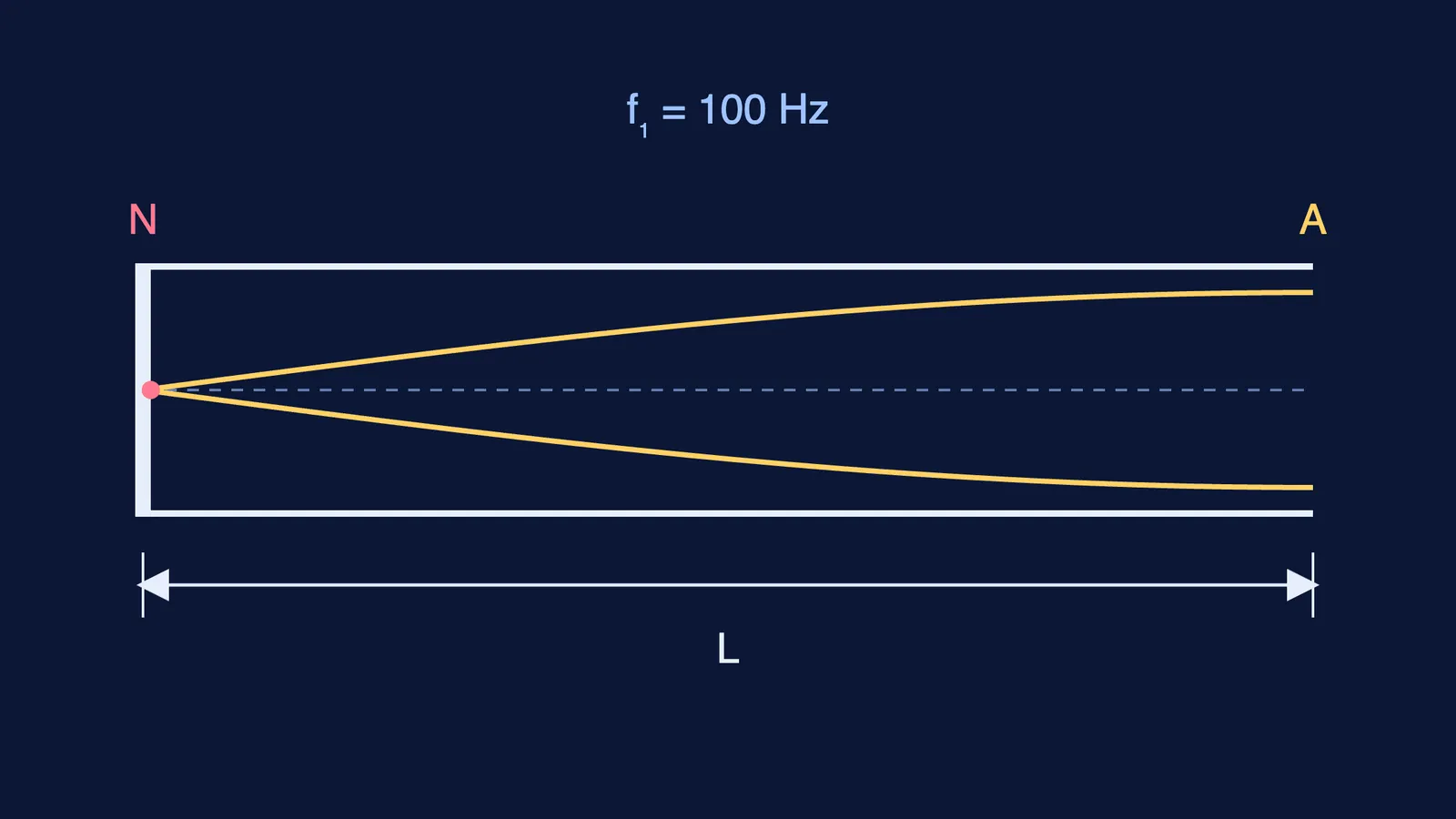
Q8 (hard, match). A pipe of length L closed at one end has a 100 Hz fundamental. Match each case with its frequency.
List-I: A. Same pipe, third-lowest natural frequency; B. Length L, open at both ends, first overtone; C. Length L/3, closed at one end, fundamental; D. Length L/3, open at both ends, fundamental.
List-II: I. 300 Hz; II. 400 Hz; III. 500 Hz; IV. 600 Hz.
(1) A-I, B-II, C-III, D-IV (2) A-III, B-IV, C-I, D-II (3) A-III, B-II, C-I, D-IV (4) A-IV, B-II, C-I, D-III
Answer: (3). v/4L = 100 Hz, so v/2L = 200 Hz. A-III: odd harmonics only: 100, 300, 500 Hz. B-II: 2 × 200 = 400 Hz. C-I: v/(4L/3) = 300 Hz. D-IV: v/(2L/3) = 600 Hz.
Trap: (1) takes the third natural frequency as 3 × 100 Hz.
How do you solve these faster?
Read k and ω first; λ, f, v and direction follow.
Write √(γRT/M) before judging any change to a gas.
Sketch nodes, then count half or quarter wavelengths.
In beats, first decide which way the change moves the frequency.
Did a pipe catch you? The Fermi Problem Library has worked problems with a step-by-step solver that explains the reasoning rather than printing an answer.
Next, try waves and sound JEE Main practice questions or our method for match-the-list questions.


