

On this page
Statement and match-the-list questions appear in recent JEE Main papers. Here are eight original wave optics questions.
What do these wave optics questions cover?
All fit the Wave optics part of Unit 16 of the NTA's Syllabus for JEE (Main) 2027. The JEE (Main) 2027 information bulletin marks MCQs +4 or −1. Facts follow NCERT Class 12 Physics Chapter 10, Wave Optics. New to the chapter? Read our guide on how to prepare wave optics for JEE Main.
Statement I/II options: (1) Both correct (2) Both incorrect (3) I correct, II incorrect (4) I incorrect, II correct.
Statement questions
Q1 (easy, Statement I/II). Single slit of width a, wavelength λ. Statement I: With λ = 600 nm and a = 0.12 mm, the central maximum spans about 0.010 rad. Statement II: Halving both λ and a halves the central maximum's width.
Answer: (3). I is correct: the angular width is 2λ/a = 2 × 600 nm ÷ 0.12 mm = 0.010 rad. II is incorrect: the width is 2λD/a, and λ/a is unchanged.
Trap: (1) forgets the narrower slit.
Q2 (medium, statements). Light of 700 nm and 560 nm falls on slits 0.50 mm apart, screen 1.0 m away. Which are correct? A. The 700 nm fringe width is 1.4 mm. B. Off the centre, bright fringes of both first coincide 5.6 mm out. C. There, the 700 nm fringe is its 5th bright. D. At 0.70 mm, both give dark fringes. E. Dark fringes of the two never coincide.
(1) A, B, C and E only (2) A, B and E only (3) A, B and D only (4) B, C and E only
Answer: (2). A true: β = λD/d = 1.4 mm. B true: 4 × 700 nm = 5 × 560 nm, so 4 × 1.4 mm = 5.6 mm. C false: it is the 4th for 700 nm, the 5th for 560 nm. D false: 0.70 mm is dark for 700 nm but 0.625 fringe widths for 560 nm. E true: (2n + 1) × 5 = (2m + 1) × 4 equates odd and even.
Trap: (1) swaps the orders.
Q3 (medium, Statement I/II). Two identical narrow slits each give intensity I₀ alone near the screen's centre. One is covered. Statement I: The central fringe falls from 4I₀ to I₀. Statement II: A former dark fringe rises from zero to I₀.
Answer: (1). I is correct: 4I₀ becomes one slit's I₀, a quarter, not a half. II is correct: nothing is left to cancel the open slit's light.
Trap: (3) assumes covering a slit only dims.
Q4 (hard, statements). In a double slit, one slit alone gives I₀ and the other alone 4I₀. Which are correct? A. I_max = 9I₀. B. I_min = 0. C. At phase difference π/3, I = 7I₀. D. Averaged over many fringes, I = 5I₀. E. Were the slits incoherent, I = 9I₀ everywhere.
(1) A, B and C only (2) A, D and E only (3) A, C, D and E only (4) A, C and D only
Answer: (4). Amplitudes are 1 : 2, so I = 5I₀ + 4I₀cos φ. A true: (1 + 2)²I₀. B false: (2 − 1)²I₀ = I₀. C true: 5I₀ + 4I₀ × ½. D true: cos φ averages to zero. E false: incoherent intensities add, 5I₀.
Trap: (3) adds amplitudes for incoherent light.
Match-the-list questions
Q5 (easy, match). A double-slit pattern has fringe width β. Match each pair of changes with the new width. List-I: (A) d ×3, D ×1.5 (B) λ 450 → 600 nm, D ×¾ (C) d ×½, λ ×¾ (D) D ×2, d ×⅔. List-II: (I) 3β (II) β (III) β/2 (IV) 3β/2.
(1) A-III, B-II, C-I, D-IV (2) A-IV, B-II, C-III, D-I (3) A-III, B-II, C-IV, D-I (4) A-III, B-IV, C-II, D-I
Answer: (3). β = λD/d. A-III: 1.5/3 = ½. B-II: (4/3)(3/4) = 1. C-IV: (3/4)/(½) = 3/2. D-I: 2/(2/3) = 3.
Trap: (2) applies only the change in D for A.
Q6 (medium, match). Identical coherent slits give fringe width β and peak intensity I_max. Match each distance from the central fringe with the intensity. List-I: (A) 5β/6 (B) 3β/4 (C) 3β (D) 5β/2. List-II: (I) 0 (II) I_max/2 (III) 3I_max/4 (IV) I_max.
(1) A-III, B-II, C-IV, D-I (2) A-II, B-III, C-IV, D-I (3) A-III, B-II, C-I, D-IV (4) A-IV, B-II, C-III, D-I
Answer: (1). Phase difference is 2πy/β, so I = I_max cos²(πy/β). A-III: cos²150° = ¾. B-II: cos²135° = ½. C-IV: a bright fringe. D-I: a dark fringe.
Trap: (3) puts bright fringes at half-integer multiples of β.
Q7 (medium, match). Light of 500 nm, a 0.25 mm slit, screen 1.5 m away. List-I: (A) centre to first minimum (B) central maximum width (C) centre to first secondary maximum (D) centre to third minimum. List-II: (I) 3.0 mm (II) 4.5 mm (III) 6.0 mm (IV) 9.0 mm.
(1) A-III, B-I, C-II, D-IV (2) A-I, B-III, C-IV, D-II (3) A-I, B-II, C-III, D-IV (4) A-I, B-III, C-II, D-IV
Answer: (4). λD/a = 3.0 mm. A-I: one unit. B-III: two units. C-II: 1.5 units. D-IV: three units.
Trap: (1) swaps half-width and width.
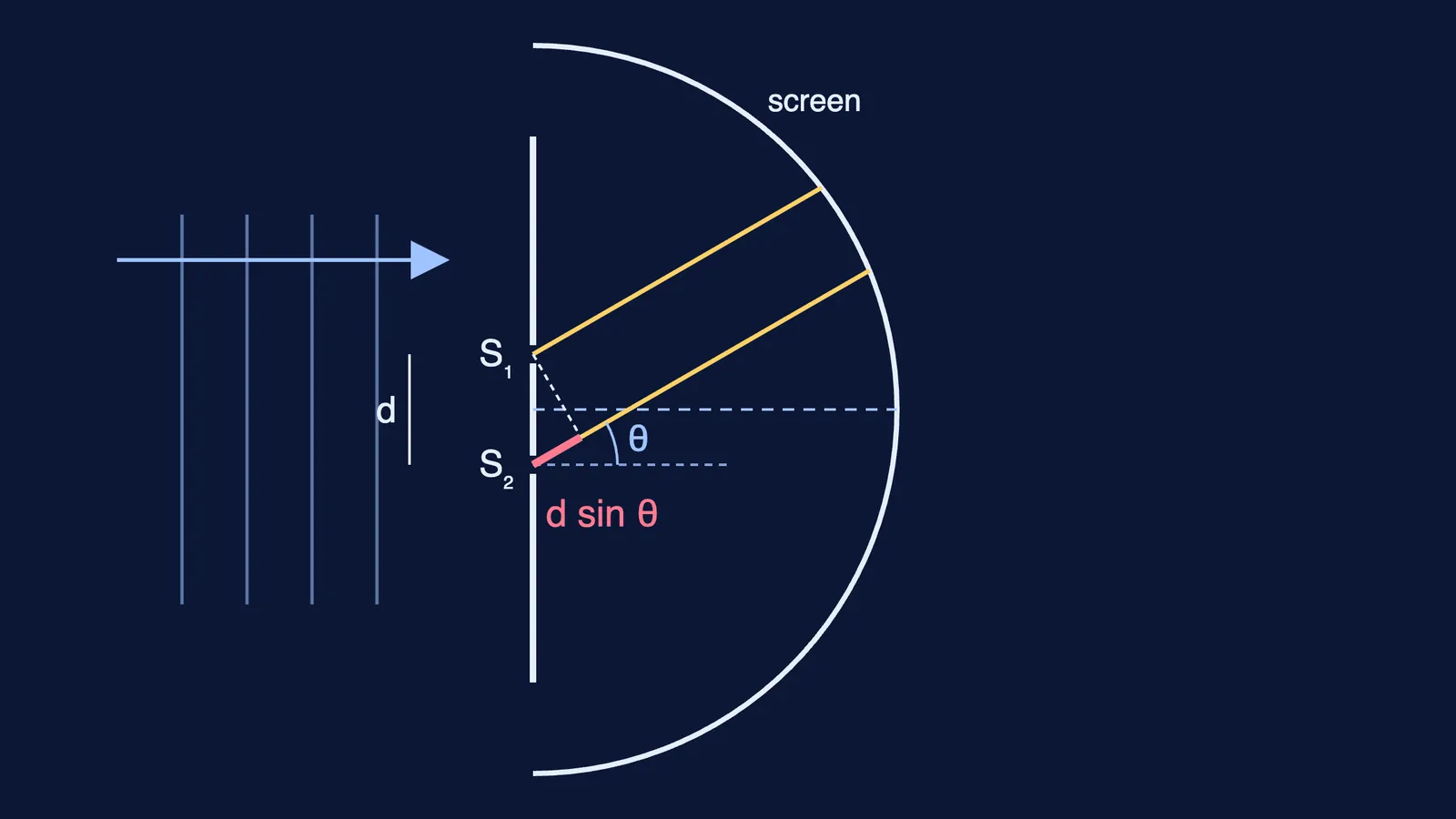
Q8 (hard, match). Two very narrow in-phase slits, d apart, face a large semicircular screen. Count directions between −90° and +90°. List-I: (A) bright directions, d = 2.2λ (B) dark directions, d = 2.2λ (C) bright directions, d = 3.4λ (D) dark directions, d = 3.4λ. List-II: (I) 4 (II) 5 (III) 6 (IV) 7.
(1) A-I, B-II, C-III, D-IV (2) A-II, B-I, C-IV, D-III (3) A-II, B-III, C-IV, D-I (4) A-II, B-I, C-III, D-IV
Answer: (2). Bright: d sin θ = nλ, |n| < d/λ. Dark: (n + ½)λ. A-II: n = 0, ±1, ±2. B-I: ±½, ±3/2. C-IV: n up to ±3. D-III: up to ±5/2.
Trap: (1) swaps the bright and dark counts.
How do you work these faster?
Find β or λD/a first; every distance is a multiple of it.
For intensity, write I = I₁ + I₂ + 2√(I₁I₂)cos φ.
For coincidences, reduce the wavelength ratio: 700 : 560 is 5 : 4.
To count every direction, use |sin θ| < 1, not small angles.
Struggling to picture how d sin θ grows with angle? The Fermi Simulation Lab has interactive simulations for the ideas that are easier to see than to read.
For longer problems, try set 1 of our wave optics JEE Main practice questions.


