

On this page
This is the second set of original JEE Main-style wave optics questions; it follows our first wave optics JEE Main practice set and tests the parts of the chapter that set skipped. Each has a worked solution and a trap line naming the most tempting wrong option. Q6 is numerical.
How should you use this second set?
The Wave optics paragraph in Unit 16 of NTA's Syllabus for JEE (Main) - 2027 covers Huygens' principle, Young's experiment, single-slit diffraction and Polaroids. Every question stays inside it and inside NCERT Class 12 Physics Chapter 10, Wave Optics (Reprint 2026-27).
Take 25 minutes, on paper, without a calculator.
Draw the figure before you calculate.
Read every trap line, even where you were right.
Not planned the chapter yet? Start with our guide on how to prepare wave optics for JEE Main.
Easy: can you use Huygens' construction, angular width and a rotating Polaroid?
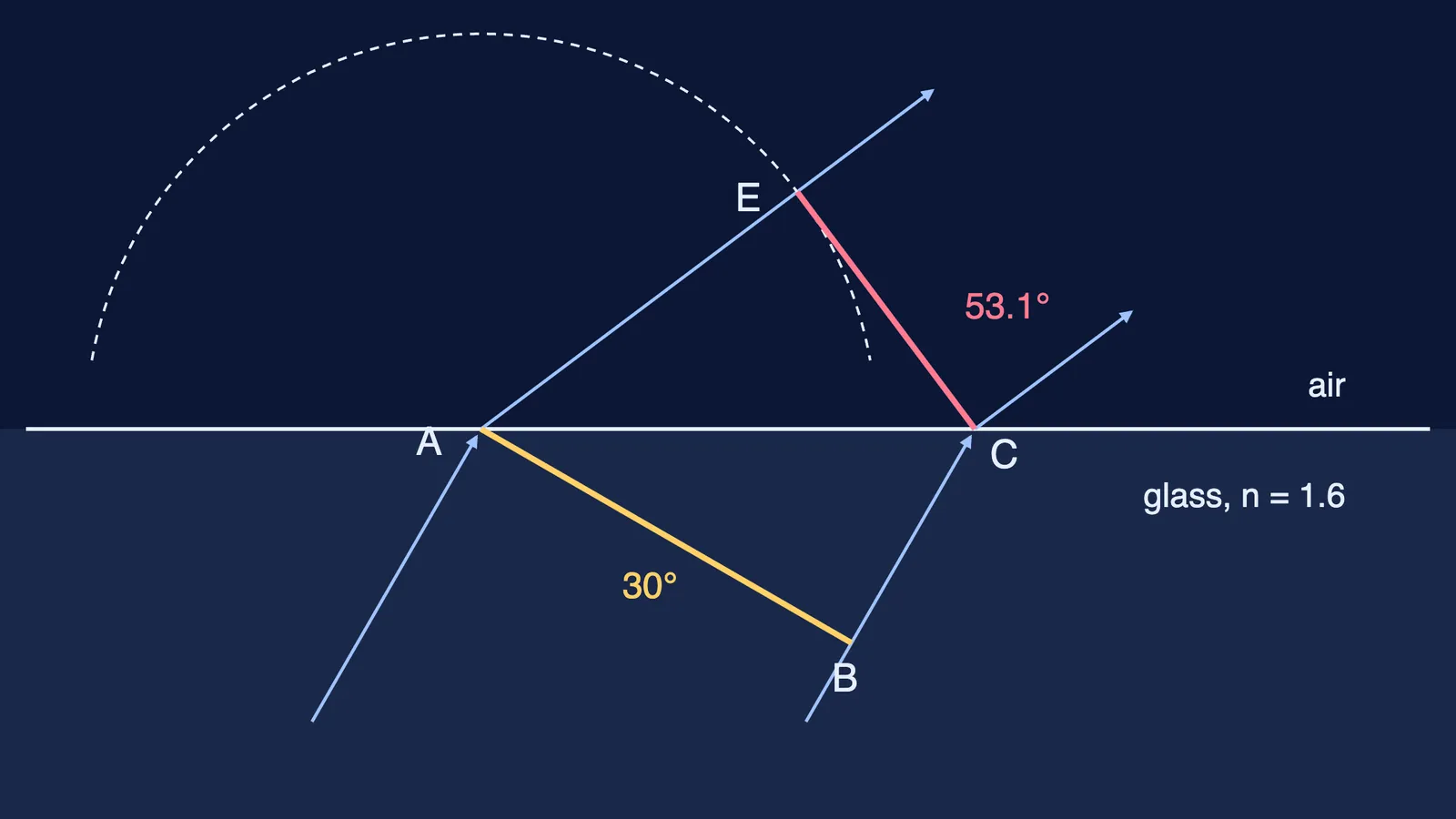
Q1 (easy). A plane wavefront travelling in glass (n = 1.6) reaches a flat glass-air surface, making an angle of 30° with the surface. Using Huygens' construction, the refracted wavefront in air makes an angle with the surface of:
(A) 18.2° (B) 30° (C) 36.9° (D) 53.1°
Answer: (D). While the far edge covers BC in glass, the wavelet from A grows to 1.6 × BC in air, where light is 1.6 times faster. Both share the hypotenuse AC, so sin r = 1.6 × sin 30° = 0.8 and r = 53.1°. Trap: (A), which divides by 1.6 as if the light were entering a denser medium.
Q2 (easy). In a double-slit set-up, the angular separation between neighbouring bright fringes is 0.12°. The slit separation is reduced to two-thirds of its value and the screen is moved twice as far away, with the same light. The new angular fringe separation is:
(A) 0.08° (B) 0.18° (C) 0.24° (D) 0.36°
Answer: (B). Bright fringes sit where d sin θ = nλ, so the angular separation is about λ/d, independent of screen distance. Dividing d by 1.5 gives 0.12° × 1.5 = 0.18°. Trap: (D), which also doubles for the screen distance.
Q3 (easy). You look at three beams through one Polaroid and turn it through a full 360°. Beam X shows no change. Beam Y goes dark twice. Beam Z gets brighter and dimmer twice but never goes dark. The beams are:
(A) X polarised, Y unpolarised, Z partly polarised (B) X unpolarised, Y polarised, Z partly polarised (C) X unpolarised, Y partly polarised, Z polarised (D) X partly polarised, Y polarised, Z unpolarised
Answer: (B). NCERT notes that unpolarised light through one Polaroid stays at half intensity at every angle. Plane-polarised light follows I₀cos²θ, which is zero twice per turn. A mix dims twice but never reaches zero. Trap: (C), which mixes up "dims" with "goes dark".
Medium: can you handle secondary maxima, mixed light and a moving screen?
Q4 (medium). A single slit is lit by 600 nm light. Taking secondary maxima at a sin θ = (n + ½)λ, the first secondary maximum falls at the same angle as the second minimum for a second wavelength λ′ through the same slit. λ′ is:
(A) 300 nm (B) 450 nm (C) 800 nm (D) 900 nm
Answer: (B). Set 1.5 × 600 nm = 2λ′, so λ′ = 450 nm. Trap: (D), which matches the first minimum of λ′ (a sin θ = λ′) instead of the second.
Q5 (medium). A beam mixes unpolarised and plane-polarised light. Through a rotating Polaroid, the brightest reading is 5 times the dimmest. What fraction of the beam's intensity is plane-polarised?
(A) 1/3 (B) 1/2 (C) 2/3 (D) 4/5
Answer: (C). The unpolarised part I_u always gives I_u/2; the polarised part I_p adds between I_p and 0. So (I_u/2 + I_p)/(I_u/2) = 5, giving I_p = 2I_u, and the polarised fraction is 2I_u/3I_u = 2/3. Trap: (D), which forgets that a Polaroid passes only half of the unpolarised part.
Q6 (medium, numerical). In a double-slit experiment the slits are 1.0 mm apart and the screen is 1.8 m away. When the screen is moved 40 cm closer to the slits, the fringe width falls by 0.20 mm. Find the wavelength in nanometres.
Answer: 500. Since β = λD/d, a change ΔD changes β by λΔD/d. Then λ = 0.20 × 10⁻³ × 1.0 × 10⁻³ / 0.40 m = 5.0 × 10⁻⁷ m. Trap: 111, which divides by the full 1.8 m instead of the 0.40 m change.
Hard: can you place a dark fringe and read a fringe shift?
Q7 (hard). Two narrow slits are 1.2 mm apart, with the screen 1.0 m away. The point directly in front of one slit is the second dark fringe from the centre. The wavelength is:
(A) 360 nm (B) 480 nm (C) 720 nm (D) 1440 nm
Answer: (B). That point is d/2 = 0.60 mm from the centre. The second dark fringe sits at 1.5λD/d, so λ = d²/(3D) = (1.2 × 10⁻³)²/3.0 m = 480 nm. Trap: (A), which uses the second bright fringe, 2λD/d.
Q8 (hard). In a double-slit experiment with 590 nm light, one slit is covered with a thin transparent sheet of refractive index 1.59. The central bright fringe moves to where the 4th bright fringe used to be. The sheet's thickness and the direction of the shift are:
(A) 4.0 μm, towards the covered slit (B) 4.0 μm, away from the covered slit (C) 1.48 μm, towards the covered slit (D) 2.36 μm, towards the covered slit
Answer: (A). Inside the sheet the wavelength is λ/n, so the sheet adds an optical path of (n − 1)t. The central fringe moves to where the path from the covered slit is shorter by that much: the covered side. Setting (n − 1)t = 4λ gives t = 4 × 590 nm / 0.59 = 4.0 μm. Trap: (C), which divides by n instead of (n − 1).
What should you do after checking your answers?
Sort each miss: wrong geometry (Q1, Q7), wrong quantity (angle versus distance, Q2 and Q6), wrong kind of light (Q3, Q5) or wrong condition (Q4, Q8). Redo the misses two days later without the solutions.
If you cannot see where your working broke, the Fermi Problem Library has worked problems with a step-by-step solver that explains the reasoning rather than printing an answer.


