

On this page
Statement-based and match-the-list questions appear in recent JEE Main papers. Here are eight original ones on Units and Measurements.
What does JEE Main test in Units and Measurements?
In NTA's Syllabus for JEE (Main) - 2027, Physics Unit 1 covers SI units, least count, significant figures, errors in measurements and dimensional analysis. The text is NCERT Class 11 Physics Chapter 1, Units and Measurement (Reprint 2026-27). For theory, read how to prepare Units and Measurements for JEE Main.
Statement I/II options: (1) both correct (2) both incorrect (3) I correct, II incorrect (4) I incorrect, II correct.
Statement questions
Q1 (easy, statements). Using NCERT's rounding rules, which are correct? A. 0.003070 kg has four significant figures. B. 4.700 × 10³ m has two significant figures. C. 6.235 rounded to three significant figures is 6.24. D. 8.465 rounded to three significant figures is 8.47. E. 12.6 g + 0.347 g, correctly reported, is 12.9 g.
(1) A, C and E only (2) A, D and E only (3) B, C and D only (4) A, B and C only
Answer: (1). A true: leading zeros never count; the trailing zero does. B false: 4.700 has four. C true: NCERT raises the digit before a dropped 5 if it is odd (3). D false: 6 is even, so the 5 is dropped: 8.46. E true: 12.947 keeps one decimal place, like 12.6.
Trap: (2), reversing the odd/even rule.
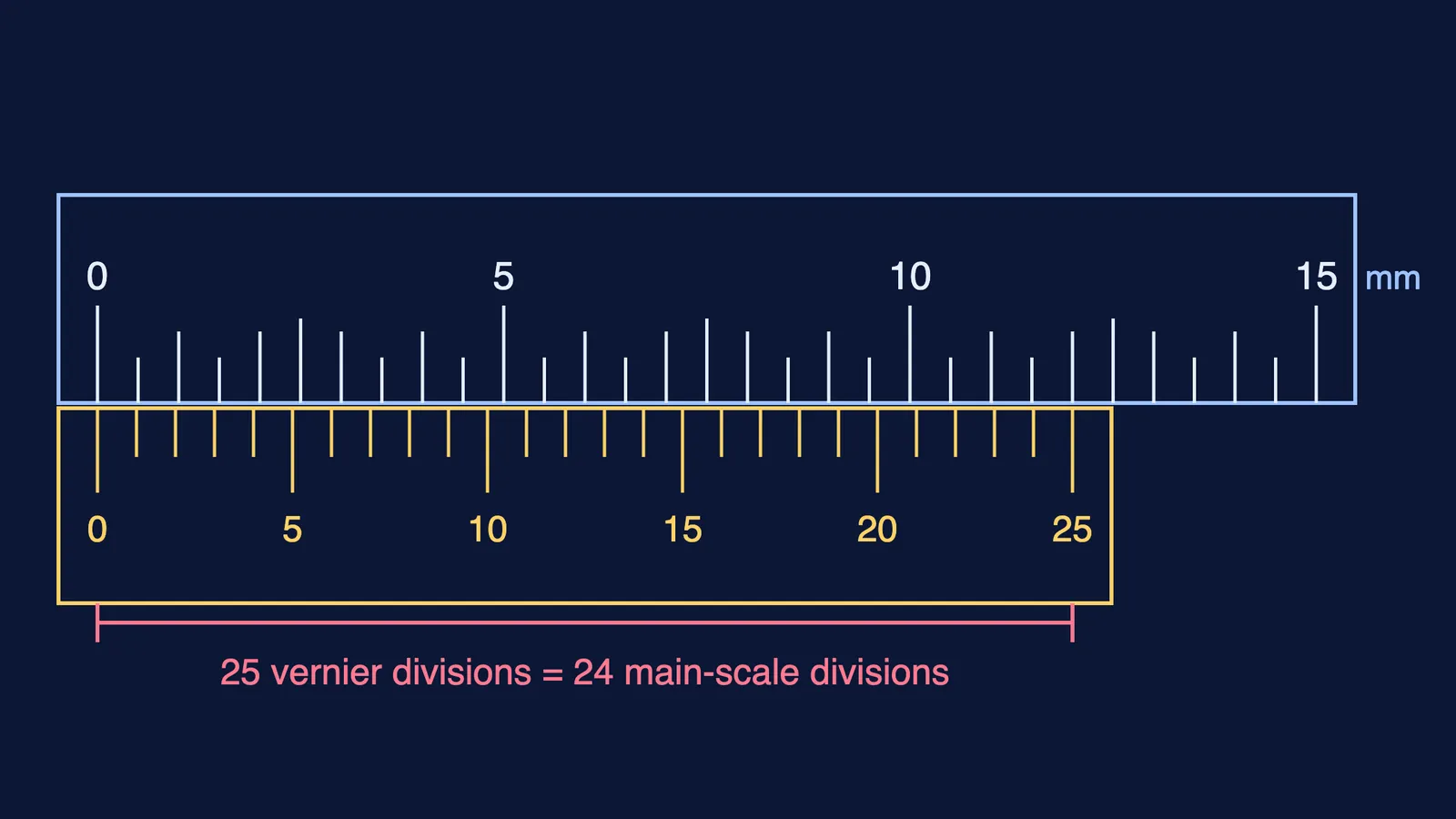
Q2 (easy, Statement I/II). Statement I: A vernier calliper whose 25 vernier divisions equal 24 main-scale divisions of 0.5 mm has a least count of 0.02 mm. Statement II: In a screw gauge of pitch 0.5 mm with 50 circular divisions, 30 divisions move the spindle 0.15 mm.
Answer: (3). I true: 0.5 mm/25 = 0.02 mm. II false: least count 0.5/50 = 0.01 mm, so 30 divisions give 0.30 mm.
Trap: (1), taking 0.005 mm per division.
Q3 (medium, Statement I/II). Let a = 4.0 ± 0.1 cm, b = 2.0 ± 0.1 cm. Statement I: The maximum percentage error in a²/√b is 10%. Statement II: The maximum percentage error in (a − b) is three times that in (a + b).
Answer: (4). I false: 2(0.1/4.0) + ½(0.1/2.0) = 5% + 2.5% = 7.5%. II true: both carry ±0.2 cm: 0.2/2.0 = 10%, 0.2/6.0 = 3.3%, a ratio of 3.
Trap: (1), giving √b a full 5% instead of half.
Q4 (hard, statements). R is resistance, C capacitance, L inductance, G the gravitational constant, ρ density, h Planck's constant, c light's speed, λ wavelength. Which are correct? A. RC has the dimensions of time. B. L/R has the dimensions of frequency. C. √(LC) has the dimensions of time. D. 1/√(Gρ) has the dimensions of time. E. hc/λ has the dimensions of momentum.
(1) A, B and C only (2) A, C and D only (3) C, D and E only (4) B, D and E only
Answer: (2). A true: [M L² T⁻³ A⁻²][M⁻¹ L⁻² T⁴ A²] = [T]. B false: L = [M L² T⁻² A⁻²], so L/R = [T], a time. C true: LC = [T²]. D true: Gρ = [M⁻¹ L³ T⁻²][M L⁻³] = [T⁻²]. E false: hc/λ = [M L² T⁻²], an energy.
Trap: (1), not checking what L/R measures.
Match-the-list questions
Q5 (easy, match). Match each with its SI base units. List-I: (A) Pressure gradient dp/dx (B) Intensity (power per area) (C) Coefficient of viscosity (D) Electric potential. List-II: (I) kg m² s⁻³ A⁻¹ (II) kg m⁻¹ s⁻¹ (III) kg m⁻² s⁻² (IV) kg s⁻³
(1) A-III, B-I, C-II, D-IV (2) A-III, B-IV, C-II, D-I (3) A-II, B-IV, C-III, D-I (4) A-I, B-IV, C-III, D-II
Answer: (2). A: Pa m⁻¹ = kg m⁻² s⁻², III. B: W m⁻², IV. C: Pa s, II. D: W A⁻¹, I.
Trap: (3), swapping gradient and viscosity.
Q6 (medium, match). a = 20.0 ± 0.2, b = 5.00 ± 0.10, c = 4.00 ± 0.12. Match each with its maximum percentage error. List-I: (A) a²b³ (B) ab/c² (C) c√a/b (D) a − 2b. List-II: (I) 9% (II) 4% (III) 8% (IV) 5.5%
(1) A-I, B-III, C-IV, D-II (2) A-III, B-I, C-II, D-IV (3) A-III, B-I, C-IV, D-II (4) A-IV, B-I, C-III, D-II
Answer: (3). Relative errors: 1%, 2%, 3%. A: 2 + 6 = 8%, III. B: 1 + 2 + 6 = 9%, I. C: 0.5 + 3 + 2 = 5.5%, IV. D: 10.0 ± (0.2 + 0.20) = 10.0 ± 0.4, 4%, II.
Trap: (1), swapping the 8% and 9% items.
Q7 (medium, match). Match dimensions. List-I: (A) Magnetic flux (B) Permittivity of free space ε₀ (C) Self-inductance (D) Resistivity. List-II: (I) [M L³ T⁻³ A⁻²] (II) [M L² T⁻² A⁻¹] (III) [M⁻¹ L⁻³ T⁴ A²] (IV) [M L² T⁻² A⁻²]
(1) A-IV, B-III, C-II, D-I (2) A-II, B-I, C-IV, D-III (3) A-IV, B-I, C-II, D-III (4) A-II, B-III, C-IV, D-I
Answer: (4). A: B = F/(IL) = [M T⁻² A⁻¹], times area, II. B: ε₀ = q²/(4πFr²), III. C: flux/current, IV. D: ρ = RA/l = R × [L], I.
Trap: (1), swapping flux and inductance.
Q8 (hard, match). A system uses units of 4 kg, 0.5 m and 2 s. Match each SI unit with its value in the new units. List-I: (A) 1 N (B) 1 J (C) 1 W (D) 1 Pa. List-II: (I) 1/2 (II) 2 (III) 4 (IV) 8
(1) A-II, B-III, C-IV, D-I (2) A-I, B-III, C-IV, D-II (3) A-II, B-IV, C-III, D-I (4) A-III, B-II, C-IV, D-I
Answer: (1). A: 4 × 0.5/2² = 0.5 N, so 1 N = 2 units, II. B: 4 × 0.5²/2² = 0.25 J, so 4 units, III. C: 4 × 0.5²/2³ = 0.125 W, so 8 units, IV. D: 4/(0.5 × 2²) = 2 Pa, so 1 Pa = 1/2 unit, I.
Trap: (2), quoting the unit's size instead of the count.
How do you work these faster?
Lock your surest pair, then strike out codes without it.
Derive [M L T A] from a defining equation, not memory.
Products: relative errors times powers. Differences: absolute errors add.
Unit conversion: find the new unit's SI size, then invert it.
Does the same slip keep costing you marks? The Fermi Problem Library has worked problems with a step-by-step solver that explains the reasoning rather than printing an answer.
For the method, see how to approach statement-based questions, then try the timed Units and Measurements JEE Main practice questions with solutions.


