

On this page
This set follows our first Units and Measurements practice set for JEE Main, and every question here tests something set 1 left out: SI base units, the decimal-place rule, constants inside an exponent, repeated readings, systematic error, errors in a parallel combination, dimensional checks and scaling.
What does set 2 cover that set 1 did not?
NTA's Syllabus for JEE (Main) - 2027 lists Physics Unit 1 as SI units, fundamental and derived units, least count, significant figures, errors in measurements, and dimensional analysis. The textbook match is NCERT Class 11 Physics Chapter 1. For the theory and a revision plan, start with our guide on how to prepare Units and Measurements for JEE Main.
How should you use this set?
Cover the answers and give yourself 16 minutes for all eight.
For every miss, check whether the trap line describes your mistake. That is the habit to fix.
Easy: SI units, significant figures and dimensions
Q1 (easy). Which physical quantity has an SI base unit, not a derived one?
(A) electric charge, coulomb (B) amount of substance, mole (C) plane angle, radian (D) force, newton
Answer: (B). The seven SI base units are the metre, kilogram, second, ampere, kelvin, mole and candela. The coulomb is an ampere-second and the radian is a dimensionless ratio.
Trap: (A). Charge feels basic, but the base quantity in SI is electric current.
Q2 (easy). A wet towel weighs 102.4 g on a kitchen balance. After drying, a lab balance reads 98.715 g. How much water was lost, correctly reported?
(A) 3.685 g (B) 3.68 g (C) 3.7 g (D) 4 g
Answer: (C). 102.4 − 98.715 = 3.685 g. In a difference, keep the fewest decimal places in the data. 102.4 has one, so the answer is 3.7 g.
Trap: (B) applies the multiplication rule (four significant figures) to a subtraction.
Q3 (easy). In an isothermal atmosphere, pressure falls with height z as p = p₀ exp(−αz/kT), where k is the Boltzmann constant and T is temperature. What are the dimensions of α?
(A) [M L T⁻²] (B) [M L² T⁻²] (C) [M L⁻¹ T⁻²] (D) dimensionless
Answer: (A). The power of e must be dimensionless, so αz has the dimensions of kT, an energy [M L² T⁻²]. Dividing by [L] gives α = [M L T⁻²], a force.
Trap: (B) forgets to divide out the height z.
Medium: repeated readings, systematic error and combined errors
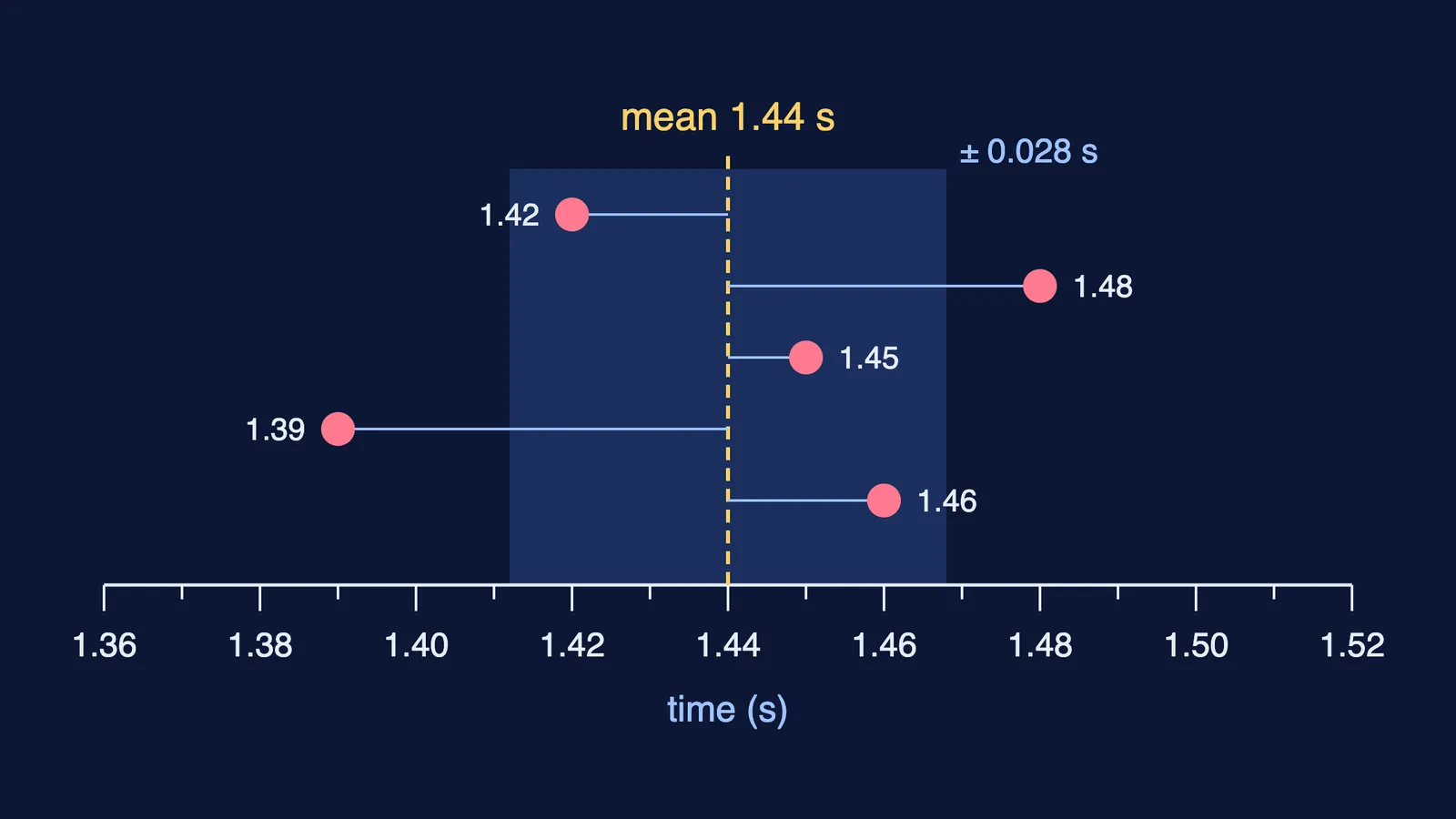
Q4 (medium). A ball rolling down a ramp is timed five times: 1.42 s, 1.48 s, 1.45 s, 1.39 s and 1.46 s. How should the result be reported, with the mean absolute error?
(A) 1.44 ± 0.01 s (B) 1.44 ± 0.03 s (C) 1.44 ± 0.05 s (D) 1.44 ± 0.14 s
Answer: (B). The mean is 7.20/5 = 1.44 s. The absolute deviations are 0.02, 0.04, 0.01, 0.05 and 0.02 s. Their mean is 0.14/5 = 0.028 s, which rounds to 0.03 s, about a 2% error.
Trap: (C) reports the largest single deviation; (D) forgets to divide by five.
Q5 (medium). A student times 20 swings of a pendulum five times and averages 32.40 s. She later finds that her stopwatch gains 3 s in every 100 s. What is the pendulum's true period?
(A) 1.57 s (B) 1.62 s (C) 1.67 s (D) 1.50 s
Answer: (A). The watch shows 103 s for every 100 true seconds, so the true time is 32.40 × 100/103 = 31.46 s, and the period is 31.46/20 = 1.57 s. This is a systematic error: averaging more readings never removes it, only a correction does.
Trap: (B) trusts the average and ignores the fast watch; (C) corrects in the wrong direction, multiplying by 1.03.
Q6 (medium). Two resistors, 6.0 ± 0.3 Ω and 12.0 ± 0.6 Ω, are joined in parallel. What is the equivalent resistance with its maximum error?
(A) 4.0 ± 0.2 Ω (B) 4.0 ± 0.9 Ω (C) 4.0 ± 0.4 Ω (D) 4.0 ± 0.1 Ω
Answer: (A). R = 6 × 12/18 = 4.0 Ω. Differentiating 1/R = 1/R₁ + 1/R₂ gives ΔR/R² = ΔR₁/R₁² + ΔR₂/R₂², so ΔR = 16(0.3/36 + 0.6/144) = 0.2 Ω.
Trap: (B) adds the absolute errors as for a series combination; (C) adds the two 5% errors as if R were a product.
Hard: can you use dimensions to check and predict?
Q7 (hard). Here E is an electric field, B a magnetic field, T the tension in a string, μ its mass per unit length, P a pressure, ρ a density and γ a pure number. Which expression does NOT have the dimensions of speed?
(A) 1/√(μ₀ε₀) (B) E/B (C) √(T/μ) (D) √(γPρ)
Answer: (D). √(γPρ) has dimensions [M L⁻² T⁻¹]. The speed of sound is √(γP/ρ), with ρ dividing. The others are speeds: 1/√(μ₀ε₀) is the speed of light, E/B follows from qE = qvB, and √(T/μ) is the speed of a wave on a string.
Trap: (A). Electrical constants look as if they cannot give a speed, but the A and the extra powers of M and L cancel.
Q8 (hard, numerical value). The power needed to keep a helicopter hovering depends only on its weight W, the air density ρ and the rotor radius r. If the weight doubles with ρ and r unchanged, by what factor does the power rise? Give two decimal places.
Answer: 2.83. Write P ∝ Wᵃ ρᵇ rᶜ with P = [M L² T⁻³] and W = [M L T⁻²]. T gives −2a = −3, so a = 3/2; M gives a + b = 1, so b = −1/2; L gives a − 3b + c = 2, so c = −1. P ∝ W^(3/2)/(r√ρ), and the factor is 2^(3/2) = 2.83.
Trap: 2.00, from assuming power is simply proportional to weight.
What should you do after this set?
7 or 8 correct: mix sets 1 and 2 into one timed 16-question test next week.
4 to 6: redo your misses, then read our explainer on how errors combine in a calculation.
Under 4: reread the NCERT sections on significant figures and dimensional formulae before trying again.
If a unit or a dimensional formula still feels shaky, the Fermi Concept Library gives each concept in physics its own lesson and shows where it sits in the map.


