

On this page
In JEE Main's Section B you type a number, with no options to check against. Here are eight original Units and Measurements questions in that format, easy to hard.
How are numerical-value questions marked in JEE Main 2027?
NTA's Information Bulletin for JEE (Main) 2027 gives Physics in Paper 1 two sections: 20 multiple-choice questions in Section A and 5 numerical-value questions in Section B. A correct numerical answer earns +4 and an incorrect one costs −1, so a guess is not free. The answer must be rounded off to the nearest integer and entered on an on-screen keypad.
All eight questions stay inside Unit 1 of the JEE (Main) 2027 syllabus (units, least count, significant figures, errors and dimensional analysis) and NCERT Class 11 Physics Chapter 1. For theory and a study plan, read our guide on how to prepare Units and Measurements for JEE Main.
Easy: conversions, significant figures and dimensions
Q1 (easy). An old handbook lists the Young's modulus of a steel wire as 2.1 × 10¹² dyn cm⁻². Enter its value in GPa.
Answer: 210. 1 dyn = 10⁻⁵ N and 1 cm² = 10⁻⁴ m², so 1 dyn cm⁻² = 0.1 Pa. That gives 2.1 × 10¹¹ Pa = 210 GPa.
Trap: 2, from converting cm² as 10⁻² m².
Q2 (easy). A sound's frequency is measured as 256 Hz and its wavelength as 1.3 m. Report the speed of sound, v = fλ, with the correct number of significant figures, and enter that reported value in m s⁻¹.
Answer: 330. 256 × 1.3 = 332.8 m s⁻¹. 1.3 has only two significant figures, so the speed is reported as 3.3 × 10² m s⁻¹, which is 330.
Trap: 333, from rounding the calculator value to the nearest integer instead of to two significant figures.
Q3 (easy). The Boltzmann constant k has dimensions [Mᵃ Lᵇ Tᶜ Kᵈ], where K stands for temperature. Find a + b − c − d.
Answer: 6. k = energy/temperature, so its unit is J K⁻¹ = kg m² s⁻² K⁻¹. Then a = 1, b = 2, c = −2, d = −1, and 1 + 2 + 2 + 1 = 6.
Trap: 5, from treating k as an energy and leaving out the K⁻¹.
Medium: errors, new base quantities and an angular vernier
Q4 (medium). A wooden block measures 4.00 cm × 2.50 cm × 1.60 cm, each reading with a maximum error of ±0.01 cm. Find the maximum error in its volume, in mm³.
Answer: 204. The relative errors add: 0.01/4.00 + 0.01/2.50 + 0.01/1.60 = 0.25% + 0.40% + 0.625% = 1.275%. V = 16.0 cm³, so ΔV = 0.204 cm³ = 204 mm³.
Trap: 20, from using 100 instead of 1000 to turn cm³ into mm³.
Q5 (medium). In a system where surface tension S, speed V and time T are the base quantities, density has dimensions [Sᵃ Vᵇ Tᶜ]. Find a − b − c.
Answer: 5. Surface tension is force per length, [M T⁻²], so mass is S T². Length is V T. Density = M/L³ = S T²/(V³ T³) = S V⁻³ T⁻¹. So a = 1, b = −3, c = −1, and 1 + 3 + 1 = 5.
Trap: −1, from writing length as V/T instead of V T, which turns T⁻¹ into T⁵.
Q6 (medium). A spectrometer's main circular scale is marked in divisions of 20 arcminutes, and 20 vernier divisions match 19 main-scale divisions. The vernier zero lies just past the 72° 40′ mark, and the 17th vernier division lines up with a main-scale mark. Enter the reading in arcminutes beyond 72°.
Answer: 57. One main-scale division is 20′, and one vernier division is 19/20 of that, 19′. The least count is 20′ − 19′ = 1′. The reading is 72° 40′ + 17 × 1′ = 72° 57′.
Trap: 17, from reading the main scale as 72° and dropping the 40′.
Hard: can you handle sums and scaling laws?
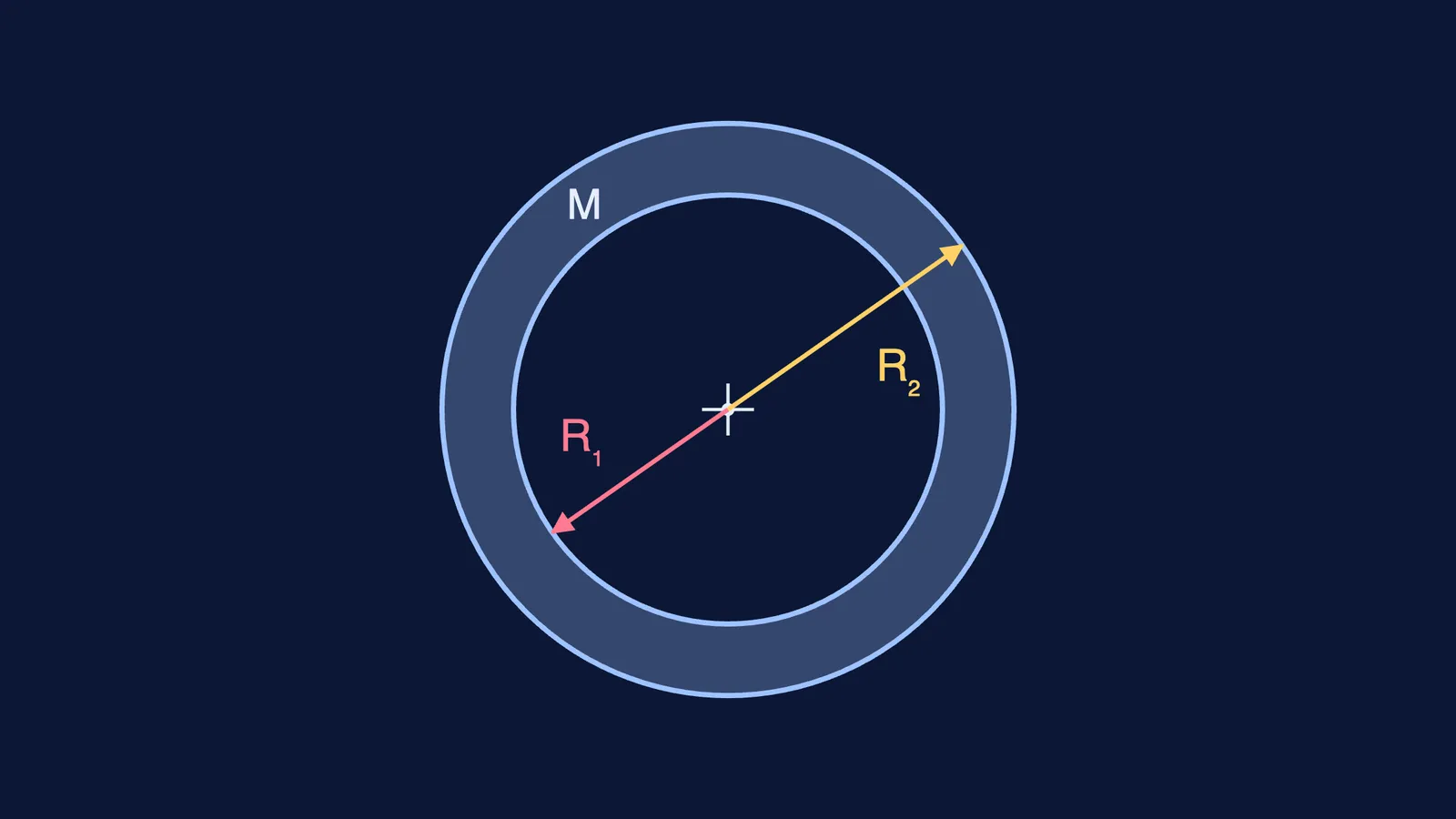
Q7 (hard). An annular disc has moment of inertia I = ½M(R₁² + R₂²) about its axis. The measurements are M = 400 ± 2 g, R₁ = 3.0 ± 0.1 cm and R₂ = 4.0 ± 0.1 cm. Find the maximum error in I, in g cm².
Answer: 305. I = ½ × 400 × (9 + 16) = 5000 g cm². For the sum, add absolute errors: Δ(R₁² + R₂²) = 2(3.0)(0.1) + 2(4.0)(0.1) = 1.4 cm², which is 1.4/25 = 5.6%. Mass adds 0.5%, so ΔI/I = 6.1% and ΔI = 305 g cm².
Trap: 608, from adding 2ΔR/R for each radius as if the radii were multiplied, not added.
Q8 (hard). The radius R of the fireball from a large explosion, at time t after detonation, depends only on the energy released E, the density of the surrounding air ρ and t. By what factor must E increase for R, at the same t and in the same air, to triple?
Answer: 243. Write R ∝ Eˣ ρʸ tᶻ. Matching M: x + y = 0. Matching L: 2x − 3y = 1. Matching T: −2x + z = 0. So x = 1/5, y = −1/5, z = 2/5, and R ∝ E^(1/5). Tripling R needs 3⁵ = 243 times the energy.
Trap: 27, from guessing R ∝ E^(1/3) because the fireball's volume grows with R³.
Want more problems like these, with each step explained? The Fermi Problem Library has worked problems with a step-by-step solver that explains the reasoning rather than printing an answer.
How do you get the number right?
Convert squared and cubed units with squared and cubed factors, as Q1 and Q4 show.
Round only at the end. Keep one extra digit in intermediate steps, as NCERT advises.
Use relative errors for products and powers, absolute errors for sums and differences. Q7 mixes both in one formula.
Solve the exponent equations fully. In Q3, Q5 and Q8 a dropped sign or factor gives a clean but wrong integer.
Check the size before you type. A steel modulus near 200 GPa is a quick sanity test.
When you are done, try the multiple-choice questions in our Units and Measurements JEE Main practice set with solutions.


