

On this page
When a person dies, the body stops making heat and starts to cool towards the temperature of its surroundings. Forensic investigators use that cooling as one of several clues to how long ago the death happened. The physics underneath is Newton's law of cooling, a standard topic in thermal physics. This post shows how to run the law backwards from two temperature readings to a time, how sensitive that answer is to its assumptions, and why real forensic estimates use refined models and are always given as ranges.
How can body temperature show how long ago someone died?
Newton's law of cooling says the rate of cooling is proportional to the temperature difference with the surroundings. Solved, it gives an exponential decay of that difference:
T − T_room = (T₀ − T_room) e^(−kt)
Here T₀ is the starting temperature and k is a cooling constant. The law itself, and its usual exam shortcut using average temperature, are covered in Newton's law of cooling: the exact law and the average shortcut. The new step here is to treat the start time as the unknown. If you know T₀, T_room, k and the present temperature, you can solve for t, the time since cooling began.
Why do you need two temperature readings?
Because k is not known in advance. It depends on body size, clothing, air movement, humidity and what the body is lying on. A single reading with a guessed k is just a guess. Two readings taken a known time apart let you measure k directly, since the unknown starting point cancels:
k = ln[(T₁ − T_room)/(T₂ − T_room)] ÷ (time between readings)
Worked example: estimating the time from two readings
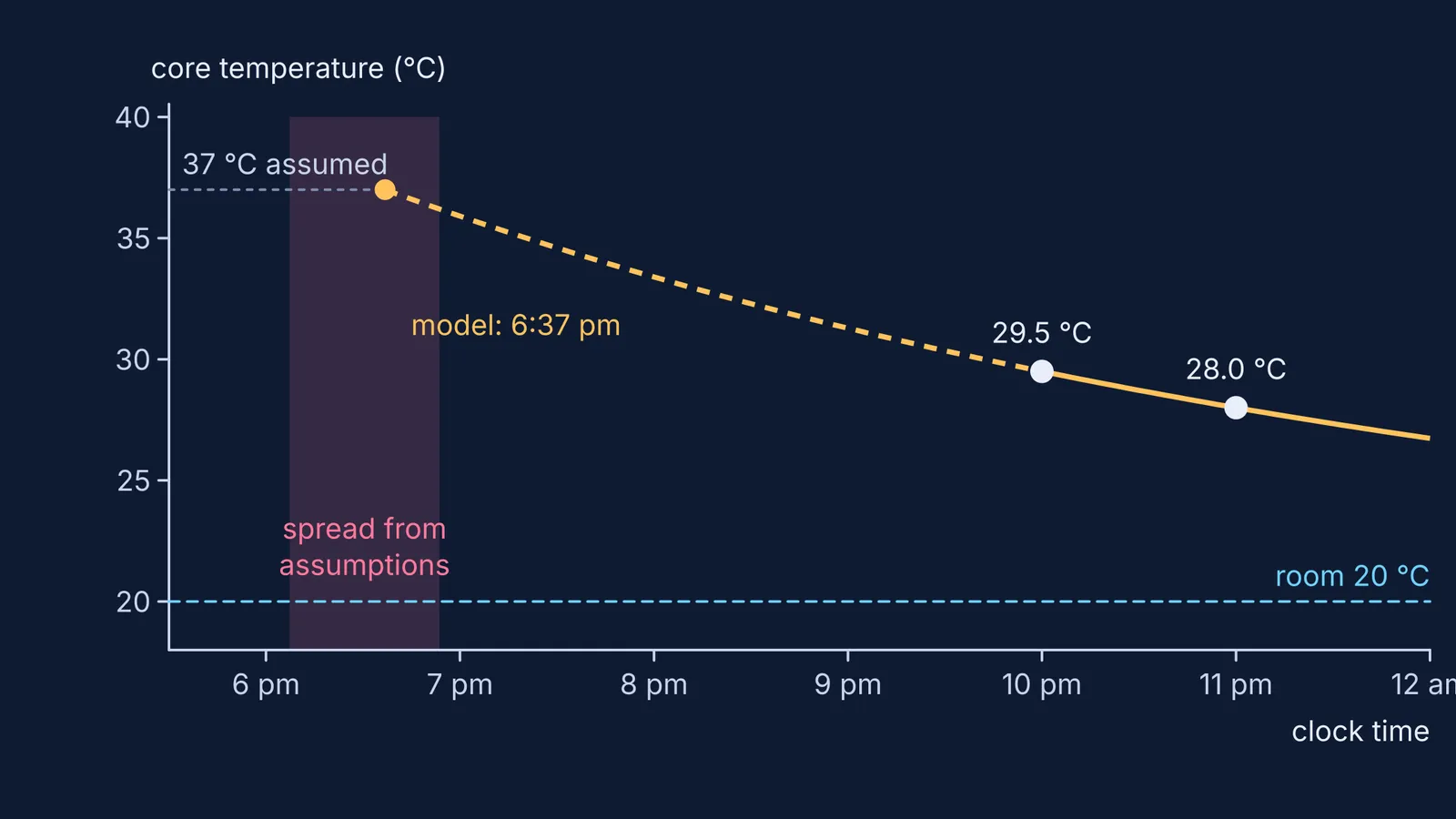
A body is found in a room at 20.0 °C. At 10:00 pm its core temperature is 29.5 °C. At 11:00 pm it is 28.0 °C. Assume a temperature of 37.0 °C at death (a round textbook value for normal core temperature).
Temperature differences from the room. At 10 pm: 29.5 − 20.0 = 9.5 °C. At 11 pm: 28.0 − 20.0 = 8.0 °C. At death: 37.0 − 20.0 = 17.0 °C.
Find k. k = ln(9.5/8.0) ÷ 1 h = 0.172 per hour.
Time from death to the first reading. 9.5 = 17.0 e^(−kt), so t = ln(17.0/9.5)/k = 0.582/0.172 = 3.39 h.
Convert to a clock time. 3.39 h is 3 h 23 min. Counting back from 10:00 pm gives about 6:37 pm.
Check. Run the law forward: 20 + 17 e^(−0.172 × 3.39) = 29.5 °C at 10 pm, and one hour later 28.0 °C. Units: k is per hour and t is in hours, so kt is dimensionless, as an exponent must be.
The check in the callout: with the wrong k = ln(29.5/28.0) = 0.052 per hour, t = 0.585/0.052 ≈ 11 h instead of 3.4 h.
How sensitive is the answer to the assumptions?
Very. Change one input at a time and keep the two readings the same:
Fever at death, 38.5 °C instead of 37.0 °C. k is unchanged, but t = ln(18.5/9.5)/0.172 = 3.88 h, so death moves to about 6:07 pm.
Room at 18 °C instead of 20 °C. k = ln(11.5/10.0) = 0.140 per hour, t = 3.59 h, about 6:24 pm.
Room at 22 °C instead of 20 °C. k = ln(7.5/6.0) = 0.223 per hour, t = 3.11 h, about 6:54 pm.
These illustrative changes alone spread the answer from 6:07 pm to 6:54 pm, about 46 minutes, before you even ask whether the model itself is right.
How do forensic scientists actually estimate time since death?
Not with the plain exponential. Three problems with it are well known.
The early plateau. For the first hours after death, the core temperature stays close to its starting value before it begins to fall, because heat has to travel from the core to the skin first. A single exponential has its fastest fall at t = 0, so it misses this. Since the real curve is flatter at the start, the simple model tends to make the time since death look shorter than it is.
Refined curves. Marshall and Hoare proposed a double-exponential curve with a correction term for the plateau. Henssge gave its parameters in terms of body weight and the surrounding temperature, and that approach has found wide use in forensic practice, as described in a 2018 review of uncertainty in temperature-based time of death estimation by Weiser and colleagues. The same paper notes that uncertainty in the starting core temperature matters most during the early plateau.
Wide error bars. A 2024 test of the Henssge method on 76 people with known times of death found that the actual time fell inside the method's 95% prediction interval in only 36.8% of cases (Heinrich and colleagues, International Journal of Legal Medicine).
So temperature gives a range, not a time, and investigators combine it with other evidence.
If you want to see the same law stepped forward in time instead of solved backwards, the spreadsheet model of Newton's law of cooling builds it one row at a time. For more cooling problems with a full method shown, the Fermi Problem Library has a step-by-step solver that explains the reasoning.
Quick checklist
Newton's law: T − T_room decays as e^(−kt).
Two readings a known time apart give k; one reading does not.
Always use differences from the room temperature in the logarithm.
Example: readings of 29.5 °C and 28.0 °C an hour apart in a 20 °C room, with 37 °C at death, give about 3.4 h before the first reading.
A fever or a 2 °C error in room temperature shifts the answer by up to about half an hour.
Real forensic methods correct for the early plateau and body weight, and still give wide ranges.


