

On this page
You can test Newton's law of cooling with a kitchen thermometer and a cup of chai, and predict it without calculus. A spreadsheet marches the temperature forward one small step at a time, and the gap between that answer and the exact one shows how computers solve physics.
What does Newton's law of cooling say?
Your NCERT Class 11 textbook states it plainly: the rate of cooling of a body is proportional to the excess temperature of the body over the surroundings (NCERT Physics Part II, Chapter 10). The chapter adds that the law holds only for small temperature differences, and gives a cup of tea on the table as a case where it works.
In symbols, dT/dt = −k(T − T_room). The exact solution is T = T_room + (T_start − T_room) × e^(−kt).
How big is k? Ulrich Kurzweg of the University of Florida timed coffee in a mug, black and with cream, and fitted both with k = 0.036 per minute (Kurzweg, Cooling of a cup of coffee). He notes that k depends on the cup, so use the same cup each time. We will borrow his value as a starting guess.
How do you build the model in a spreadsheet step by step?
The method is called Euler's method: new value = old value + step size × rate of change (MIT course notes on the forward Euler method). Here the rate is −k(T − T_room), so each row subtracts a small loss from the row above. In Google Sheets or Excel:
Put inputs in column E: step size Δt in E1 (5 minutes), k in E2 (0.036), room temperature in E3 (say 30 °C).
In A2 type 0; in B2 type the starting temperature, 90.
In A3 type `=A2+$E$1` to move the clock one step.
In B3 type `=B2-$E$2*(B2-$E$3)*$E$1`. This is one Euler step.
In C2 type `=$E$3+($B$2-$E$3)*EXP(-$E$2*A2)` for the exact answer, and in D2 type `=B2-C2` for the error.
Fill down to 60 minutes and chart columns B and C against A.
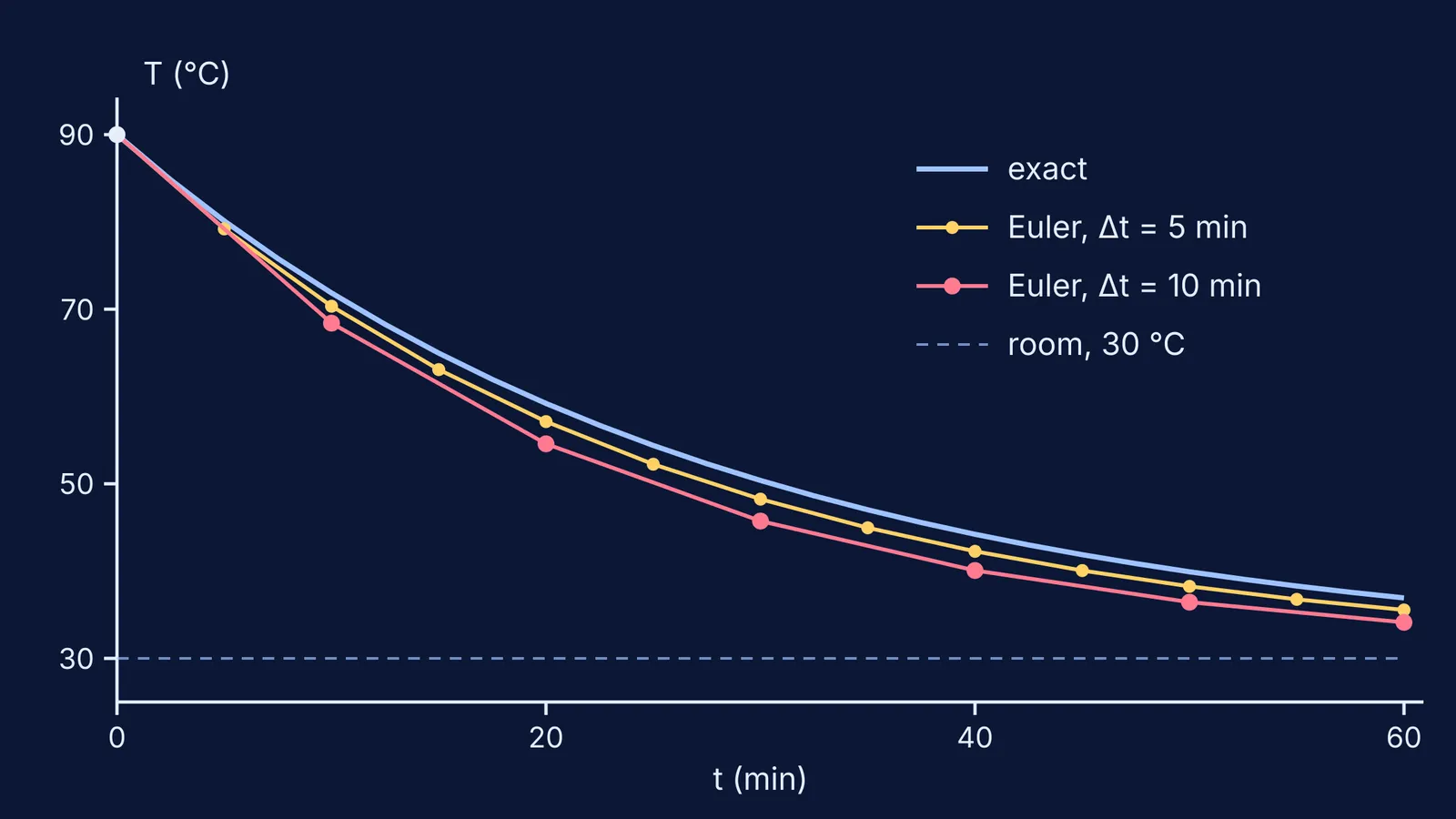
Worked first step: the tea starts 60 °C above the room, so it loses 0.036 × 60 × 5 = 10.8 °C, and B3 shows 79.2 °C. The exact formula gives 80.1 °C, so the model is already a little too cold.
How does step size change the accuracy?
Change E1 and watch column D. At 20 minutes, where the exact answer is 59.2 °C, our sheet gave:
Δt = 10 minutes: 54.6 °C, 4.6 °C too low
Δt = 5 minutes: 57.1 °C, 2.1 °C too low
Δt = 2 minutes: 58.4 °C, 0.8 °C too low
Δt = 1 minute: 58.8 °C, 0.4 °C too low
Halving the step roughly halves the error, because Euler's method is first order: its global error is proportional to the step size (MIT course notes).
Why always too low? Euler uses the cooling rate at the start of each step, when the tea is hottest, and pretends it lasts the whole step. The real cup slows down.
Push the step too far and the model breaks. The MIT notes show forward Euler for dy/dt = −ay is stable only when the step is below 2/a; for our tea (a = k) that is about 56 minutes. Nonsense starts sooner: with Δt = 30 minutes, the first step gives 90 − 0.036 × 60 × 30 = 25.2 °C, colder than the room.
How do you compare the model with a real cup of tea?
Our guide to planning a safe science experiment at home covers the basics; with hot liquids, keep younger children at a distance.
Use a kitchen probe thermometer, one mug and a spot away from the fan.
Type the room temperature into E3, pour the tea and read it every 2 minutes for 30 minutes.
Type times into column G and readings into column H, from row 2.
In I2 type `=LN(H2-$E$3)` and fill down. NCERT shows that the log of (T − T_room) against time is a straight line (NCERT Chapter 10).
In E2 type `=-SLOPE(I2:I17,G2:G17)`. That is your cup's own k.
Add column H to the chart and compare.
If the hottest readings sit off the line, remember that the law works best for small temperature differences. Then change one thing at a time, such as a steel tumbler instead of a ceramic mug (see why metal feels colder than wood), and fit a new k.
Where does this kind of model fit in your studies?
Many computer simulations step equations forward like this; learn the limits of physics simulations too. For ideas that are easier to see than to read, the Fermi Simulation Lab has interactive simulations. For numericals like NCERT's cooling-pan example, the Fermi Problem Library has worked problems with a step-by-step solver that explains the reasoning.
Start with k = 0.036, write down your guess, and let your own cup of tea correct it.


