

On this page
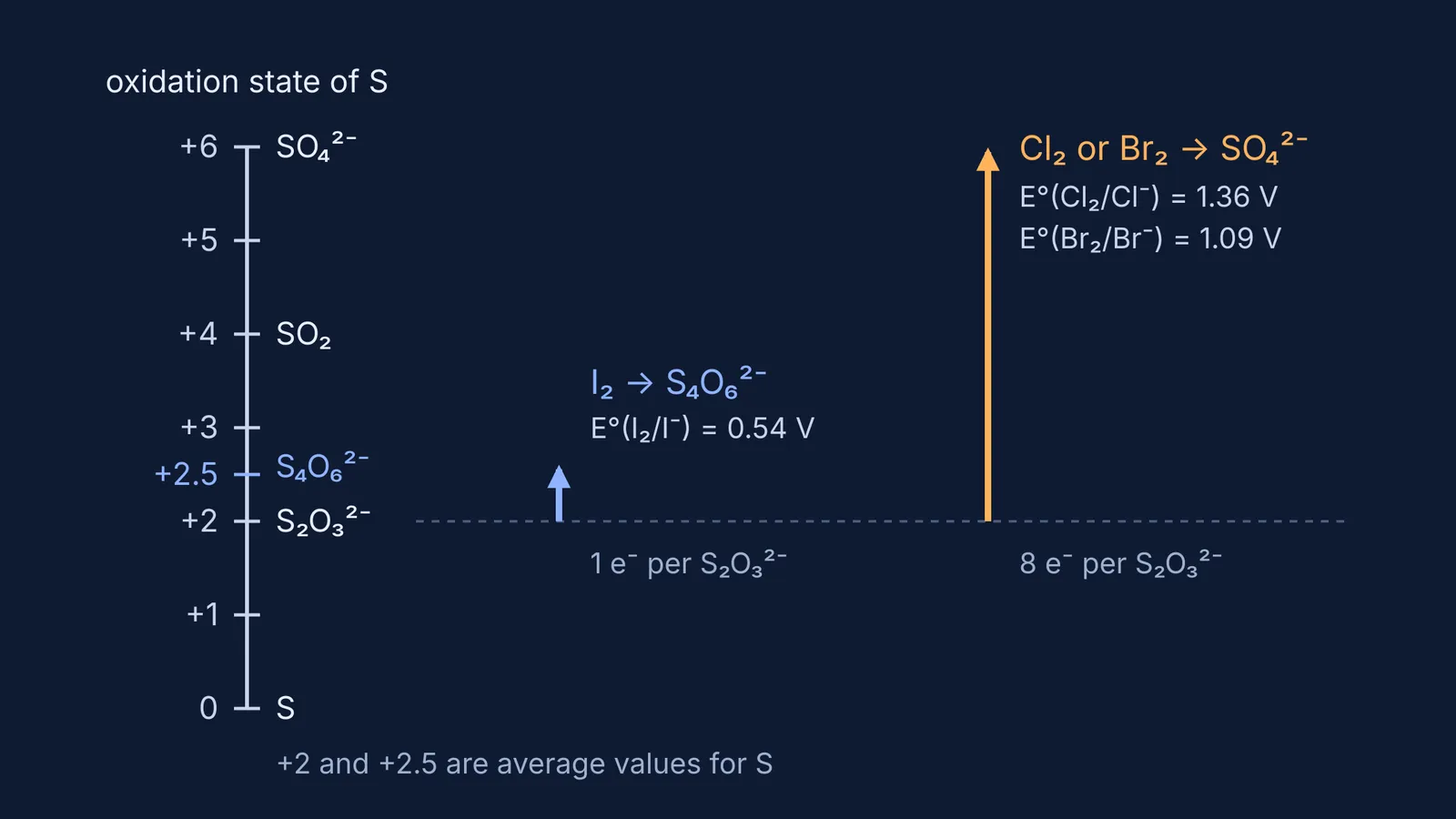
Sodium thiosulphate reacts with iodine and with chlorine, but the products are different. Iodine turns it into tetrathionate, S₄O₆²⁻. Chlorine, and bromine too, take it all the way to sulphate, SO₄²⁻. NCERT's redox chapter uses this pair to show that the same reducing agent can give different products with different oxidising agents. Knowing why matters for iodometric titrations, for n-factor questions, and for one everyday use of hypo: removing leftover chlorine after bleaching.
What happens when thiosulphate reacts with iodine?
The reaction is:
2S₂O₃²⁻ + I₂ → S₄O₆²⁻ + 2I⁻
Two thiosulphate ions join through a new S–S bond, and each gives up one electron. The average oxidation state of sulphur goes from +2 to +2.5. How to balance this equation step by step is covered in balancing the thiosulphate–iodine tetrathionate reaction, so it is not repeated here.
Note the word average. In tetrathionate the four sulphur atoms are not alike. The two end sulphurs are each bonded to three oxygens, and the two middle sulphurs are bonded only to sulphur. Giving the end ones +5 and the middle ones 0 gives (5 + 0 + 0 + 5)/4 = +2.5. This is worked out in oxidation numbers from structure for Fe₃O₄, S₄O₆²⁻ and CrO₅.
What happens when thiosulphate reacts with chlorine or bromine?
With chlorine water, sulphur goes all the way to +6:
S₂O₃²⁻ + 4Cl₂ + 5H₂O → 2SO₄²⁻ + 8Cl⁻ + 10H⁺
NCERT's own example uses bromine, which behaves the same way:
S₂O₃²⁻ + 4Br₂ + 5H₂O → 2SO₄²⁻ + 8Br⁻ + 10H⁺
Check the chlorine equation. Sulphur: 2 on each side. Oxygen: 3 + 5 = 8 on the left, 2 × 4 = 8 on the right. Hydrogen: 10 and 10. Chlorine: 8 and 8. Charge: −2 on the left, −4 − 8 + 10 = −2 on the right. Electrons: two sulphurs each rise by 4, so 8 electrons are lost; four Cl₂ each take 2, so 8 are gained. Everything balances.
So one thiosulphate ion gives 1 electron to iodine but 8 electrons to chlorine. That eightfold difference is the whole story for calculations.
Why does iodine stop at tetrathionate but chlorine goes to sulphate?
The textbook answer is that iodine is a weaker oxidising agent than chlorine or bromine. The standard reduction potentials show the order:
Cl₂/Cl⁻: about +1.36 V
Br₂/Br⁻: about +1.09 V
I₂/I⁻: about +0.54 V
That order is right, but potentials alone are not the full reason. Working from standard Gibbs energies of formation, oxidising thiosulphate to sulphate has a potential of only about +0.3 V. Iodine at +0.54 V is strong enough on paper to do it too. What stops it is speed. Iodine reacts with thiosulphate very fast by joining two of them through an S–S bond, and that route ends at tetrathionate. Going on to sulphate means breaking S–S bonds and adding oxygen, which iodine in neutral or weakly acidic solution does far too slowly to matter. Chlorine and bromine are strong enough to push through that path quickly.
You can see the kinetic side in one more fact. In alkaline solution, iodine forms hypoiodite, IO⁻, which is a much faster oxidant, and then some thiosulphate does go to sulphate:
S₂O₃²⁻ + 4IO⁻ + 2OH⁻ → 2SO₄²⁻ + 4I⁻ + H₂O
Why does iodometry use iodine and never chlorine?
A titration needs one fixed equation. With iodine near neutral pH, every thiosulphate gives exactly one electron, so 2 mol S₂O₃²⁻ always match 1 mol I₂. That clean 2 : 1 ratio is why iodometry works, and why the method is described in iodometric vs iodimetric titration, with worked calculations.
The pH has to be controlled on both sides:
Not alkaline, or hypoiodite turns part of the thiosulphate into sulphate and the ratio drifts.
Not strongly acidic, or thiosulphate decomposes on its own: S₂O₃²⁻ + 2H⁺ → S + SO₂ + H₂O. The milky sulphur is a sign this has happened.
Chlorine is never the titrated species because it goes all the way to sulphate and is hard to handle as a standard solution. When you need to measure chlorine, you let it oxidise excess iodide to iodine first, then titrate that iodine with thiosulphate.
What is an antichlor?
After cotton, paper pulp or other materials are bleached with chlorine, some chlorine stays behind and would keep attacking the fibres. Sodium thiosulphate is added to destroy it. Used this way it is called an antichlor. Because each thiosulphate takes up 8 electrons, a small amount removes a lot of chlorine, and the products, sulphate and chloride, are harmless salts.
How much I₂ or Cl₂ does a given amount of thiosulphate remove?
Here is a worked example. You have 10.0 mL of 0.100 M Na₂S₂O₃.
Moles of thiosulphate. 10.0 mL × 0.100 mol/L = 1.00 mmol.
With iodine. The ratio is 2 S₂O₃²⁻ : 1 I₂. Iodine removed = 1.00/2 = 0.500 mmol.
With chlorine. The ratio is 1 S₂O₃²⁻ : 4 Cl₂. Chlorine removed = 1.00 × 4 = 4.00 mmol, which is 4.00 × 70.9 = 284 mg of Cl₂.
With bromine. Same ratio as chlorine: 4.00 mmol Br₂.
Check with n-factors. Thiosulphate has n-factor 1 in the iodine reaction and 8 in the chlorine reaction. I₂ and Cl₂ each have n-factor 2. Equivalents: 1.00 × 1 = 0.500 × 2, and 1.00 × 8 = 4.00 × 2. Both match.
The same 1.00 mmol of thiosulphate removes eight times as many moles of chlorine as of iodine.
A follow-up: how much Na₂S₂O₃·5H₂O (molar mass 248.2 g/mol) removes 0.71 g of Cl₂? Moles of Cl₂ = 0.71/70.9 = 0.0100 mol. Thiosulphate needed = 0.0100/4 = 0.00250 mol, which is 0.00250 × 248.2 = 0.62 g.
If you want more practice working out n-factors from the products, the Fermi Problem Library has a step-by-step solver that explains the reasoning.
Quick checklist
2S₂O₃²⁻ + I₂ → S₄O₆²⁻ + 2I⁻: S goes from +2 to an average of +2.5.
S₂O₃²⁻ + 4Cl₂ + 5H₂O → 2SO₄²⁻ + 8Cl⁻ + 10H⁺: S goes from +2 to +6. Bromine gives the same.
n-factor of thiosulphate: 1 with I₂, 8 with Cl₂ or Br₂.
I₂ is the weaker oxidant, but the stop at tetrathionate is mainly about speed.
Iodometry needs near-neutral pH: alkali gives sulphate, strong acid gives S and SO₂.
Hypo as antichlor removes leftover chlorine after bleaching.


