

On this page
Eight original questions in two NEET-UG formats many students find slow, each with reasons and a trap. New to the chapter? Read how to prepare Thermodynamics for NEET.
What do these questions cover?
The NMC syllabus for NEET (UG)-2026 lists Thermodynamics as Physics Unit 8. Every fact matches Chapter 11 of NCERT Class 11 Physics Part II (Reprint 2026-27). We use ΔQ = ΔU + ΔW (W by the gas), R = 8.3 J mol⁻¹ K⁻¹.
Key for Q1 and Q3: (1) Both statements correct (2) Both incorrect (3) I correct, II incorrect (4) I incorrect, II correct.
Statement questions: which ones are true?
Q1 (easy, statements). Statement I: Pressure and temperature are intensive. Statement II: Density is extensive, since it halves when a system is split in two.
Answer: (3). I is true: P and T stay the same in each half. II is false: mass and volume both halve, so density is intensive.
Trap: (1) forgets that volume halves too.
Q2 (easy, statements). For an ideal gas, which are correct?
A. Internal energy is a state variable. B. In an isobaric expansion of μ moles, W = μR(T₂ − T₁). C. In an adiabatic compression, the work done by the gas is positive. D. Work done between two given states is path-independent. E. A quasi-static process passes through equilibrium states only.
(1) A, B and E only (2) A, C and E only (3) B, D and E only (4) A, B, D and E only
Answer: (1). A: U depends only on the state, not the path. B: W = PΔV = μRΔT. C: V shrinks, so ΔW < 0. D: work depends on the path. E is NCERT's definition.
Trap: (4) treats work like a state variable.
Q3 (medium, statements). 3 mol of ideal diatomic gas (Cp = 7R/2) is heated at constant pressure by 40 K. Statement I: It absorbs about 2.49 kJ. Statement II: It does about 1.0 kJ of work.
Answer: (4). ΔQ = nCpΔT = 3 × 3.5 × 8.3 × 40 ≈ 3.49 kJ (I false). W = nRΔT = 3 × 8.3 × 40 ≈ 1.0 kJ (II true).
Trap: (1). 2.49 kJ is ΔU = nCvΔT.
Q4 (hard, statements). Which are correct?
A. Heat drawn from one reservoir cannot all become work with no other change anywhere. B. By Clausius, heat can never pass from a colder to a hotter body, even with work done. C. A Carnot engine between 400 K and 300 K has an efficiency of 25%. D. A Carnot engine's efficiency depends on the working substance. E. Free expansion of a gas is irreversible.
(1) A, B and C only (2) A, C and E only (3) C, D and E only (4) A, B, C and E only
Answer: (2). A is Kelvin-Planck. B: Clausius forbids it only as the sole result; a refrigerator does it with work. C: η = 1 − 300/400 = 0.25. D: it is independent of the substance. E is NCERT's own example.
Trap: (4) drops "sole result".
Match-the-list questions: can you pair them in one pass?
Q5 (easy, match). List-I: (A) Molar specific heat capacity (B) Specific heat capacity (C) Work done by a gas, PΔV (D) γ = Cp/Cv. List-II: (I) J kg⁻¹ K⁻¹ (II) no unit (III) J mol⁻¹ K⁻¹ (IV) J.
(1) A-I, B-III, C-IV, D-II (2) A-III, B-I, C-II, D-IV (3) A-IV, B-I, C-III, D-II (4) A-III, B-I, C-IV, D-II
Answer: (4). A is per mole per kelvin, B per kilogram per kelvin; Pa × m³ = J; γ is a ratio.
Trap: (1) swaps "molar" and "specific".
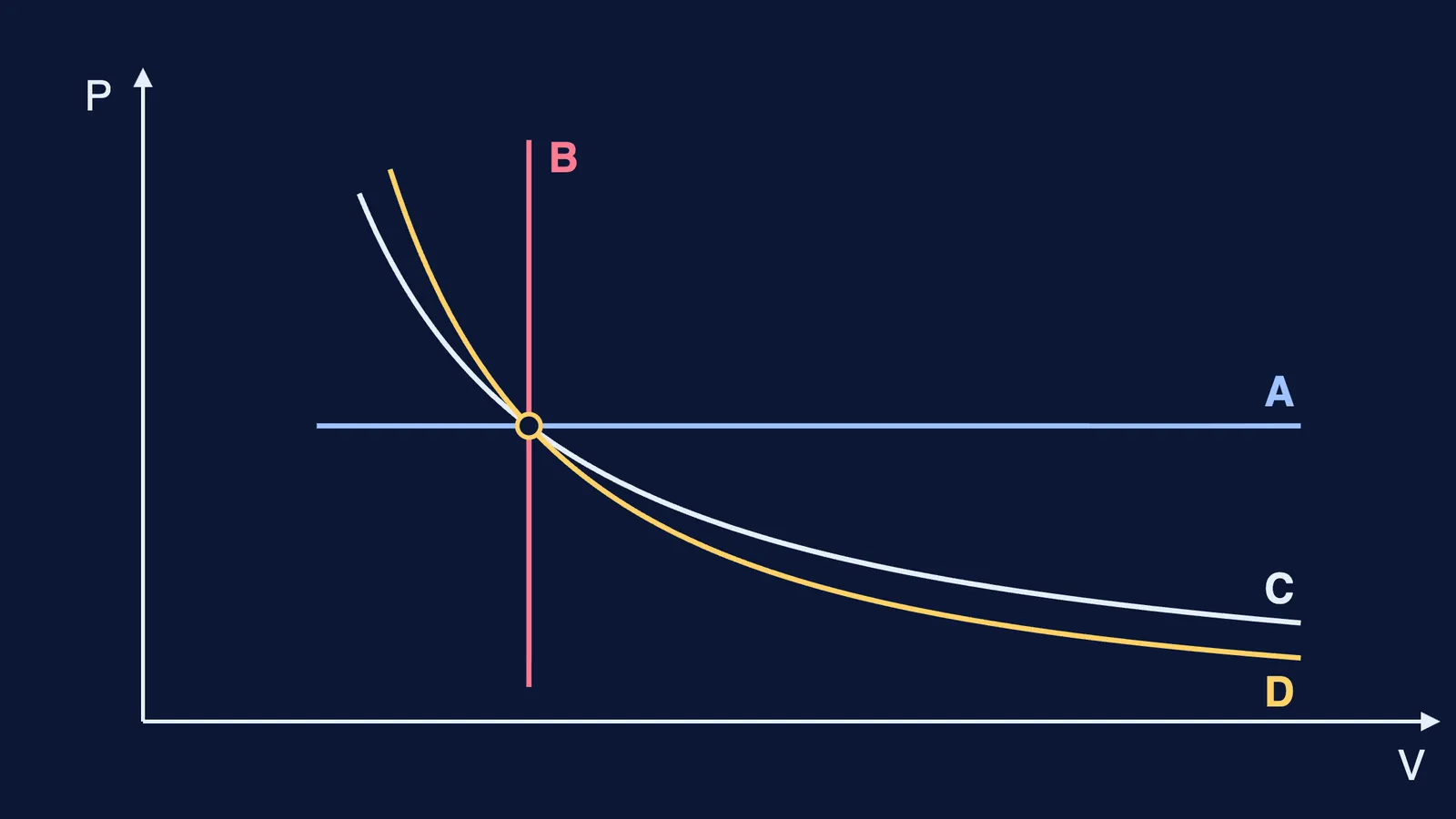
Q6 (medium, match). Match each ideal-gas process to its P-V graph (diagram above). List-I: (A) Isobaric (B) Isochoric (C) Isothermal (D) Adiabatic. List-II: (I) Rectangular hyperbola, PV = constant (II) Horizontal line (III) PV^γ = constant, steeper than the isotherm (IV) Vertical line.
(1) A-II, B-IV, C-I, D-III (2) A-IV, B-II, C-I, D-III (3) A-II, B-IV, C-III, D-I (4) A-IV, B-II, C-III, D-I
Answer: (1). Fixed P is horizontal, fixed V vertical. C: PV = μRT with T fixed. D: slope −γP/V beats the isotherm's −P/V since γ > 1.
Trap: (2) swaps the axes.
Q7 (medium, match). List-I: (A) X and Y, each in equilibrium with Z, are in equilibrium together (B) A gas absorbs 500 J, does 200 J of work, gains 300 J of internal energy (C) A refrigerator moves heat from its cold inside to the warm room only with work input (D) No cyclic engine turns all heat from one reservoir into work. List-II: (I) Kelvin-Planck statement (II) Zeroth law (III) Clausius statement (IV) First law.
(1) A-II, B-IV, C-I, D-III (2) A-IV, B-II, C-III, D-I (3) A-II, B-IV, C-III, D-I (4) A-II, B-I, C-III, D-IV
Answer: (3). A: zeroth law. B: ΔU = 500 − 200 = 300 J. C: cold-to-hot heat flow (Clausius). D: complete conversion to work (Kelvin-Planck).
Trap: (1) swaps the two second-law statements.
Q8 (hard, match). Four moles of monatomic ideal gas (γ = 5/3): match process to work done by the gas. List-I: (A) Heated at constant volume by 35 K (B) Heated at constant pressure by 35 K (C) Adiabatic expansion, cooling by 35 K (D) Isothermal doubling of volume at 300 K (ln 2 = 0.693). List-II: (I) about 6.90 kJ (II) 1743 J (III) zero (IV) 1162 J.
(1) A-II, B-IV, C-III, D-I (2) A-III, B-IV, C-II, D-I (3) A-III, B-II, C-IV, D-I (4) A-III, B-I, C-II, D-IV
Answer: (2). A: W = 0. B: W = nRΔT = 4 × 8.3 × 35 = 1162 J. C: W = nR(T₁ − T₂)/(γ − 1) = 1162/(2/3) = 1743 J. D: W = nRT ln 2 = 4 × 8.3 × 300 × 0.693 ≈ 6.90 kJ.
Trap: (1). 1743 J is A's heat, not its work.
How do you work these faster?
Judge the easiest statement first; strike options that contradict it.
In a match, fix your surest pair (a line, a zero) and cancel options.
Write which of Q, W and ΔU is zero first; check Cp or Cv, γ and kelvin.
Next, read how to solve NEET match-the-list questions or try the Thermodynamics NEET practice set.
Still unsure why an adiabat is steeper? The Fermi Simulation Lab has interactive simulations for the ideas that are easier to see than to read.


