

On this page
Statement-based and match-the-list questions appear in recent JEE Main papers; here are eight original ones.
Which Thermodynamics topics do these questions test?
NTA's Syllabus for JEE (Main) - 2027, Physics Unit 8, covers the zeroth, first and second laws, heat, work, internal energy, and isothermal and adiabatic processes. NCERT Class 11 Physics Part II Chapter 11 (Reprint 2026-27) writes ΔQ = ΔU + ΔW, ΔW done by the system. R = 8.3 J mol⁻¹ K⁻¹. For theory, read how to prepare Thermodynamics for JEE Main.
Statement I/II options: (1) both correct (2) both incorrect (3) I correct, II incorrect (4) I incorrect, II correct.
Statement questions
Q1 (easy, Statement I/II). A paddle does 500 J of work on a gas in a rigid box; 200 J of heat leaks out. Statement I: The gas's internal energy rises by 300 J. Statement II: In ΔQ = ΔU + ΔW, ΔW = +500 J here.
Answer: (3). I true: ΔU = ΔQ − ΔW = −200 − (−500) = +300 J. II false: work is done on the gas, so ΔW = −500 J.
Trap: (4), a sign slip on ΔW.
Q2 (easy, statements). Which are correct? A. Two bodies each in thermal equilibrium with a third share its temperature. B. The hotter of two bodies always has more internal energy. C. Free expansion of a gas into vacuum is irreversible. D. A gas can be warmed with no heat given. E. Heating 2 mol of ideal gas by 10 K takes 166 J less heat at constant pressure than at constant volume.
(1) A, C and D only (2) A, B and C only (3) A, C, D and E only (4) B, C and E only
Answer: (1). A: zeroth law. B false: it scales with amount. C true (NCERT 11.11). D true: adiabatic compression. E false: Cp − Cv = R, so constant pressure takes 2×8.3×10 = 166 J more.
Trap: (3), flipping E.
Q3 (medium, Statement I/II). A Carnot engine is 25% efficient. Statement I: If lowering the sink by 60 K gives 40%, the source is at 400 K. Statement II: Raising the source by 60 K instead would also give 40%.
Answer: (3). I true: T₂ = 0.75T₁ and T₂ − 60 = 0.60T₁, so T₁ = 400 K. II false: 1 − 300/460 ≈ 34.8%.
Trap: (1), assuming 60 K helps equally at either end.
Q4 (hard, statements). One mole of monatomic ideal gas at 400 K expands slowly along PV² = constant to double its volume. Which are correct? A. Final temperature is 200 K. B. The gas does 1660 J of work. C. ΔU = −2490 J. D. It absorbs 830 J of heat. E. Final pressure is half the initial.
(1) A, B and C only (2) A, B, C and D only (3) A, C and E only (4) B, C, D and E only
Answer: (1). A true: T ∝ PV ∝ 1/V. B true: W = R(T₁ − T₂)/(2 − 1) = 8.3×200 = 1660 J. C true: 1.5×8.3×(−200). D false: ΔQ = −2490 + 1660 = −830 J, given out. E false: P ∝ 1/V², a quarter.
Trap: (2), reading −830 J as heat absorbed.
Match-the-list questions
Q5 (easy, match). Match ideal-gas processes with signs (W by the gas). List-I: (A) Isothermal compression (B) Isochoric cooling (C) Adiabatic compression (D) Isobaric expansion. List-II: (I) Q<0, W=0, ΔU<0 (II) Q=0, W<0, ΔU>0 (III) Q<0, W<0, ΔU=0 (IV) Q>0, W>0, ΔU>0
(1) A-II, B-I, C-III, D-IV (2) A-III, B-IV, C-II, D-I (3) A-III, B-I, C-II, D-IV (4) A-I, B-III, C-II, D-IV
Answer: (3). A: ΔU = 0, Q = W < 0, III. B: W = 0, I. C: ΔU = −W > 0, II. D: all rise, IV.
Trap: (1), swapping the compressions.
Q6 (medium, match). Monatomic ideal gas (γ = 5/3) at 300 K; match final temperatures. List-I: (A) Isothermal, volume doubled (B) Adiabatic, volume ×8 (C) Isobaric, volume doubled (D) Along P ∝ V, volume doubled. List-II: (I) 75 K (II) 300 K (III) 600 K (IV) 1200 K
(1) A-II, B-I, C-IV, D-III (2) A-II, B-I, C-III, D-IV (3) A-I, B-II, C-III, D-IV (4) A-II, B-III, C-I, D-IV
Answer: (2). A: II. B: TV^(γ−1) constant, 300/8^(2/3) = 75 K, I. C: V ∝ T, so 600 K, III. D: T ∝ PV ∝ V², so 1200 K, IV.
Trap: (1), swapping the isobaric and P ∝ V results.
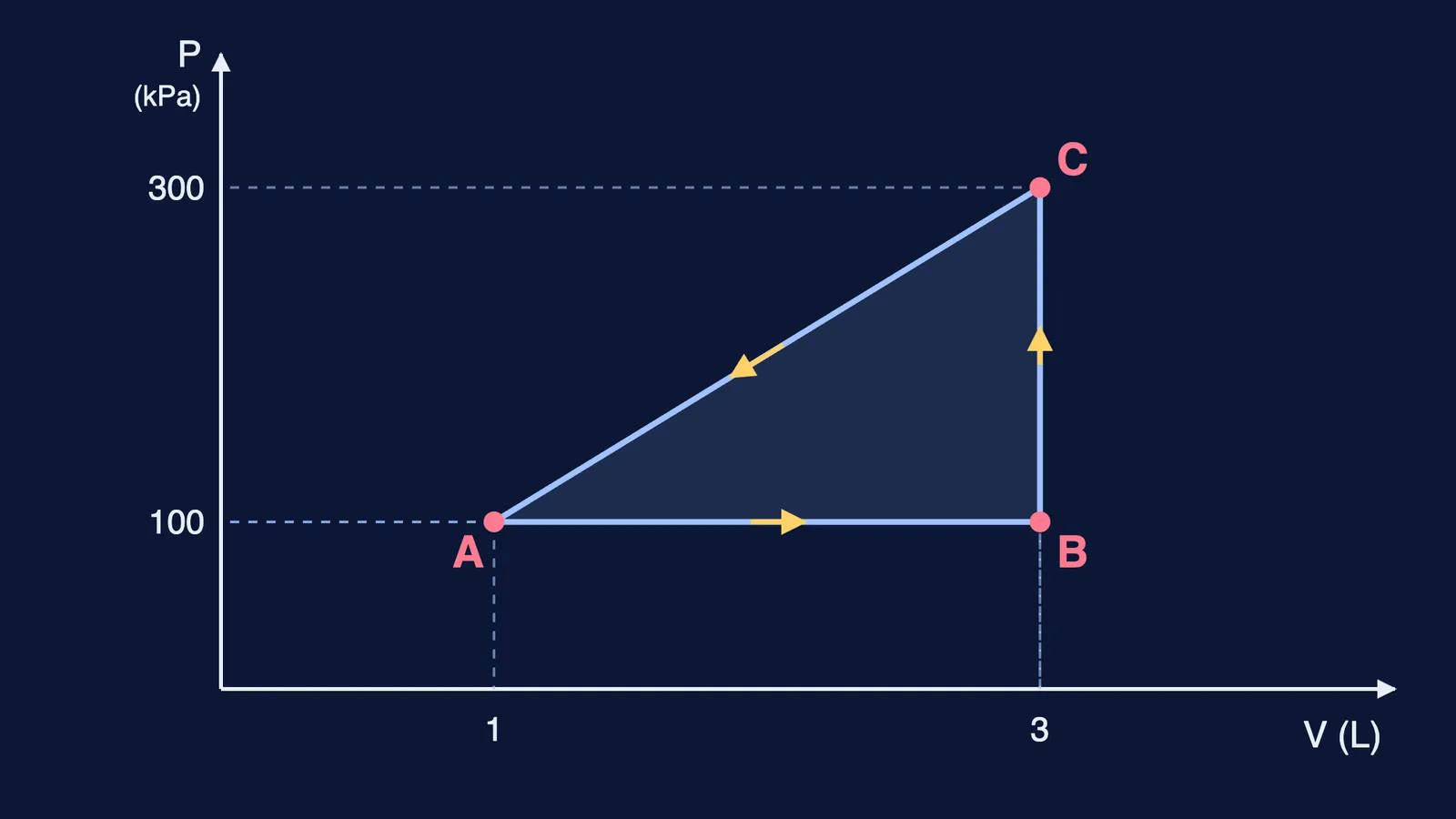
Q7 (medium, match). A monatomic ideal gas runs the cycle in the diagram: A (100 kPa, 1 L) to B (100 kPa, 3 L), up to C (300 kPa, 3 L), then straight back to A. List-I: (A) Heat absorbed, A→B (B) Heat absorbed, B→C (C) Work by the gas, C→A (D) Net work per cycle. List-II: (I) −400 J (II) +500 J (III) −200 J (IV) +900 J
(1) A-IV, B-II, C-I, D-III (2) A-II, B-IV, C-I, D-III (3) A-II, B-IV, C-III, D-I (4) A-IV, B-II, C-III, D-I
Answer: (2). kPa×L = J. A: (5/2)PΔV = 2.5×100×2 = 500 J, II. B: (3/2)VΔP = 1.5×3×200 = 900 J, IV. C: −½(300 + 100)×2 = −400 J, I. D: +200 − 400 = −200 J, anticlockwise, III.
Trap: (3), swapping leg work and net work.
Q8 (hard, match). Match each monatomic ideal-gas process (Cv = 3R/2) with its molar heat capacity. List-I: (A) V ∝ T (B) PV³ = constant (C) P ∝ V² (D) P²V = constant. List-II: (I) R (II) 11R/6 (III) 5R/2 (IV) 7R/2
(1) A-IV, B-I, C-II, D-III (2) A-III, B-II, C-I, D-IV (3) A-III, B-IV, C-II, D-I (4) A-III, B-I, C-II, D-IV
Answer: (4). For PVⁿ = constant, P dV = R dT/(1 − n), so C = Cv + R/(1 − n). A: isobaric, 5R/2, III. B: n = 3, R, I. C: n = −2, 11R/6, II. D: n = 1/2, 7R/2, IV.
Trap: (2), swapping the n = 3 and n = −2 values.
How do you work these faster?
Write the signs of Q, W and ΔU first; W is done by the gas.
Read temperatures off P–V diagrams: T ∝ PV.
Write each process as PVⁿ = constant; n fixes T, W and C.
Fix your surest pair; strike codes without it.
Lost marks to a sign? The Fermi Problem Library has worked problems with a step-by-step solver that explains the reasoning rather than printing an answer.
Next, read how to solve match-the-list questions or try the Thermodynamics JEE Main practice questions with solutions.


