

On this page
Most functional group tests in the chemistry practical work directly. You add a reagent and a colour or a gas appears. The nitro group (–NO₂) does not cooperate. It does not react with Tollens' reagent, Fehling's solution, sodium bicarbonate or neutral FeCl₃, so a nitro compound passes through the usual scheme with nothing to show except a positive Lassaigne test for nitrogen. The way round this is to reduce the nitro group first, into something that does react, and then test again. This post gives the two common reduction routes, the reasoning behind each, and a worked example with three isomers of C₇H₇NO₂.
Is the nitro group test on the JEE Advanced syllabus?
Yes. The practical organic chemistry part of the JEE Advanced syllabus lists nitro alongside hydroxyl, carbonyl, carboxyl and amino groups for detection. Check the current year's information brochure for the exact wording. The standard tests for the other groups are collected in tests for organic functional groups in the chemistry practical, which mentions nitro but gives no test for it.
How does the Zn/NH₄Cl and Tollens' test detect a nitro group?
This route is often called the Mulliken–Barker test. Lab manuals do not all use that name, so learn it by its reagents.
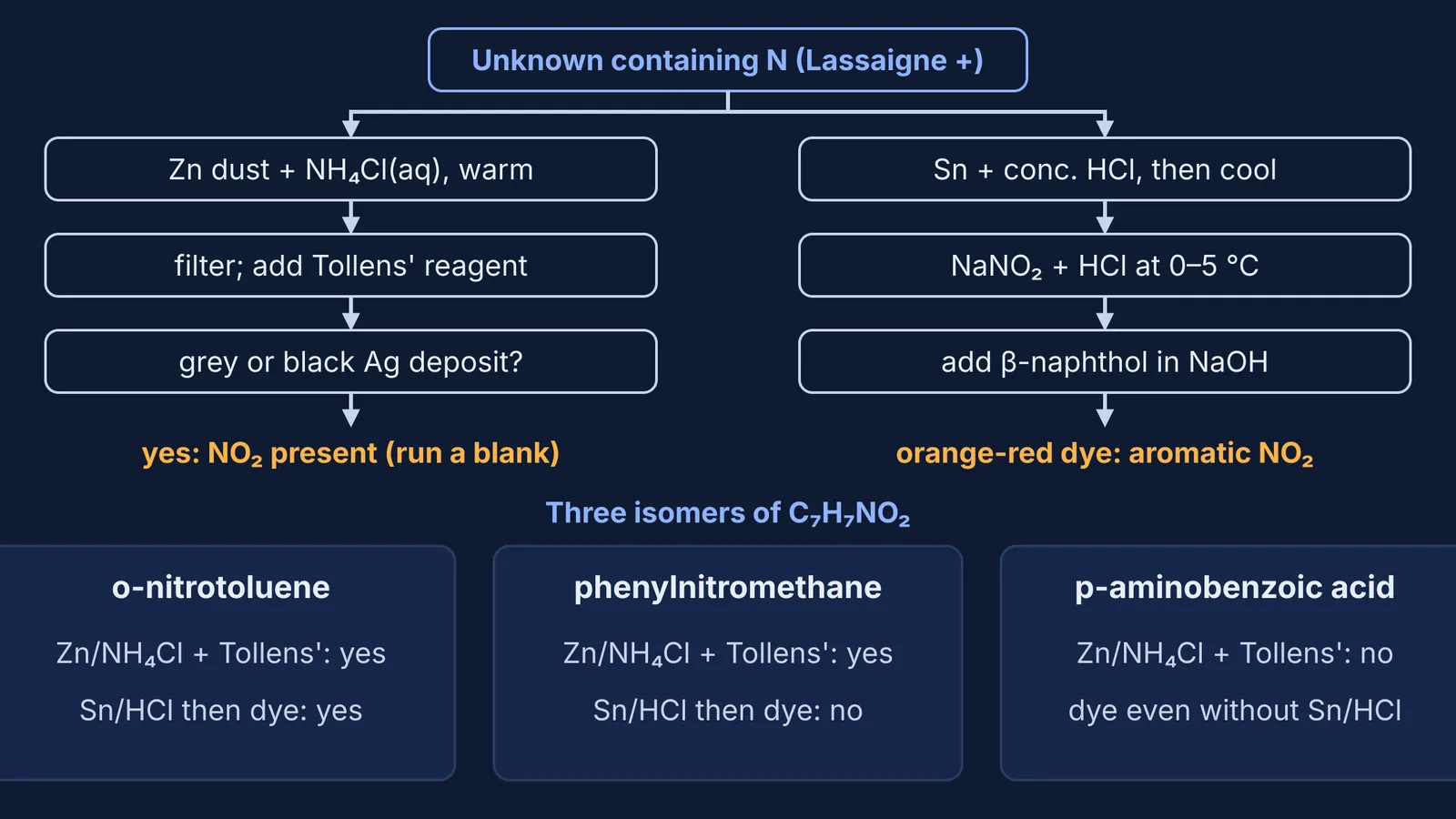
Reduce. Warm the compound with zinc dust and aqueous ammonium chloride for a few minutes. This is a neutral medium, so reduction stops at the hydroxylamine stage: R–NO₂ goes to R–NHOH. For nitrobenzene, with NH₄⁺ as the proton source:
C₆H₅NO₂ + 2Zn + 4NH₄⁺ → C₆H₅NHOH + 2Zn²⁺ + 4NH₃ + H₂O
Each Zn gives 2 electrons, and N goes from +3 to −1, a gain of 4 electrons, so 2 Zn are needed. Atoms and charge both balance (4+ on each side).
Filter off the zinc and keep the filtrate.
Test the filtrate with Tollens' reagent and warm gently. A hydroxylamine is a reducing agent. It is oxidised to the nitroso compound and reduces Ag⁺ to silver:
C₆H₅NHOH + 2[Ag(NH₃)₂]⁺ + 2OH⁻ → C₆H₅NO + 2Ag + 4NH₃ + 2H₂O
A grey or black deposit of silver, sometimes a mirror, means a nitro group was present.
The reduction chemistry behind step 1, and what happens in other media, is covered in reduction of nitrobenzene in neutral and alkaline media. Here it is only the first half of a test.
Why is a blank test essential?
Tollens' reagent does not care where the reducing power comes from. Aldehydes, formic acid, reducing sugars and some phenols and amines give silver on their own. So always test a portion of the original compound with Tollens' reagent before reduction. The nitro test counts as positive only if the original sample is negative and the reduced sample is positive. If the sample already reduces Tollens', this test cannot detect a nitro group in it, and you need the second route.
Do tertiary nitroalkanes give the test?
Yes. (CH₃)₃C–NO₂ still reduces to (CH₃)₃C–NHOH, so it is Mulliken-positive like primary and secondary nitroalkanes. What changes is everything that depends on an α-hydrogen. A tertiary nitroalkane has no H on the carbon carrying NO₂, so it cannot form the nitronate anion and does not dissolve in NaOH, while primary and secondary nitroalkanes do.
How does Sn/HCl and the azo dye test confirm an aromatic nitro group?
The second route turns an aromatic nitro group into an aromatic primary amine, then uses the dye test for that amine.
Reduce with tin and concentrated HCl. Warm, then cool and decant from any tin left over. The product is the anilinium salt:
ArNO₂ + 3Sn + 7HCl → ArNH₃⁺Cl⁻ + 3SnCl₂ + 2H₂O
Here N goes from +3 to −3, a gain of 6 electrons, supplied by 3 Sn going to Sn²⁺.
Diazotise the cold solution with NaNO₂ and HCl at 0 to 5 °C: ArNH₂ + NaNO₂ + 2HCl → ArN₂⁺Cl⁻ + NaCl + 2H₂O.
Couple with β-naphthol dissolved in NaOH. An orange-red precipitate is the azo dye.
Steps 2 and 3 are the ordinary amine test. The colour, the temperature and why it must stay cold are explained in the azo dye test for aromatic primary amines.
This route works only for aromatic nitro compounds. An aliphatic nitro compound reduces to an aliphatic amine. Its diazonium salt is not stabilised by a ring, so it loses N₂ at once, and no dye forms. Bubbles of nitrogen and no colour are the sign of an aliphatic primary amine. Here too, run a blank: if the original compound gives the dye without reduction, it was already an aromatic amine.
Worked example: which C₇H₇NO₂ isomer is it?
Problem. Three bottles contain isomers of C₇H₇NO₂: o-nitrotoluene, phenylnitromethane (C₆H₅CH₂NO₂) and p-aminobenzoic acid. All three give a positive Lassaigne test for nitrogen. Use the tests above to tell them apart.
Sodium bicarbonate first. p-Aminobenzoic acid has a COOH group, so it gives brisk effervescence of CO₂ with NaHCO₃. The two nitro compounds do not. Phenylnitromethane is a weak C–H acid and dissolves in NaOH, but it does not liberate CO₂ from bicarbonate.
Blank Tollens' on all three. None should reduce Tollens' reagent before treatment.
Zn/NH₄Cl, then Tollens'. o-Nitrotoluene gives N-(2-methylphenyl)hydroxylamine, and phenylnitromethane gives N-benzylhydroxylamine. Both reduce Tollens' reagent to grey or black silver. Both are nitro compounds. p-Aminobenzoic acid has no nitro group, so it should stay negative.
Sn/HCl, then the dye test, on the two nitro compounds. o-Nitrotoluene becomes o-toluidine, an aromatic amine, which diazotises and couples with β-naphthol to give an orange-red dye. Phenylnitromethane becomes benzylamine, C₆H₅CH₂NH₂. The NH₂ is on a CH₂ group, not on the ring, so this is an aliphatic amine. It gives N₂ gas with nitrous acid and no dye.
Dye test on p-aminobenzoic acid without reduction. Its NH₂ is already on the ring, so it gives an orange-red dye directly.
Answer. Mulliken-positive and dye-positive after Sn/HCl: o-nitrotoluene. Mulliken-positive but no dye: phenylnitromethane. Effervesces with NaHCO₃ and gives the dye with no reduction: p-aminobenzoic acid.
If you are unsure which of these reduction products forms in each medium, the Concept Library lets you look up nitro group reduction and diazonium chemistry one concept at a time.
Checklist for the nitro test
Lassaigne positive for N, but no direct functional group test responds: suspect NO₂.
Zn dust + NH₄Cl(aq), warm, filter, then Tollens': grey or black silver means NO₂ present.
Run Tollens' on the untreated sample first. It must be negative.
Tertiary nitroalkanes still give the hydroxylamine test, but do not dissolve in NaOH.
Sn/HCl, then NaNO₂/HCl at 0 to 5 °C, then β-naphthol in NaOH: orange-red dye means aromatic NO₂.
Aliphatic nitro compounds give N₂ and no dye after reduction.


