

On this page
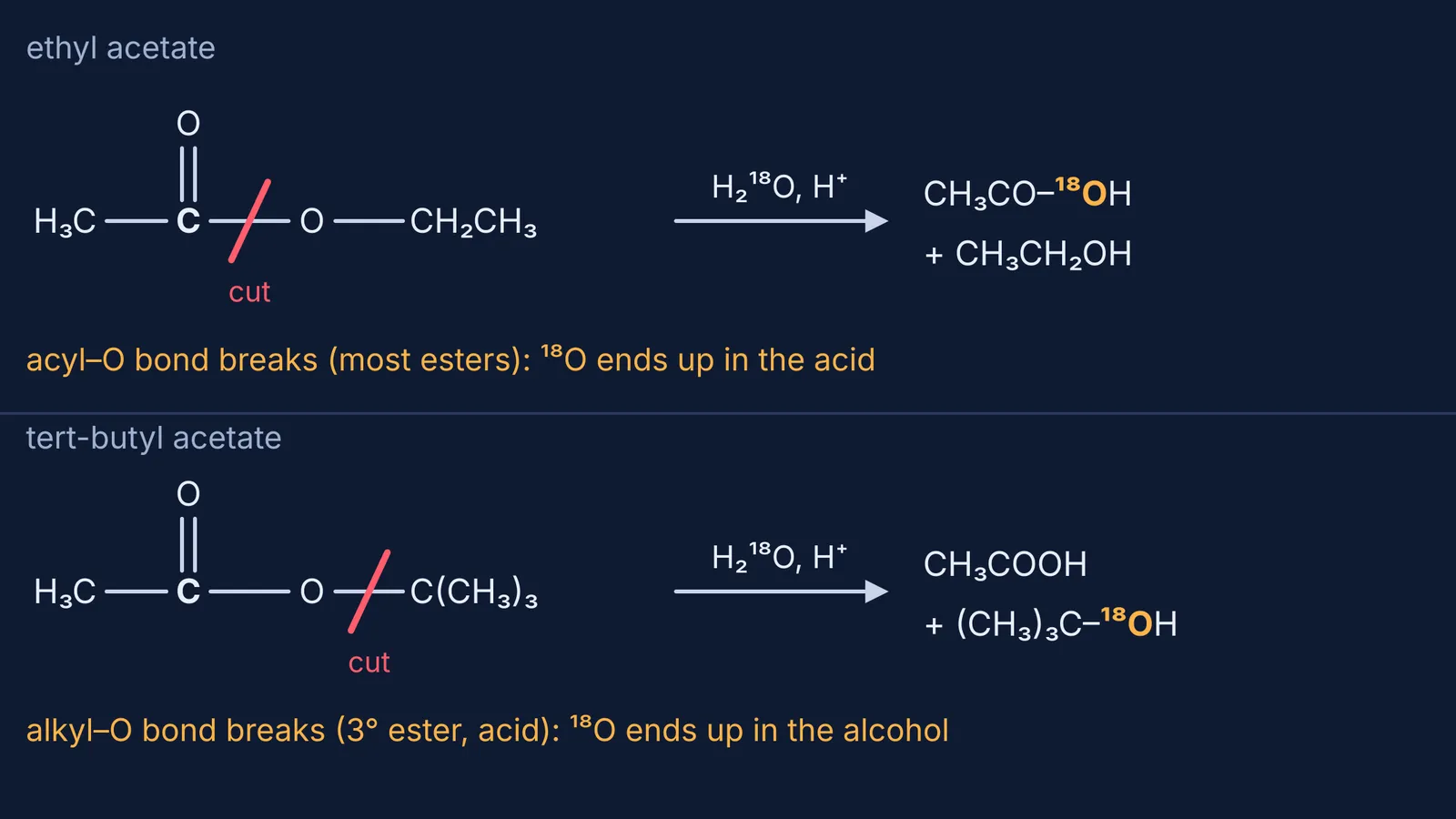
Ask where the ¹⁸O goes when an ester is hydrolysed in H₂¹⁸O and most students say: into the acid. That is right for ethyl acetate, methyl benzoate and almost every ester you meet. It is wrong for tert-butyl acetate in acid. There the ester breaks at the other C–O bond, and the label ends up in tert-butyl alcohol. This post explains why the bond switches, and what that changes in three types of exam question.
Which bond breaks when an ester is hydrolysed?
An ester R–CO–O–R′ has two single C–O bonds:
the acyl–oxygen bond, between the carbonyl carbon and the ester oxygen;
the alkyl–oxygen bond, between that oxygen and the alkyl group R′.
In normal acid or base hydrolysis, water (or OH⁻) attacks the carbonyl carbon. A tetrahedral intermediate forms, and R′–OH leaves with the oxygen it always had. So the acyl–oxygen bond breaks, and the oxygen from the water ends up in the acid:
CH₃COOC₂H₅ + H₂¹⁸O → CH₃CO¹⁸OH + C₂H₅OH
The full mechanisms and the ¹⁸O evidence are in acid vs base hydrolysis of esters and the ¹⁸O test. That post treats alkyl–oxygen cleavage as a student mistake, which it is for ethyl esters. This post is about the one common case where it really happens.
Why does tert-butyl acetate break at the alkyl–oxygen bond in acid?
Two effects push the same way.
The alkyl group can leave as a stable carbocation. Once the ester is protonated, the O–C(CH₃)₃ bond can break on its own. Acetic acid leaves as a neutral molecule and the tert-butyl cation, (CH₃)₃C⁺, is left behind. A tertiary cation is stabilised by the +I effect of three methyl groups and by hyperconjugation with nine C–H bonds, so this step is fast enough to compete.
The usual route is slowed. Water has to attack the carbonyl carbon and build a crowded tetrahedral intermediate next to a bulky tert-butoxy group.
The carbocation is then captured by water, which brings its oxygen with it. That is why the label from H₂¹⁸O ends up in the alcohol.
Textbooks beyond NCERT call this path AAL1. The label is a code: A for acid-catalysed, AL for alkyl–oxygen cleavage, and 1 for a unimolecular slow step (the ionisation, like SN1). The normal path is AAC2: acid-catalysed, acyl–oxygen cleavage, bimolecular. You do not need the codes for NCERT, but they are a compact way to remember which bond goes.
Other esters whose alkyl group forms a very stable cation, such as triphenylmethyl esters, can react the same way. Ordinary primary and secondary esters do not: their cations are far less stable, so they stay on the acyl–oxygen route.
Worked example: where does the ¹⁸O end up?
Question. tert-Butyl acetate is warmed with dilute acid in H₂¹⁸O. Which product carries the ¹⁸O? Compare with ethyl acetate.
Protonate the ester. CH₃COOC(CH₃)₃ + H₃O⁺ ⇌ [CH₃COOC(CH₃)₃H]⁺ + H₂O. The ester oxygen now carries a positive charge, which weakens the O–C(CH₃)₃ bond.
Ionise (slow step). [CH₃COOC(CH₃)₃H]⁺ → CH₃COOH + (CH₃)₃C⁺. The acid takes both of its original oxygens with it. No water oxygen has entered it.
Capture by water. (CH₃)₃C⁺ + H₂¹⁸O → (CH₃)₃C–¹⁸OH₂⁺.
Lose a proton. (CH₃)₃C–¹⁸OH₂⁺ + H₂O → (CH₃)₃C–¹⁸OH + H₃O⁺.
Add up. CH₃COOC(CH₃)₃ + H₂¹⁸O → CH₃COOH + (CH₃)₃C–¹⁸OH. Check the atoms: C₆H₁₄O₃ on each side, and no net charge.
Answer. The ¹⁸O is in tert-butyl alcohol and the acetic acid is unlabelled. With ethyl acetate it is the other way round: CH₃CO¹⁸OH and unlabelled ethanol.
Two details make the answer complete. First, some of the tert-butyl cation loses H⁺ instead of adding water, giving isobutene (2-methylpropene): (CH₃)₃C⁺ → CH₂=C(CH₃)₂ + H⁺. That side product has no oxygen at all. Second, acetic acid left standing in H₂¹⁸O and acid slowly exchanges its oxygens with the water, so the clean result is the one seen when the products are examined promptly.
Why does Fischer esterification fail with tert-butanol?
Fischer esterification runs the normal hydrolysis backwards: the alcohol oxygen attacks a protonated carboxylic acid, as set out in Fischer esterification: mechanism and how to push the equilibrium. That needs the alcohol to act as a nucleophile at the carbonyl carbon.
tert-Butanol is a poor choice on both counts. It is bulky, so it attacks slowly. More importantly, hot concentrated acid turns it into the tert-butyl cation, and that cation loses a proton far faster than it finds the acid:
(CH₃)₃COH → CH₂=C(CH₃)₂ + H₂O (conc. H₂SO₄, heat)
Tertiary alcohols are the easiest of all to dehydrate, so the main product is isobutene, not the ester. This is a change of mechanism, not just a slower rate. The slow-but-normal case for bulky groups is covered in why bulky acids and alcohols esterify slowly.
Chemists who want a tert-butyl ester use the AAL1 path in reverse. They add isobutene to the carboxylic acid with an acid catalyst. The alkene is protonated to the tert-butyl cation, and the carboxylic acid oxygen captures it.
What happens to a chiral alcohol part during hydrolysis?
This is where the bond question turns into a stereochemistry question.
Secondary ester, normal path. Hydrolyse (R)-butan-2-yl acetate in acid or base and you get (R)-butan-2-ol with its original configuration and rotation. The C–O bond at the stereocentre is never touched, because the bond that breaks is acyl–oxygen. Historically, this retention was itself evidence for acyl–oxygen cleavage.
Tertiary ester, acid. Take a chiral tertiary ester such as the acetate of 3-methylhexan-3-ol, whose stereocentre carries CH₃, C₂H₅, C₃H₇ and O. In acid the alkyl–oxygen bond breaks, the stereocentre becomes a planar carbocation, and water adds to either face. The alcohol comes out racemised, largely or completely, just as in an SN1 reaction.
So an exam question that says "optical activity of the alcohol is lost on hydrolysis" is telling you the alkyl–oxygen bond broke. One that says "configuration retained" is telling you it did not.
Does the switch also happen in base?
No. In NaOH there is no acid to protonate the ester and no carbocation can form. Hydroxide attacks the carbonyl carbon, so even tert-butyl acetate is cleaved at the acyl–oxygen bond. The label from ¹⁸OH⁻ ends up in the acetate ion and the tert-butyl alcohol is unlabelled.
That attack is slow, because the tert-butyl group crowds the carbonyl. This is why organic chemists use tert-butyl esters to protect carboxylic acids: they survive basic conditions that hydrolyse methyl and ethyl esters, and come off cleanly in acid by the AAL1 path. The switch is about acid, not about tert-butyl groups in general.
If you want to practise placing labels in mechanism questions like these, the Fermi Problem Library has a step-by-step solver that explains the reasoning at each stage.
Quick checklist
Most esters, acid or base: acyl–oxygen bond breaks, ¹⁸O from water goes into the acid.
tert-Butyl esters in acid: alkyl–oxygen bond breaks via (CH₃)₃C⁺, ¹⁸O goes into the alcohol.
Some isobutene forms alongside tert-butanol.
tert-Butyl esters in base still break at acyl–oxygen, slowly.
Fischer esterification with tert-butanol gives isobutene instead of the ester.
Secondary alkyl esters keep their alcohol configuration on hydrolysis; a chiral tertiary ester in acid racemises.
AAL1 = acid-catalysed, alkyl–oxygen cleavage, unimolecular. Do not apply it to ordinary secondary esters.


