

On this page
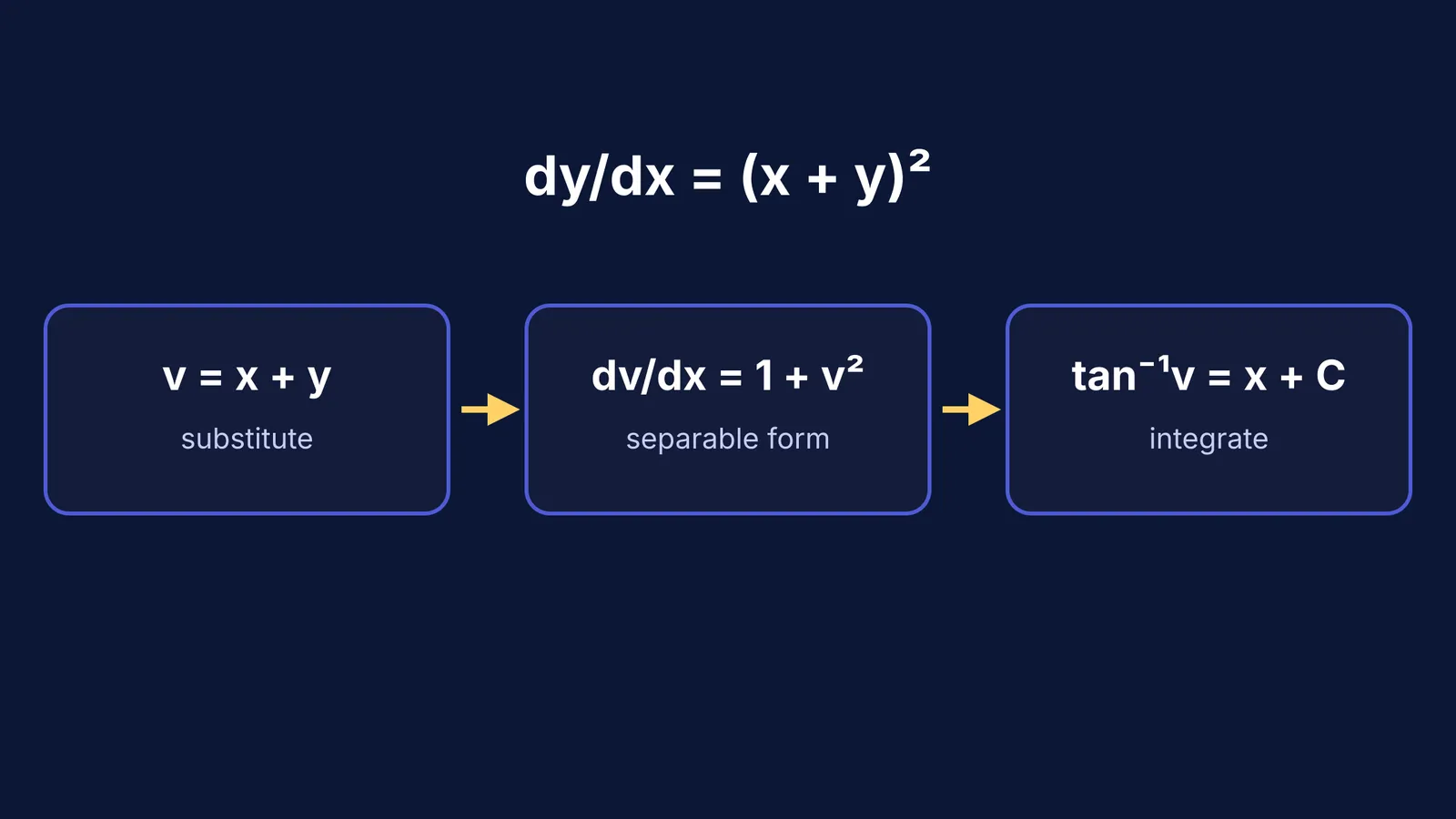
dy/dx = (x + y)² will not separate as it stands, and it is neither linear nor homogeneous. But its right-hand side cares only about the sum x + y. That is the signal to give the sum its own name.
When should you put v = x + y in a differential equation?
Use it when dy/dx is a function of one combination ax + by + c and nothing else. Paul Dawkins' notes on substitutions in differential equations give the general case: for y′ = G(ax + by), put v = ax + by, so that v′ = a + by′, and the new equation is separable.
If v = x + y, then dv/dx = 1 + dy/dx = 1 + f(v), which contains only v and x. So dv/(1 + f(v)) = dx, and you integrate both sides. If that step feels shaky, our guide to solving variable separable differential equations covers it on its own.
A quick test before you substitute:
Only (x + y) appears, as in (x + y)² or cos(x + y): put v = x + y.
A ratio whose top and bottom share x + y, such as (x + y + 1)/(2x + 2y + 3): v = x + y still works.
A ratio with different combinations, such as (x + 2y + 1)/(2x − y + 3): shift the origin to make it homogeneous instead.
A function of y/x: use the y = vx substitution for homogeneous equations.
How do you solve dy/dx = (x + y)²?
Put v = x + y. Then dv/dx = 1 + dy/dx.
Substitute: dv/dx = 1 + v².
Separate: dv/(1 + v²) = dx.
Integrate: tan⁻¹ v = x + C.
Put x + y back: tan⁻¹(x + y) = x + C, so x + y = tan(x + C) and y = tan(x + C) − x.
Check by differentiating: dy/dx = sec²(x + C) − 1 = tan²(x + C). Since x + y = tan(x + C), that is exactly (x + y)². If the question adds y(0) = 0, then tan⁻¹(0) = 0 + C gives C = 0, and the particular solution is y = tan x − x.
Since 1 + v² is never zero, dividing by it lost nothing.
How do you solve dy/dx = cos(x + y)?
Put v = x + y, so dv/dx = 1 + cos v.
Use the half-angle identity 1 + cos v = 2cos²(v/2): dv/dx = 2cos²(v/2).
Separate: (1/2)sec²(v/2) dv = dx.
Integrate: tan(v/2) = x + C, because the derivative of tan(v/2) is (1/2)sec²(v/2).
Answer: tan((x + y)/2) = x + C.
Check by implicit differentiation: (1/2)sec²((x + y)/2)(1 + dy/dx) = 1, so 1 + dy/dx = 2cos²((x + y)/2) = 1 + cos(x + y).
What about v = ax + by + c?
The idea is the same with numbers in front. If dy/dx = f(ax + by + c) and b is not zero, put v = ax + by + c. Then dv/dx = a + b f(v), and dv/(a + b f(v)) = dx.
Take dy/dx = (4x + y + 1)². Put v = 4x + y + 1, so dv/dx = 4 + v². Separate and integrate: dv/(4 + v²) = dx gives (1/2)tan⁻¹(v/2) = x + C, so v = 2tan(2x + K) with K = 2C. Then y = 2tan(2x + K) − 4x − 1. Check: dy/dx = 4sec²(2x + K) − 4 = 4tan²(2x + K) = (4x + y + 1)².
To revise which type of equation calls for which method, the Fermi Concept Library has a lesson for every concept in mathematics, each with its place in the map.
Where do students lose marks with this substitution?
Writing dv/dx = (x + y)², forgetting the 1 (or the a). The wrong answer still looks tidy.
Forgetting the b: with v = x + 2y, dv/dx = 1 + 2 dy/dx.
Leaving v in the final answer.
Dropping solutions where a + b f(v) = 0, such as the lines x + y = (2k + 1)π above.
Skipping the check. Differentiating your answer catches a missing 1, a or b, but it cannot show a solution you divided away, so look for zeros of a + b f(v) separately.
If the same step keeps going wrong, the Fermi Problem Library has worked problems with a step-by-step solver that explains the reasoning rather than printing an answer, so you can see where your dv/dx went off.
Try it now on dy/dx = sin²(x − y + 1): put v = x − y + 1, and check that dv/dx = 1 − sin²v = cos²v.


