

On this page
When preparing for Class 12 board exams or JEE, students frequently encounter differential equations with linear terms in the numerator and denominator:
dy/dx = (a₁x + b₁y + c₁) / (a₂x + b₂y + c₂)
An equation like dy/dx = (x + y + 1) / (x − 2y + 4) resists direct separation of variables because the constants +1 and +4 violate the homogeneity scaling test f(λx, λy) = f(x, y).
Understanding how a shift of origin eliminates these constants transforms a tricky algebraic exercise into a predictable routine.
Why does shifting the origin make a differential equation homogeneous?
A differential equation dy/dx = F(x, y) is homogeneous of degree zero if multiplying x and y by any non-zero scalar λ leaves the expression unchanged. In dy/dx = (a₁x + b₁y + c₁) / (a₂x + b₂y + c₂), the constants c₁ and c₂ break this property because they do not scale with λ.
Geometrically, the numerator and denominator describe two straight lines:
L₁: a₁x + b₁y + c₁ = 0 L₂: a₂x + b₂y + c₂ = 0
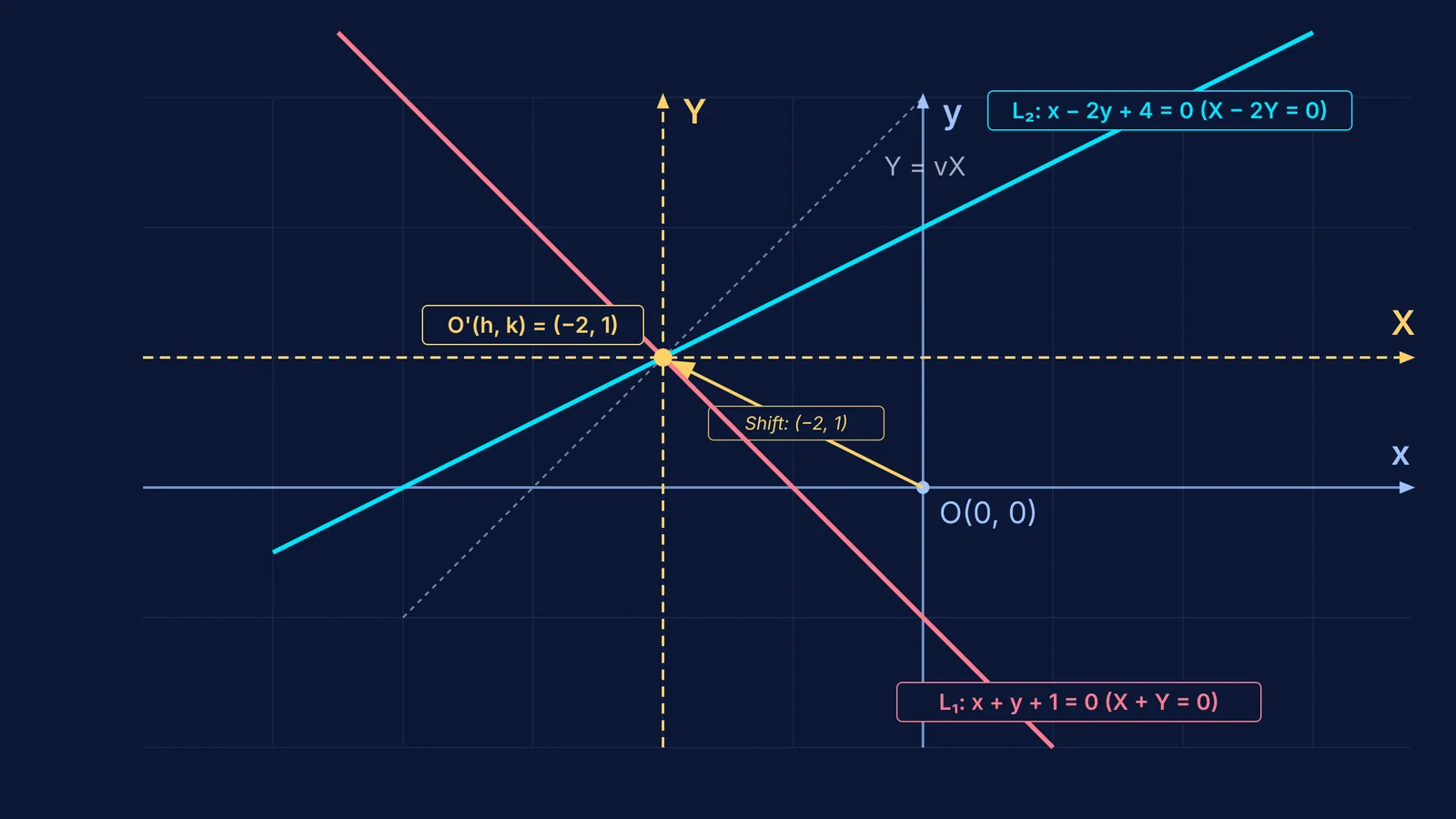
When these lines are not parallel, they intersect at a unique point (h, k). Translating the origin to (h, k) via x = X + h and y = Y + k shifts the coordinate axes so the intersection becomes (0, 0).
Because h and k are constants, dx = dX and dy = dY, preserving the derivative: dy/dx = dY/dX. Substituting into the lines gives:
dY/dX = [a₁X + b₁Y + (a₁h + b₁k + c₁)] / [a₂X + b₂Y + (a₂h + b₂k + c₂)]
Because (h, k) satisfies both line equations, a₁h + b₁k + c₁ = 0 and a₂h + b₂k + c₂ = 0. The constants vanish, leaving dY/dX = (a₁X + b₁Y) / (a₂X + b₂Y). This equation is homogeneous and solvable using Y = vX, as explained in our guide to homogeneous differential equations.
How do you find the shift coordinates h and k?
To find (h, k), solve the system formed by setting both linear expressions to zero:
a₁h + b₁k + c₁ = 0
a₂h + b₂k + c₂ = 0
This system has a unique solution when a₁b₂ − a₂b₁ ≠ 0, which corresponds to the ratio test a₁/a₂ ≠ b₁/b₂. Both the Class 12 mathematics curriculum from CBSE Academic and entrance syllabi from NTA JEE Main emphasize testing this ratio before computing.
How do you solve dy/dx = (x + y + 1) / (x − 2y + 4) step by step?
Here is the step-by-step solution for an equation containing the linear expression x + y + 1:
Verify ratios: Here a₁ = 1, b₁ = 1 and a₂ = 1, b₂ = −2. Because a₁/a₂ = 1 ≠ b₁/b₂ = −1/2, the lines intersect.
Find (h, k): Solve h + k + 1 = 0 and h − 2k + 4 = 0. Subtracting gives 3k − 3 = 0, so k = 1 and h = −2. The intersection is (−2, 1).
Shift variables: Let x = X − 2 and y = Y + 1. The equation becomes dY/dX = (X + Y) / (X − 2Y).
Substitute Y = vX: Setting dY/dX = v + X(dv/dX) gives:
v + X(dv/dX) = (1 + v) / (1 − 2v) X(dv/dX) = (1 + 2v²) / (1 − 2v)
Separate and integrate:
[(1 − 2v) / (1 + 2v²)] dv = dX / X Integrating yields (1 / √2) arctan(v√2) − (1/2) ln(1 + 2v²) = ln|X| + C.
Back-substitute: Substituting v = (y − 1)/(x + 2) and X = x + 2 gives the general solution:
(1 / √2) arctan([(y − 1)√2] / (x + 2)) = (1/2) ln((x + 2)² + 2(y − 1)²) + C
When does the origin shift fail, and what should you do instead?
When the coefficient ratios match, a₁/a₂ = b₁/b₂ = m, the lines are parallel. For example:
dy/dx = (x + y + 1) / (2x + 2y + 5)
Setting h + k + 1 = 0 and 2h + 2k + 5 = 0 produces 2(−1) + 5 = 3 = 0, an algebraic impossibility. Because parallel lines never meet, no origin shift can eliminate the constants.
Instead, substitute the repeating linear term z = x + y:
Differentiate: dz/dx = 1 + dy/dx, so dy/dx = dz/dx − 1.
Substitute: dz/dx − 1 = (z + 1) / (2z + 5).
Separate variables: dz/dx = (3z + 6) / (2z + 5), yielding ∫ [(2z + 5) / (3z + 6)] dz = ∫ dx.
Distinguishing parallel from intersecting lines is essential when mastering differential equations for JEE alongside linear differential equations.
How can students master multi-step calculus methods without cognitive overload?
Balancing coordinate geometry, variable substitutions, and integration in one problem places heavy demands on working memory. Seminal research by John Sweller and Graham A. Cooper (Cognition and Instruction, 1985) showed that studying structured worked examples reduces extraneous cognitive load compared to unguided problem solving, enabling faster schema acquisition.
The Fermi Problem Library has worked problems with a step-by-step solver that explains the reasoning rather than printing an answer, helping students verify each algebraic shift. To explore how geometric transformations link with calculus, the Fermi Concept Library maps every concept across mathematics and physics.


