

On this page
NCERT's Class 11 Thermodynamics exercises include a short question that most students finish in three lines. For 2A(g) + B(g) → 2D(g), ΔU° = −10.5 kJ and ΔS° = −44.1 J K⁻¹ at 298 K. Calculate ΔG° and say whether the reaction is spontaneous. The answer is ΔG° ≈ +0.16 kJ mol⁻¹, "not spontaneous". That verdict is correct for what was asked, but it hides the more interesting fact: a ΔG° this close to zero gives an equilibrium constant close to 1, and a real mixture of A and B makes plenty of D. This post works the full chain from ΔU° to K, and shows why a near-zero ΔG° punishes small slips harder than any other case.
How do you get ΔH° from ΔU° for 2A + B → 2D?
ΔU° is the heat at constant volume; ΔG° needs ΔH°. The bridge is ΔH = ΔU + ΔngRT, derived in relating ΔH and ΔU with ΔngRT.
Δng counts gaseous moles only, products minus reactants. All three species are gases here, so Δng = 2 − (2 + 1) = −1.
Three gas molecules become two, the surroundings push the system in, and ΔH° comes out more negative than ΔU°.
How do you find ΔG° and decide spontaneity?
Here is the full calculation, with every quantity in kJ mol⁻¹ (per mole of reaction as written).
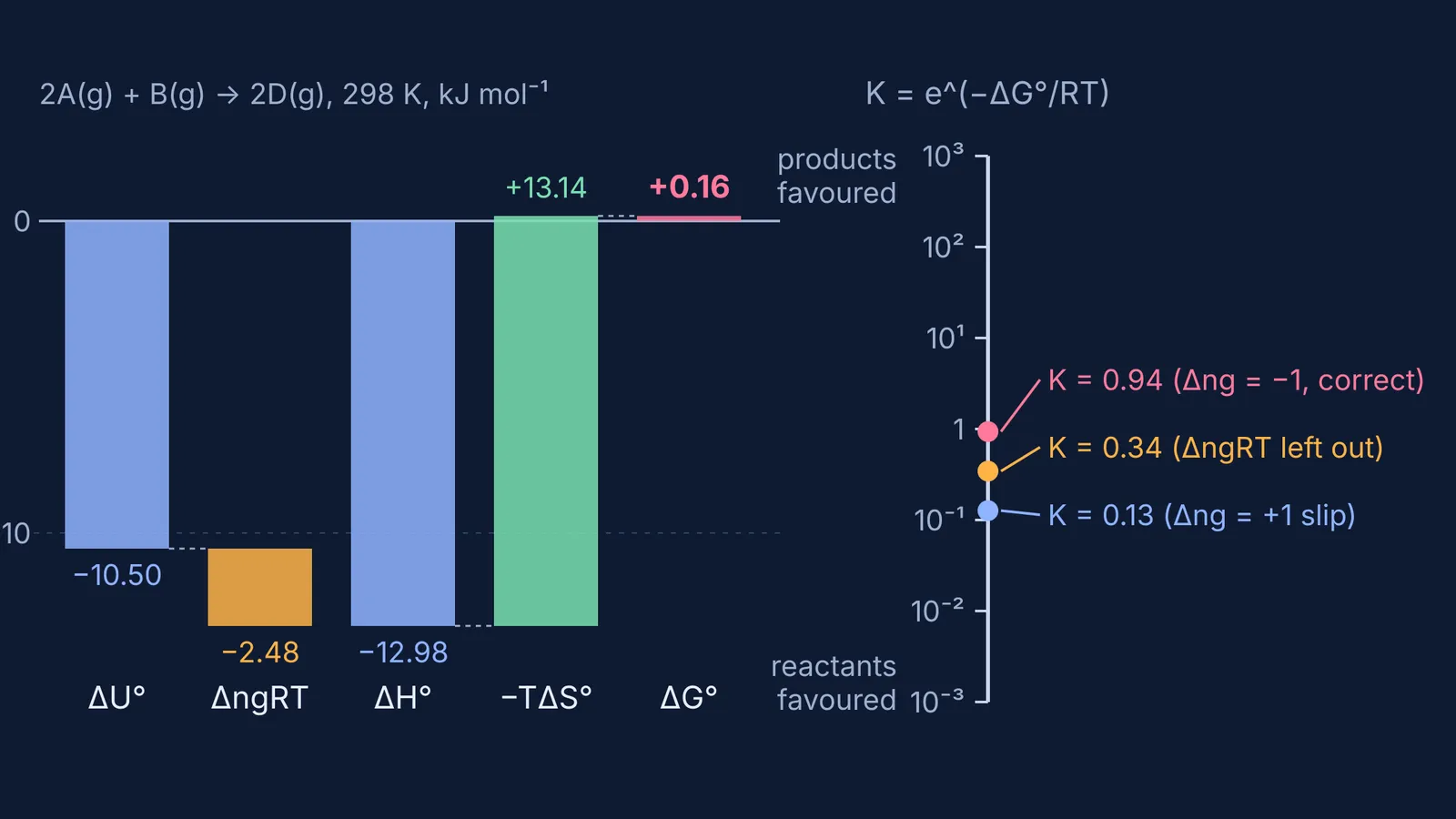
ΔngRT. (−1) × 8.314 × 298 = −2478 J = −2.48 kJ.
ΔH°. ΔH° = ΔU° + ΔngRT = −10.5 + (−2.48) = −12.98 kJ.
Convert ΔS° to kJ. ΔS° = −44.1 J K⁻¹ = −0.0441 kJ K⁻¹.
TΔS°. 298 × (−0.0441) = −13.14 kJ.
ΔG°. ΔG° = ΔH° − TΔS° = −12.98 − (−13.14) = +0.16 kJ mol⁻¹ (+0.164 unrounded, which matches NCERT's printed answer).
Verdict. ΔG° > 0, so under standard conditions the forward reaction is not spontaneous.
Look at what happened in step 5. The enthalpy term favours products by 12.98 kJ. The entropy term, at 298 K, opposes them by 13.14 kJ. The two nearly cancel, and the reaction balances on a margin of 0.16 kJ. That is less than a tenth of RT, which is 2.48 kJ at 298 K.
What does ΔG° = +0.16 kJ mean for K?
Convert it with ΔG° = −RT ln K, worked in more examples in how to calculate K from ΔG°.
ln K. ln K = −ΔG°/RT = −164 ÷ (8.314 × 298) = −164 ÷ 2478 = −0.066.
K. K = e^(−0.066) ≈ 0.94.
This K is the standard (thermodynamic) constant, with each pressure divided by p° = 1 bar. In pressure terms it is Kp ≈ 0.94 bar⁻¹, since Δng = −1.
A K of 0.94 is not "no reaction". To see how much D forms, start with 2 mol A and 1 mol B and keep the total pressure at 1 bar. Let the reaction advance by x. Then A = 2 − 2x, B = 1 − x, D = 2x, and the total is 3 − x moles. Put the partial pressures into K = p(D)² ÷ (p(A)² p(B)) and solve numerically:
x ≈ 0.33, so about a third of the reactants turn into D.
At equilibrium the mole fractions are roughly A 0.50, B 0.25 and D 0.25.
One molecule in four is product, from a reaction labelled "not spontaneous". Because Δng is negative, raising the pressure pushes the equilibrium further right: at 10 bar total, the same calculation gives x ≈ 0.56 and a D mole fraction of about 0.46, while K itself stays 0.94.
Is the reaction spontaneous or not, then?
Both answers are right, because they answer different questions. NCERT's question is about ΔG°: the change when A, B and D are each at 1 bar. In that particular mixture Q = 1, ΔG = ΔG° = +0.16 kJ, and the reaction runs slightly backwards.
In a flask that starts with only A and B, there is no D, so Q = 0 and ΔG = ΔG° + RT ln Q is hugely negative. The reaction runs forward until Q reaches K. Spontaneity in a real mixture depends on ΔG, not ΔG°. The difference between the two quantities is explained in ΔG versus ΔG°.
So the full exam answer is: ΔG° = +0.16 kJ mol⁻¹, not spontaneous under standard conditions, K ≈ 0.94, and an equilibrium mixture contains a substantial amount of D.
Why does a near-zero ΔG° punish small slips so hard?
When ΔH° and TΔS° nearly cancel, a 2 or 3 kJ error in either one is bigger than the answer itself. It can change the sign of ΔG°, or multiply the gap many times over. Here are the two usual slips on this question:
Δng = +1 instead of −1. Subtracting reactants minus products gives ΔH° = −10.5 + 2.48 = −8.02 kJ. Then ΔG° = −8.02 + 13.14 = +5.12 kJ, about 30 times the right value, and K = e^(−5120/2478) ≈ 0.13.
Leaving out ΔngRT. Using ΔU° as if it were ΔH° gives ΔG° = −10.5 + 13.14 = +2.64 kJ, and K ≈ 0.34.
The verdict "not spontaneous" survives both slips, so a careless answer could still score on the yes/no part. But K drops from 0.94 to 0.34 or 0.13, and any follow-up calculation is wrong. The diagram above shows all three K values on the same log scale.
A third slip is units. Writing TΔS° as 298 × (−44.1) = −13 142 and adding it to −12.98 mixes joules and kilojoules, giving a ΔG° of about +13 129 that no one should accept. Convert before you add.
If you set this up correctly but your numbers keep drifting, the Fermi Problem Library has a step-by-step solver that explains the reasoning line by line, so you can find the step where a sign or unit slipped.
Quick checklist
Δng counts gases only, products minus reactants: here 2 − 3 = −1.
ΔH° = ΔU° + ΔngRT = −10.5 − 2.48 = −12.98 kJ mol⁻¹.
Convert ΔS° to kJ K⁻¹ before multiplying by T: TΔS° = −13.14 kJ mol⁻¹.
ΔG° = −12.98 + 13.14 = +0.16 kJ mol⁻¹: not spontaneous under standard conditions.
K = e^(−ΔG°/RT) ≈ 0.94, so plenty of D forms in a real mixture.
ΔG° decides K; ΔG decides direction in a given mixture.
A near-zero ΔG° is very sensitive to sign and unit slips; recheck each term.


