

On this page
Statement-based and match-the-list items appear in recent JEE Main papers. Here are eight original semiconductor questions, easy to hard.
What does this set cover?
Unit 19 (Electronic Devices) of the NTA's Syllabus for JEE (Main) - 2027 lists diodes, rectifiers, the LED, photodiode, solar cell, Zener regulator and five logic gates, but not transistors.
Facts follow the NCERT chapter (silicon cut-in about 0.7 V) and NIOS lessons on special diodes and rectifiers, Zeners and gates. Use hc = 1240 eV nm. New to the unit? Read how to prepare semiconductors for JEE Main.
Key for Q1 and Q3: (1) Both correct (2) Both incorrect (3) Only I correct (4) Only II correct.
Statement questions: which ones are true?
Q1 (easy, statements). Statement I: A NAND gate with joined inputs works as a NOT gate. Statement II: A NOR gate with one input held at 0 works as a NOT gate for the other.
Answer: (1). I: with A = B, Y = NOT(A·A) = NOT A. II: NOT(A + 0) = NOT A.
Trap: (3), thinking only a NAND can become a NOT.
Q2 (easy, statements). Which are correct? A. A Zener regulator runs the Zener in reverse breakdown. B. A reverse-biased photodiode's current grows with light intensity. C. In a photodiode, light-freed electrons move to the p-side. D. 4.0 V across an 8.0 nm Zener depletion layer gives an average field of 5.0 × 10⁸ V/m. E. An LED is operated in reverse bias.
(1) A, B, C and D only (2) B, D and E only (3) A, B and D only (4) A, D and E only
Answer: (3). A and B: as NIOS states. C is false: the field sends electrons to the n-side. D: 4.0/(8.0 × 10⁻⁹) = 5.0 × 10⁸ V/m. E is false: an LED emits in forward bias.
Trap: (1), reversing the junction field.
Q3 (medium, statements). Statement I: An LED emitting 2.0 × 10¹⁶ photons per second at 496 nm radiates about 8.0 mW. Statement II: Taking photon energy as the band gap, a green (520 nm) LED needs a smaller gap than a red (700 nm) one.
Answer: (3). I: 1240/496 = 2.5 eV, or 4.0 × 10⁻¹⁹ J per photon, so 8.0 mW. II: green needs 2.38 eV, red 1.77 eV.
Trap: (1), equating longer wavelength with more energy.
Q4 (hard, statements). A 13 V supply feeds a 7.0 V Zener through 200 Ω, load across it; assume it regulates while its current is positive. Which are correct? A. With no load, the Zener current is 30 mA. B. With no load, the Zener dissipates 0.39 W. C. With a 1.4 kΩ load, the Zener current is 25 mA. D. With a 200 Ω load, the output stays 7.0 V. E. With 1.4 kΩ, a 15 V supply raises the Zener current by 10 mA, the load current unchanged.
(1) A, B, C and E only (2) A, C and E only (3) A, C, D and E only (4) C, D and E only
Answer: (2). A: 6.0 V/200 Ω = 30 mA. B is false: Vz × Iz = 0.21 W. C: 30 − 5.0 = 25 mA. D is false: 7.0 V needs 35 mA, more than 30 mA, so the Zener drops out (6.5 V). E: Is rises to 40 mA; IL stays 5.0 mA.
Trap: (3), assuming a Zener always regulates.
Match-the-list questions: can you pair them in one pass?
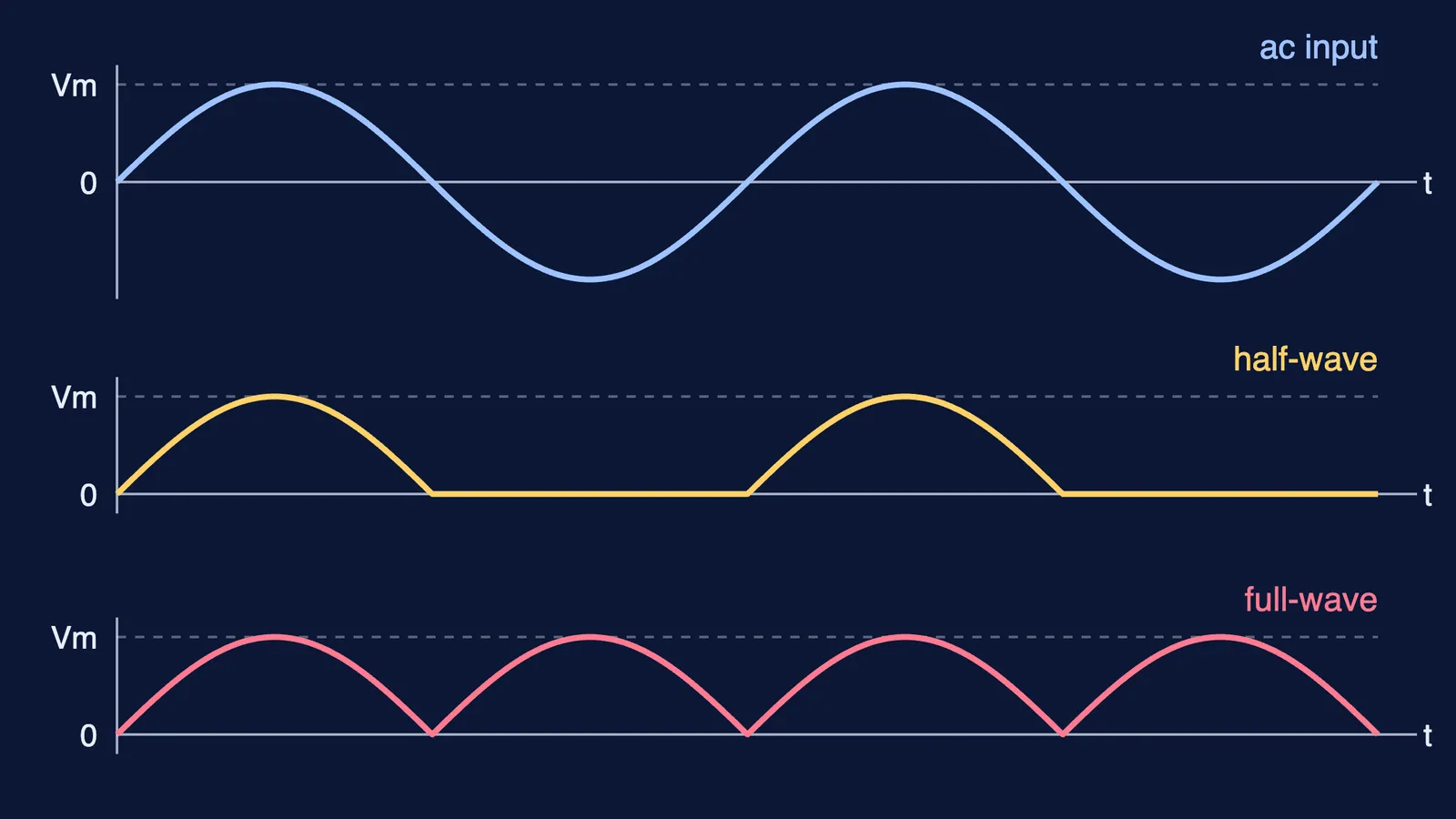
Q5 (easy, match). Ideal diodes; 31.4 V peak input (full-wave: per half of a centre-tapped secondary); π = 3.14. List-I: (A) Average load voltage, half-wave (B) Average load voltage, full-wave (C) Peak diode reverse voltage, half-wave (D) Average current, full-wave, 2.0 kΩ load. List-II: (I) 31.4 V (II) 10 mA (III) 10 V (IV) 20 V.
(1) A-IV, B-III, C-I, D-II (2) A-III, B-IV, C-II, D-I (3) A-III, B-I, C-IV, D-II (4) A-III, B-IV, C-I, D-II
Answer: (4). A: Vm/π = 10 V. B: 2Vm/π = 20 V. C: the off diode holds the full Vm. D: 20/2000 = 10 mA.
Trap: (1), swapping the rectifiers.
Q6 (medium, match). List-I: photodiode band gap, (A) 0.62 eV (B) 1.24 eV (C) 2.0 eV (D) 3.1 eV. List-II: longest detectable wavelength, (I) 0.40 μm (II) 2.0 μm (III) 620 nm (IV) 1000 nm.
(1) A-II, B-IV, C-III, D-I (2) A-IV, B-II, C-III, D-I (3) A-I, B-IV, C-III, D-II (4) A-II, B-III, C-IV, D-I
Answer: (1). λmax = 1240/Eg: 2000, 1000, 620 and 400 nm.
Trap: (3), giving the widest gap the longest wavelength.
Q7 (medium, match). List-I: (A) NOR, then NOT (B) inverted inputs into NOR (C) inverted inputs into OR (D) inverted inputs into AND. List-II, the equivalent gate: (I) NAND (II) NOR (III) OR (IV) AND.
(1) A-III, B-I, C-IV, D-II (2) A-III, B-IV, C-I, D-II (3) A-II, B-IV, C-I, D-III (4) A-III, B-II, C-I, D-IV
Answer: (2). A: NOT undoes NOR: OR. B: NOT(Ā + B̄) is 1 only at 11: AND. C: Ā + B̄ is 0 only at 11: NAND. D: Ā·B̄ is 1 only at 00: NOR.
Trap: (1), swapping B and C.
Q8 (hard, match). A 5.0 V battery and 1.0 kΩ are in series with each part; silicon diodes drop 0.7 V when on. List-I: (A) one forward diode (B) two forward diodes in series (C) a forward diode with 100 Ω across it (D) a reverse diode with 2.0 kΩ across it. List-II, battery current: (I) 4.3 mA (II) 1.7 mA (III) 4.5 mA (IV) 3.6 mA.
(1) A-III, B-IV, C-I, D-II (2) A-I, B-II, C-III, D-IV (3) A-I, B-IV, C-III, D-II (4) A-I, B-IV, C-II, D-III
Answer: (3). A: 4.3 V/1.0 kΩ = 4.3 mA. B: 3.6 mA. C: alone, 100 Ω would get 0.45 V (5.0 × 100/1100), below 0.7 V, so the diode is off: 5.0/1100 ≈ 4.5 mA. D: off, so 5.0/3000 ≈ 1.7 mA.
Trap: (1), turning C's diode on.
How do you work these faster?
Test each diode or Zener on or off first.
In Zener items, find Is first; the load never takes more.
For gate chains, write the four-row output column.
Settle your surest statement; strike disagreeing codes.
Do on-off calls trip you up? The Fermi Problem Library has worked problems with a step-by-step solver that explains the reasoning rather than printing an answer. Then try our semiconductors JEE Main practice set.


