

On this page
This set follows our first semiconductors practice set for JEE Main and tests what set 1 skipped: Zener doping, temperature, solar cells, dynamic resistance, rectifier reverse voltage, photodiodes, three-input gates and diode-battery circuits. Q7 is numerical.
How should you use this set?
Unit 19 (Electronic Devices) of the NTA's Syllabus for JEE (Main) - 2027 covers diode I-V characteristics, the rectifier, LED, photodiode, solar cell, Zener regulator and the OR, AND, NOT, NAND and NOR gates. Transistors are not listed, so they are left out here.
Take 20 minutes on paper, commit before reading each solution, and read every trap line. New to the unit? Start with our guide on how to prepare semiconductors for JEE Main.
Easy: what do doping, heat and light do to a junction?
These use the NIOS lesson on semiconducting devices: Zener diodes are heavily doped on both sides, semiconductor resistivity falls as temperature rises, and a solar cell's I-V curve lies in the fourth quadrant.
Q1 (easy). A Zener diode breaks down at only a few reverse volts because:
(A) both sides are lightly doped, so the depletion layer is wide
(B) both sides are heavily doped, so the depletion layer is very thin and its field is very high
(C) only the p-side is doped, so holes cross easily
(D) it is forward biased, so the barrier vanishes
Answer: (B). Heavy doping makes the depletion layer thinner than about 1 μm, so a few volts give a field of millions of volts per metre. Trap: (A); a wide layer needs a far larger voltage.
Q2 (easy). Pure germanium is warmed from 300 K to 330 K. Which is correct?
(A) nₑ rises, nₕ stays the same, resistance falls
(B) nₑ and nₕ both rise equally, resistance rises
(C) nₑ and nₕ both rise equally, resistance falls
(D) nₑ and nₕ both fall, resistance rises
Answer: (C). Each broken bond frees one electron and one hole, so nₑ = nₕ while both grow, and resistance falls. Trap: (B), which treats germanium like a metal, whose resistance rises with temperature.
Q3 (easy). A lit solar cell delivers 80 mA to a load at 0.50 V. The power delivered and the quadrant of the cell's operating point are:
(A) 40 mW, first quadrant
(B) 40 mW, fourth quadrant
(C) 6.3 mW, fourth quadrant
(D) 160 mW, third quadrant
Answer: (B). P = VI = 0.50 × 0.080 = 40 mW. The cell supplies current, so on diode axes V is positive and I negative: fourth quadrant. Trap: (A), which places it with an ordinary forward-biased diode.
Medium: can you read a curve, a rectifier and a photodiode?
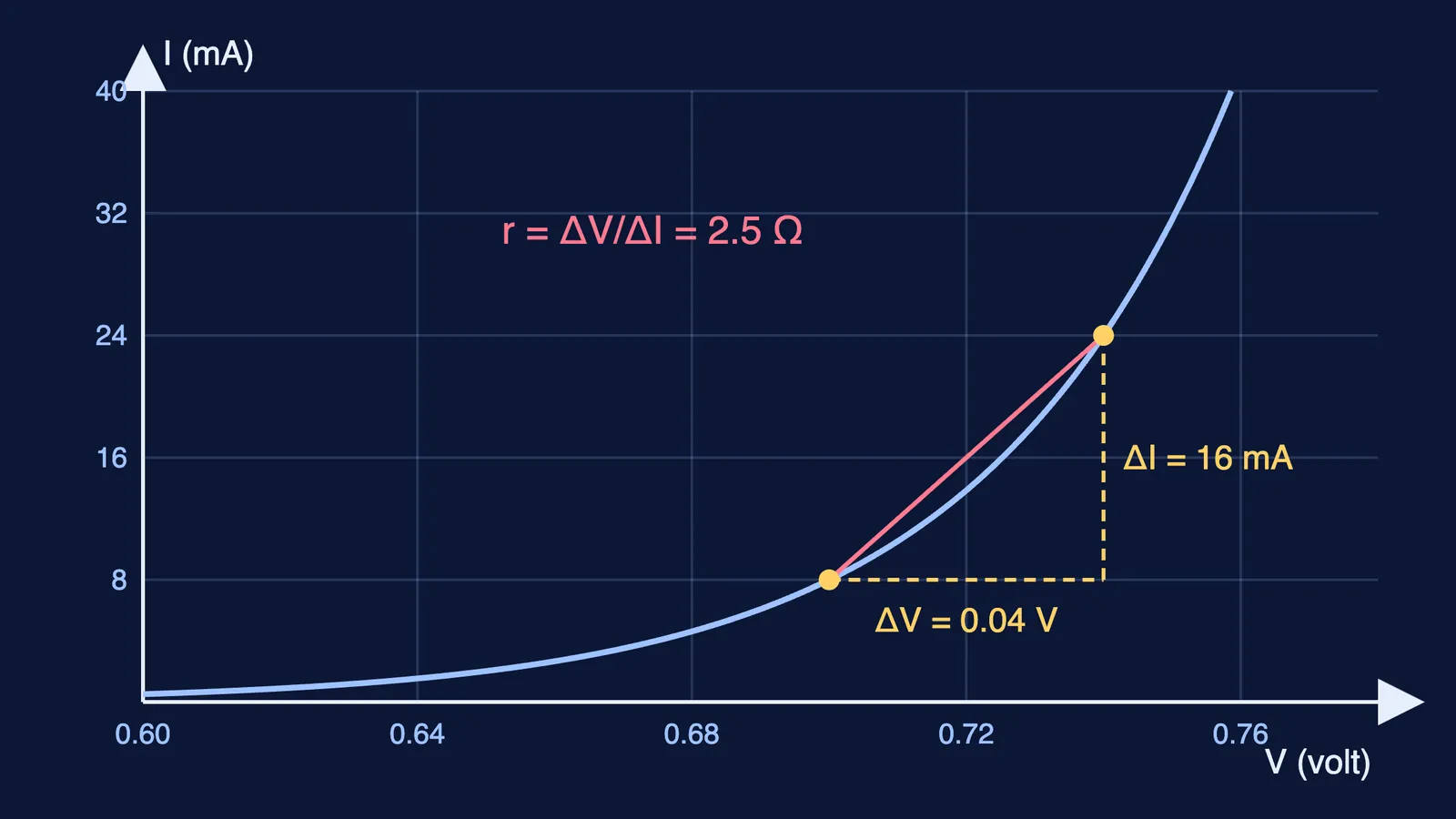
The NCERT Semiconductor Electronics chapter defines dynamic resistance as rd = ΔV/ΔI. The NIOS lesson on electronic circuits states that in a half-wave rectifier the largest reverse voltage across the diode equals the peak ac voltage Vm.
Q4 (medium). A silicon diode carries 8 mA at 0.70 V and 24 mA at 0.74 V. Its dynamic resistance in this range is:
(A) 30.8 Ω
(B) 0.4 Ω
(C) 2.5 Ω
(D) 87.5 Ω
Answer: (C). rd = ΔV/ΔI = 0.04 V/0.016 A = 2.5 Ω. Trap: (A), the static ratio V/I = 0.74/0.024 at one point, not the slope between two.
Q5 (medium). A 9.0 V rms supply feeds a half-wave rectifier: a silicon diode (0.7 V when on) and a 1.0 kΩ load. The peak load current and the peak reverse voltage across the diode are closest to:
(A) 12.0 mA and 12.7 V
(B) 8.3 mA and 9.0 V
(C) 12.7 mA and 12.7 V
(D) 12.0 mA and 25.5 V
Answer: (A). Vm = 9.0 × √2 = 12.7 V, so the peak current is (12.7 − 0.7)/1000 = 12.0 mA. In the off half-cycle the whole 12.7 V sits across the diode. Trap: (B), which uses the rms value as the peak.
Q6 (medium). A photodiode carries 15 mA in forward bias and a dark current of 1.5 μA in reverse bias. Light changes the current by 6.0 μA in either case. By what percentage does the reverse current rise?
(A) 0.04%
(B) 400%
(C) 500%
(D) 80%
Answer: (B). 6.0/1.5 = 4, a 400% rise, against 0.04% in forward bias. That is why photodiodes are run in reverse bias. Trap: (C), which divides the new current (7.5 μA) by the old instead of the change.
Hard: can you count gate outputs and test a diode against a battery?
Q7 (hard, numerical). A and B feed an AND gate. C feeds a NOT gate. The two outputs feed a NOR gate with output Y. For how many of the 8 input combinations of A, B and C is Y = 1?
Answer: 3. Y = NOT(AB + NOT C), which is 1 only when C = 1 and AB = 0: ABC = 001, 011 and 101. Trap: entering 5, the number of rows where Y = 0.
Q8 (hard). A 10 V cell drives a 2.0 kΩ resistor to point X, and a 3.0 kΩ resistor joins X to the cell's negative terminal. A silicon diode (0.7 V when on) runs from X, anode first, to the positive terminal of a 4.0 V battery whose negative terminal is joined to the cell's negative. The diode current is closest to:
(A) 0
(B) 0.43 mA
(C) 2.65 mA
(D) 1.08 mA
Answer: (D). Without the diode X sits at 10 × 3/5 = 6.0 V, above 4.7 V, so the diode conducts and holds X at 4.7 V. The 2.0 kΩ carries 5.3/2000 = 2.65 mA, the 3.0 kΩ carries 4.7/3000 = 1.57 mA, and the diode takes the difference, 1.08 mA. Trap: (B), which keeps X at 6.0 V and pushes 1.3 V through 3.0 kΩ.
What should you revise after this set?
Group your misses: junction physics (Q1-Q2), devices (Q3, Q6), curves and rectifiers (Q4-Q5), gates (Q7), diode circuits (Q8). Redo both sets in a week. If the same method keeps failing, the Fermi Problem Library has worked problems with a step-by-step solver that explains the reasoning rather than printing an answer.


