

On this page
You must hire one person. Candidates arrive one at a time in random order, and you must say yes or no on the spot; a rejected candidate never returns. When should you stop looking?
The puzzle appeared in Martin Gardner's Mathematical Games column in the February 1960 Scientific American, according to Thomas S. Ferguson's history, Who Solved the Secretary Problem? (Statistical Science, 1989). Ferguson writes that it has since grown into a whole field within probability and optimisation.
What is the secretary problem?
Ferguson's lecture notes, Optimal Stopping and Applications, chapter 2, state the classical version with these rules:
There is one position and n applicants, and you know n.
You can rank applicants from best to worst, with no ties.
They arrive in random order, every order equally likely.
After each interview you accept (and stop) or reject, using only how this applicant ranks against those seen so far.
A rejected applicant cannot be recalled.
You win only if you pick the single best applicant.
Because you cannot go back, every early yes risks missing someone better, and every no risks losing the best.
What is the 1/e rule?
Ferguson shows that an optimal strategy is a threshold rule: reject the first r − 1 applicants, then accept the next one better than everyone seen so far.
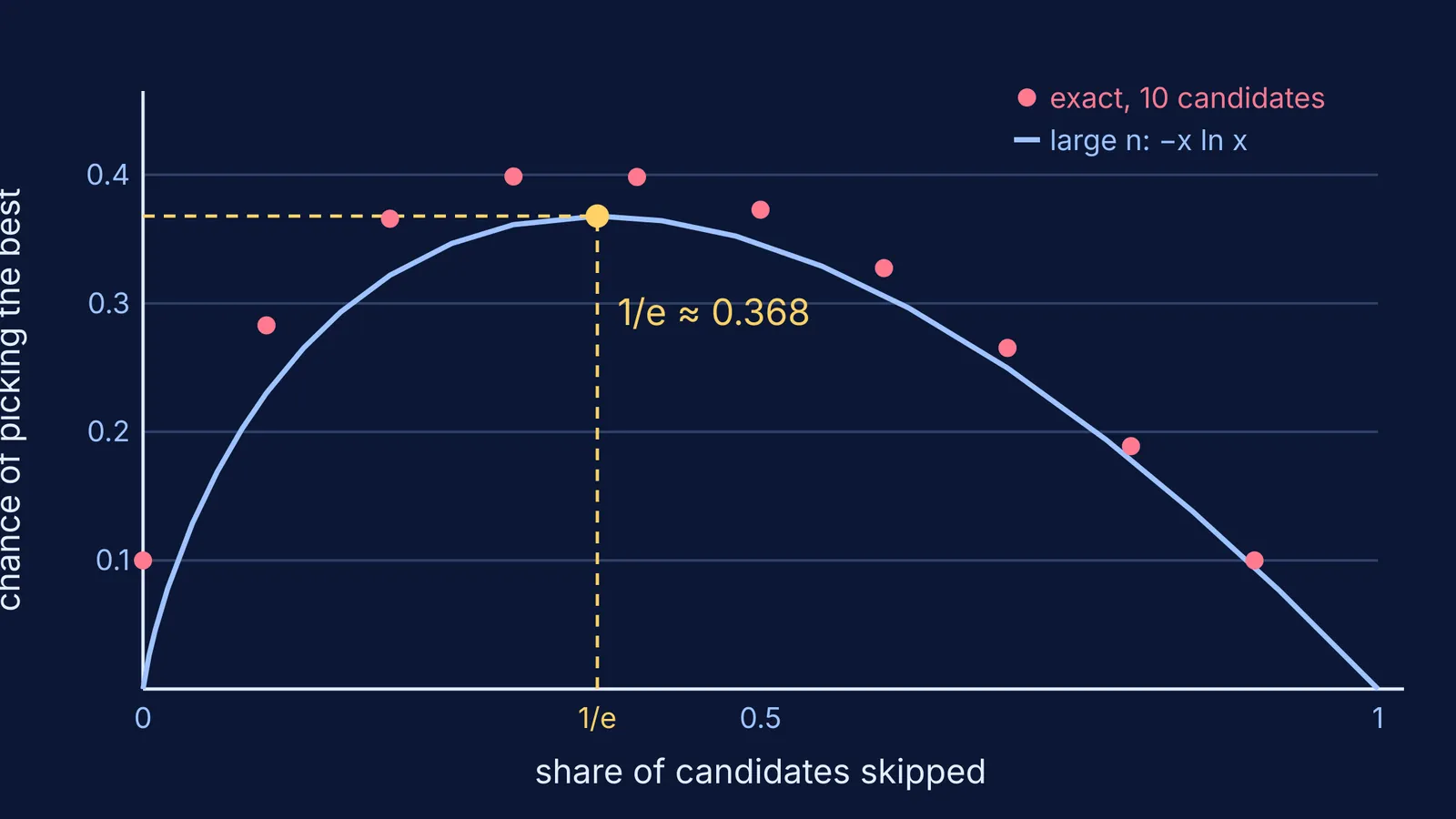
For large n, the same chapter shows it is approximately optimal to pass up a share 1/e = 36.8% of the applicants and then take the next candidate, and the chance of getting the best applicant is then about 1/e. Here e ≈ 2.718 is the base of natural logarithms; because 1/e is about 0.37, the solution is also called the 37% rule.
The surprise: the success chance does not shrink towards zero as the pool grows.
Can you work a small case by hand?
Take 3 candidates, ranked 1 (best), 2 and 3. There are 6 equally likely orders. Use the rule "skip the first, then take the first one better than everyone so far":
Order 1, 2, 3: skip 1, and nobody beats it. Lose.
Order 1, 3, 2: skip 1, and nobody beats it. Lose.
Order 2, 1, 3: skip 2, then 1 beats it. Win.
Order 2, 3, 1: skip 2, pass 3, take 1. Win.
Order 3, 1, 2: skip 3, then 1 beats it. Win.
Order 3, 2, 1: skip 3, then 2 beats it. Lose.
That is 3 wins in 6, or 1/2. Taking the first candidate wins only 1 time in 3.
For 4 candidates, use Ferguson's formula P = ((r − 1)/n) × [1/(r − 1) + 1/r + ... + 1/(n − 1)]. Skipping one gives (1/4)(1 + 1/2 + 1/3) = 11/24, about 0.458; skipping two gives (2/4)(1/2 + 1/3) = 5/12, about 0.417. His table agrees: for n = 4, skip one and win with probability .458.
Why does skipping the first 37% work?
The best candidate sits at position k with probability 1/n. You pick them only if the best of the first k − 1 candidates lies inside the skipped block, so nobody fooled you first; that has probability (r − 1)/(k − 1). These cases cannot happen together, so adding over every k gives the formula above. For another sum-over-positions trick, see linearity of expectation with indicator variables.
For large n, with x the fraction skipped, the sum becomes an integral and the derivation on Wikipedia gives P(x) = −x ln x, the curve pictured above. Setting the derivative −ln x − 1 to zero gives x = 1/e, and then P = 1/e too.
Skip too few and your benchmark is weak, so an ordinary candidate looks good. Skip too many and the best has probably walked out already.
If logarithms or derivatives are the step that stops you, the Fermi Concept Library has every concept in mathematics, each with its own lesson.
Where does the rule break down?
The classical answer assumes you know n in advance, which Wikipedia's limitations section notes is rarely true; with an uncertain number of candidates the best achievable chance is typically lower. It also scores second-best the same as worst, which is not how anyone chooses a college or a phone. Treat it as a model, not a life rule, and test it yourself:
Take cards numbered 1 to 10 and shuffle them face down.
Turn over and reject the first 3, noting the highest.
Keep turning; stop at the first card higher than that note.
Record a win if you stopped on 10. Repeat 20 times.
For 10 candidates, the table on Wikipedia gives a best success chance of 0.399, so expect roughly 8 wins in 20. Then try rejecting 1 or 6. For more puzzles where intuition misleads, see why two children with at least one boy gives 1/3 and how to check if a dice game is fair.
For worked probability problems, the Fermi Problem Library has a step-by-step solver that explains the reasoning rather than printing an answer.


