

On this page
A rigid flask holds a gas mixture. A spark sets off a reaction, and the flask is cooled back to the temperature it started at. What is the new pressure? Many students reach for PV = nRT with litres and moles, but you rarely need them. At fixed volume and temperature, pressure is proportional to moles, so you can run the whole stoichiometry in atmospheres. The one extra check is whether any product is a liquid or solid at the final temperature.
Why can you use partial pressures in place of moles?
For each gas in the flask, p = nRT/V. If V and T are the same before and after, then RT/V is a fixed number, and every partial pressure is just moles multiplied by that number. Ratios of partial pressures are ratios of moles.
That has two conditions, and both matter.
Rigid flask. V does not change. A balloon or a piston would break the rule.
Same temperature before and after. Combustion heats the gas, so the question must say the flask is cooled back to the starting temperature. If it ends at a different temperature, scale every pressure by T(final)/T(initial).
With those two in place, a reaction equation such as 2CO + O₂ → 2CO₂ can be read as "2 atm of CO uses 1 atm of O₂ and gives 2 atm of CO₂", just as it would be read in moles.
This is the constant-volume version of the volume reasoning used in finding a hydrocarbon's formula from eudiometry data, where gas volumes at constant pressure stand in for moles instead.
How do you find the final pressure after CO burns in oxygen?
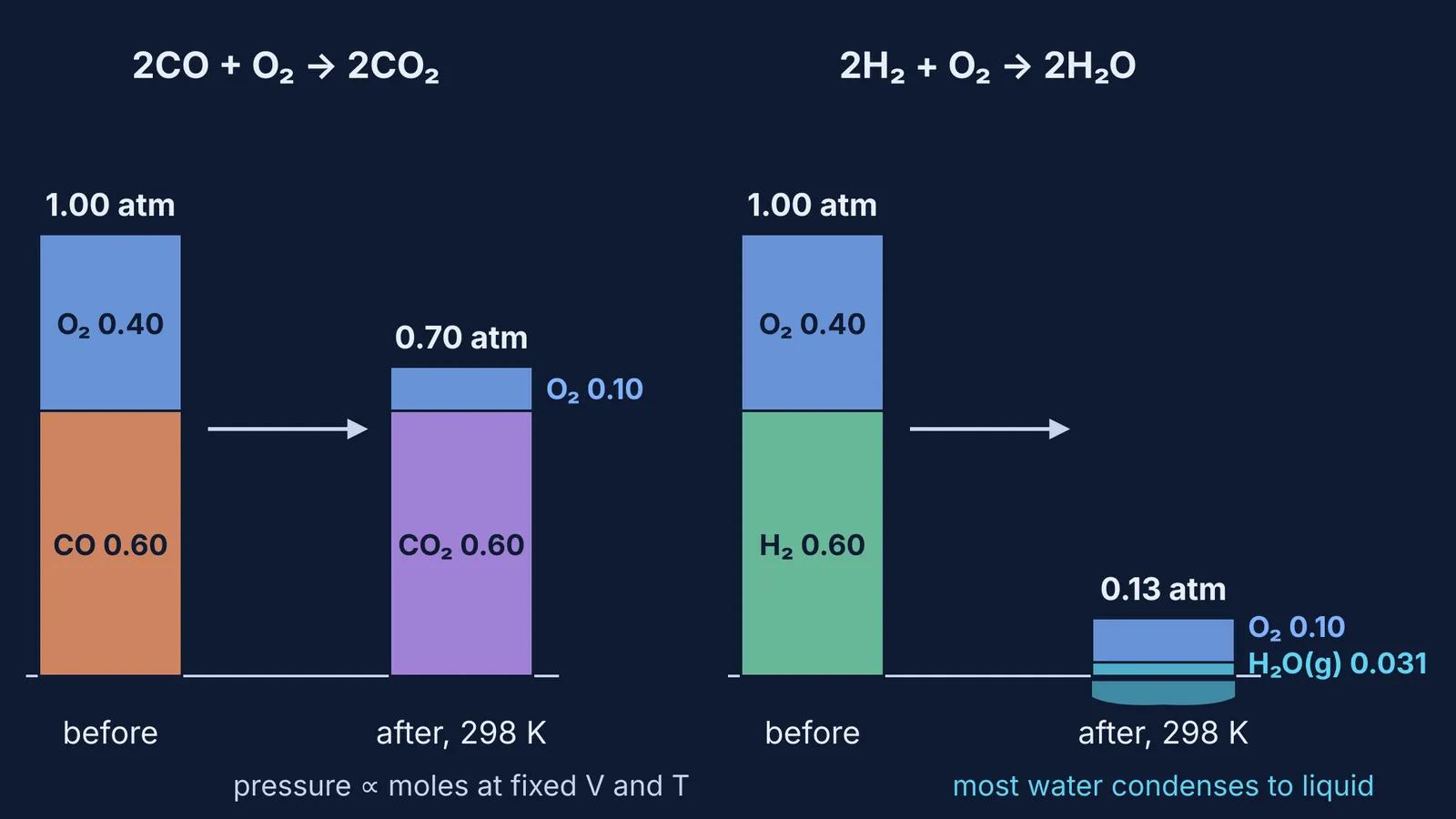
Worked example 1. At 298 K a rigid flask contains CO at 0.60 atm and O₂ at 0.40 atm. The mixture is sparked, the CO burns completely to CO₂, and the flask is cooled back to 298 K. Find the final pressure.
Write the balanced equation. 2CO + O₂ → 2CO₂. Check: 2 C on each side; 2 + 2 = 4 O on the left, 2 × 2 = 4 O on the right.
Find the limiting reagent. 0.60 atm of CO needs 0.60/2 = 0.30 atm of O₂. There is 0.40 atm of O₂, so O₂ is in excess and CO is limiting.
Work out what is used and formed. CO used: 0.60 atm. O₂ used: 0.30 atm. CO₂ formed: 0.60 atm.
List what is left. CO: 0. O₂: 0.40 − 0.30 = 0.10 atm. CO₂: 0.60 atm.
Add them up. Final pressure = 0.60 + 0.10 = 0.70 atm.
The pressure falls from 1.00 atm to 0.70 atm because three molecules of gas become two. The drop, 0.30 atm, equals the O₂ consumed, which is a quick check on your arithmetic.
What changes when the product is water?
Worked example 2. Same flask, same conditions, but H₂ at 0.60 atm in place of CO. The reaction is 2H₂ + O₂ → 2H₂O. Water's vapour pressure at 298 K is 3.17 kPa, about 0.031 atm (standard steam tables).
Balance and check. 2H₂ + O₂ → 2H₂O: 4 H and 2 O on each side.
Limiting reagent. 0.60 atm of H₂ needs 0.30 atm of O₂. H₂ is limiting, and 0.10 atm of O₂ is left over.
Water formed, if it all stayed gas. 0.60 atm.
Compare with the vapour pressure. 0.60 atm is far above 0.031 atm. Water vapour cannot exist above its vapour pressure in a flask that also holds liquid water, so the excess condenses.
Cap the water at its vapour pressure. p(H₂O) = 0.031 atm.
Add up the gases. Final pressure = 0.10 + 0.031 = 0.131 atm, about 0.13 atm.
Only 0.031/0.60, about 5%, of the water is still vapour. About 95% is liquid.
Can you ignore the volume of that liquid? Take a 10.0 L flask. The water formed is 0.60 × 10.0 / (0.0821 × 298) = 0.245 mol. The vapour is 0.031 × 10.0 / (0.0821 × 298) = 0.013 mol. That leaves about 0.233 mol of liquid, roughly 4.2 g or 4.2 mL, which is 0.04% of the flask. Neglecting it is safe. Why the vapour stays pinned at 0.031 atm no matter how much liquid forms is explained in why squeezing a flask of water vapour does not raise its pressure.
What if the flask ends at 373 K instead?
Suppose the same H₂ and O₂ flask is held at 373 K after the reaction, with the starting pressures still measured at 298 K.
Scale every pressure by the temperature ratio. 373/298 = 1.252.
Water as a gas. 0.60 × 1.252 = 0.751 atm.
Compare with the vapour pressure. At 373 K water's vapour pressure is 1 atm. 0.751 atm is below that, so no water condenses.
Total. (0.60 + 0.10) × 1.252 = 0.876 atm.
The answer moves from 0.13 atm to 0.88 atm only because of the final temperature. Always read which temperature the question means.
What if the product is a solid?
The same idea works for a solid product, which has a negligible vapour pressure at room temperature. NH₃ at 0.50 atm and HCl at 0.30 atm are mixed in a rigid flask at 298 K. They react: NH₃ + HCl → NH₄Cl(s). HCl is limiting. All 0.30 atm of HCl reacts with 0.30 atm of NH₃, and 0.20 atm of NH₃ is left. The final pressure is 0.20 atm. The white solid on the walls adds nothing.
If no reaction happens and two flasks are simply joined, the method is different. That case is covered in final pressure when two gas containers are connected.
If you want to practise more of these, the Fermi Problem Library has a step-by-step solver that explains the reasoning, including the limiting-reagent and condensation checks.
Quick checklist
Confirm the flask is rigid and returns to the starting temperature before treating pressures as moles.
Balance the equation and check atoms on both sides.
Find the limiting reagent using partial pressures.
List what is left and what is formed, then add the gases only.
Cap any condensable product at its vapour pressure at the final temperature.
Ignore solids and the small volume of liquid formed.
If the final temperature differs, scale every pressure by T(final)/T(initial).


