

On this page
Eudiometry turns a gas-volume puzzle into two small equations. You mix a known volume of a gaseous hydrocarbon with excess oxygen, spark it, cool it back to room temperature, then pass the gas through KOH solution. Two readings decide the formula: how much the volume shrank on cooling, and how much more it shrank in the KOH.
Why can you use volumes instead of moles?
Gay-Lussac reported in 1809 that gases combine in simple ratios by volume, according to these Le Moyne College teaching notes on his memoir. Avogadro's law states that equal volumes of gases at the same temperature and pressure contain equal numbers of molecules (LibreTexts, Avogadro's law/09:_Gases/9.06:_Avogadro's_Law)). Put together, the coefficients in a balanced equation for gases are also volume ratios, as long as every volume is measured at the same temperature and pressure.
That is why eudiometry questions never need you to convert to moles. If 10 mL of a hydrocarbon with x carbon atoms burns completely, 10x mL of CO₂ forms.
What do the contraction and the KOH reading tell you?
Start from the general combustion equation:
CₓHᵧ + (x + y/4) O₂ → x CO₂ + (y/2) H₂O
Take V mL of the hydrocarbon and excess oxygen. When the products cool to room temperature, the water condenses to a liquid whose volume is negligible, so it drops out of the gas count. Then:
Oxygen used: V(x + y/4)
CO₂ formed: Vx
Contraction on cooling (total gas before the spark minus gas after cooling): V + V(x + y/4) − Vx = V(1 + y/4)
Drop in volume in KOH: Vx, because KOH absorbs the CO₂
The KOH step is the chemistry of the Orsat gas analyser, where potassium hydroxide absorbs carbon dioxide and a separate reagent, alkaline pyrogallol, absorbs oxygen (NPTEL lecture on material balance in combustion). The drop in volume after KOH is read as the CO₂ (Orsat gas analyser). So the gas left after KOH is usually the unused oxygen.
How do you find the formula step by step?
Here is a full worked example, with numbers you can check line by line.
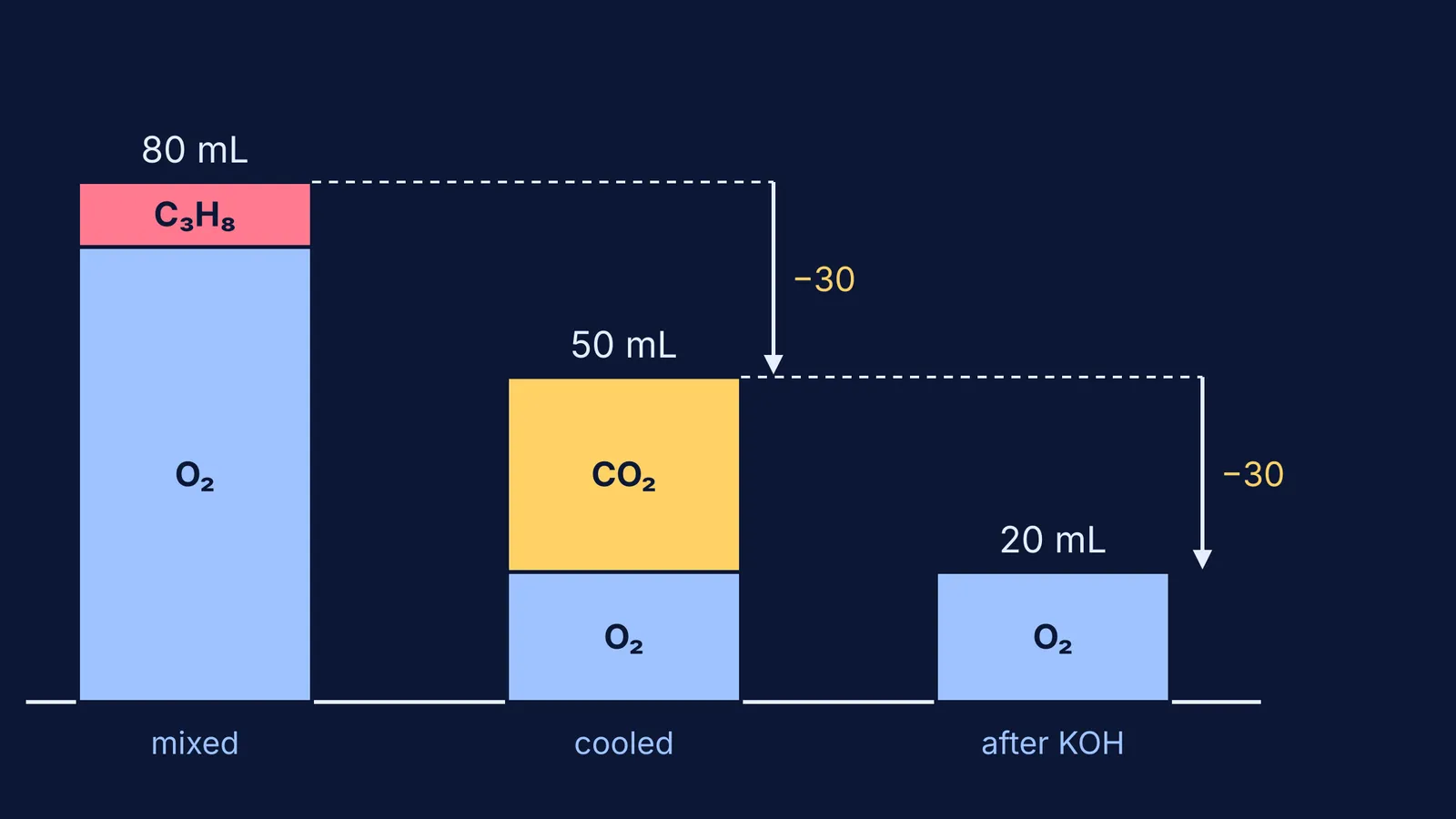
Question. 10 mL of a gaseous hydrocarbon is mixed with 70 mL of oxygen and exploded. After cooling to room temperature, the volume is 50 mL. On passing through KOH solution, it falls to 20 mL. Find the formula.
Total gas before the spark: 10 + 70 = 80 mL.
Contraction on cooling: 80 − 50 = 30 mL. So 10(1 + y/4) = 30, which gives y/4 = 2 and y = 8.
Drop in KOH: 50 − 20 = 30 mL of CO₂. So 10x = 30 and x = 3.
Formula: C₃H₈, which is propane.
Check the leftover gas. Oxygen needed is 10(3 + 8/4) = 50 mL. Oxygen supplied was 70 mL, so 20 mL should remain. That matches the 20 mL left after KOH.
Step 5 is quick, catches arithmetic slips and confirms that oxygen really was in excess.
Try one yourself: 20 mL of a hydrocarbon with 100 mL of oxygen gives 80 mL after cooling and 40 mL after KOH. (Answer: contraction 40 mL gives y = 4, KOH drop 40 mL gives x = 2, so C₂H₄; leftover oxygen 100 − 60 = 40 mL checks.)
Once you have CₓHᵧ, the degree of unsaturation from a formula tells you how many rings or π bonds it can contain. If the data come as mass percentages instead, use empirical and molecular formulas from percentage data.
Which eudiometry traps cost marks?
Water still a gas. If volumes are measured above 100 °C, water stays as vapour and the change on combustion is V(y/4 − 1), which can be an increase. Read the temperature line first.
Contraction from the wrong start. Contraction is total gas before the spark, oxygen included, minus gas after cooling.
The KOH reading taken as CO₂. The CO₂ is the drop in KOH, not the volume left afterwards.
Oxygen not in excess. The equations assume complete combustion. If the leftover check fails, look for limited oxygen in the wording.
Where should you practise next?
The method rests on Gay-Lussac's measurements, and the story of the law of combining volumes shows how he got there.
If your set-up goes wrong rather than your arithmetic, the Fermi Problem Library has worked problems with a step-by-step solver that explains the reasoning rather than printing an answer, so you can see which line of your working broke. For the gas laws underneath, the Fermi Concept Library gives each concept in chemistry its own lesson and its place in the map.


