

On this page
Statement and match-the-list questions appear in recent NEET papers; one wrong judgement sinks an option. Our NEET match-the-list question strategy explains the format. Here are eight original Rotational Motion questions, none repeating our Rotational Motion NEET practice questions with solutions.
Which Rotational Motion topics do these cover?
Rotational Motion is Physics Unit 5 of the NMC's syllabus for NEET (UG)-2026. Every fact matches NCERT Class 11 Physics, Chapter 6 (Reprint 2026-27). For theory, see our guide to preparing Rotational Motion for NEET.
Statement questions
Q1 (easy, statements). Statement I: Torque has the dimensions of work, ML²T⁻². Statement II: Like work, torque is a scalar.
(1) Both correct (2) Both incorrect (3) I correct, II incorrect (4) I incorrect, II correct
Answer: (3). I: NCERT. II is false: torque, r × F, is a vector.
Trap: (1); same dimensions, not same nature.
Q2 (medium, statements). Which statements are correct?
A. The SI unit of moment of inertia is kg m².
B. Moment of inertia depends on the axis's position and orientation.
C. A solid cylinder about its axis has the same I as a disc of equal mass and radius about its central perpendicular axis.
D. A hollow cylinder's radius of gyration about its axis is R/√2.
E. Like mass, moment of inertia is fixed for a body.
(1) A and B only (2) A, B and C only (3) A, B and D only (4) B, C and E only
Answer: (2). A, B: NCERT. C: Table 6.1 gives MR²/2 for both. D is false: I = MR², so k = R. E is false, per NCERT.
Trap: (3), using the solid cylinder's k.
Q3 (medium, statements). Statement I: A light lever balancing a 600 N load 0.2 m from the fulcrum with 150 N at 0.8 m has mechanical advantage 4. Statement II: Centre of gravity coincides with centre of mass only if gravity does not vary over the body.
(1) Both correct (2) Both incorrect (3) I correct, II incorrect (4) I incorrect, II correct
Answer: (1). I: 600 × 0.2 = 150 × 0.8; M.A. = 600/150 = 4. II: NCERT's condition.
Trap: (3), assuming they always coincide.
Q4 (hard, statements). Which statements are correct?
A. With zero total external force, the total torque is the same about every point.
B. For rotation about a fixed symmetry axis, L = Iω, along the axis.
C. In fixed-axis rotation, each particle's angular momentum about every axis point is along the axis.
D. Internal forces along lines joining particles give zero total torque.
E. Constant angular velocity needs a non-zero net external torque.
(1) A, C and D only (2) B, D and E only (3) A, D and E only (4) A, B and D only
Answer: (4). A, B (Eq. 6.42d), D: NCERT. C is false: each particle's l has a part, OC × mv, off the axis. E is false: constant ω means dL/dt = 0.
Trap: (1), applying L = Iω to each particle.
Match-the-list questions
Q5 (easy, match). Match quantity to dimensions.
List-I: (A) Angular momentum (B) Moment of inertia (C) Angular acceleration (D) Power of a torque
List-II: (I) ML²T⁻³ (II) ML² (III) T⁻² (IV) ML²T⁻¹
(1) A-I, B-II, C-III, D-IV (2) A-IV, B-II, C-III, D-I (3) A-IV, B-III, C-II, D-I (4) A-II, B-IV, C-III, D-I
Answer: (2). A: length × momentum = ML²T⁻¹. B: Σmr² = ML². C: dω/dt = T⁻². D: τω = ML²T⁻² × T⁻¹ = ML²T⁻³.
Trap: (1), swapping A and D.
Q6 (medium, match). Each body: mass 2 kg; ring and sphere radius 0.5 m; rod 1.5 m long. Match moments of inertia (kg m²).
List-I: (A) Ring, central axis perpendicular to plane (B) Ring, diameter (C) Rod, perpendicular axis through midpoint (D) Solid sphere, diameter
List-II: (I) 0.25 (II) 0.50 (III) 0.20 (IV) 0.375
(1) A-I, B-II, C-IV, D-III (2) A-II, B-III, C-IV, D-I (3) A-II, B-I, C-III, D-IV (4) A-II, B-I, C-IV, D-III
Answer: (4). From Table 6.1: A, MR² = 0.50. B, MR²/2 = 0.25. C, ML²/12 = 0.375. D, 2MR²/5 = 0.20.
Trap: (1), swapping the ring's axes.
Q7 (medium, match). Match situation to idea.
List-I: (A) A planet moves faster when nearer the Sun (B) A 300 N child 1.2 m from a see-saw's pivot balances a 400 N child 0.9 m away (C) A wheel spun twice as fast stores four times the kinetic energy (D) A longer spanner loosens a tight nut more easily
List-II: (I) Principle of moments (II) τ = r⊥F (III) K = ½Iω² (IV) Conservation of angular momentum
(1) A-IV, B-I, C-III, D-II (2) A-II, B-I, C-III, D-IV (3) A-IV, B-III, C-I, D-II (4) A-II, B-III, C-I, D-IV
Answer: (1). A: gravity points at the Sun, so no torque; mvr⊥ is constant. B: 300 × 1.2 = 400 × 0.9 = 360 N m. C: K ∝ ω², and 2² = 4. D: longer arm, more torque.
Trap: (2), swapping A and D; the planet speeds up with no torque.
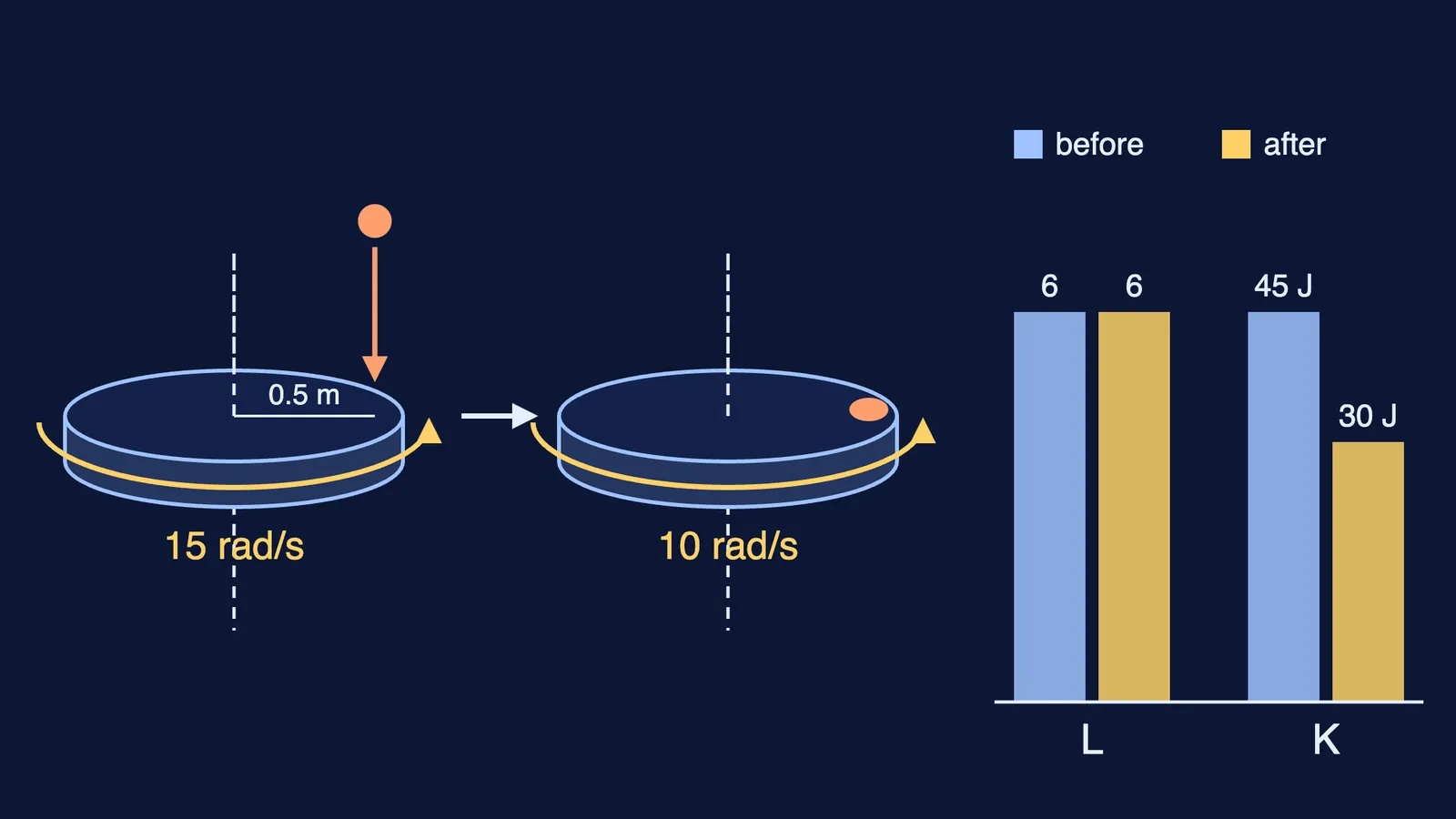
Q8 (hard, match). A horizontal turntable (I = 0.4 kg m²) spins at 15 rad/s on a frictionless vertical axle. A 0.8 kg lump of putty, dropped straight down, sticks 0.5 m from the axle. Putty is a point mass. Match SI values.
List-I: (A) Common angular speed (B) Final angular momentum (C) Final rotational kinetic energy (D) Rotational kinetic energy lost
List-II: (I) 6 (II) 10 (III) 15 (IV) 30
(1) A-II, B-I, C-III, D-IV (2) A-III, B-I, C-IV, D-II (3) A-II, B-I, C-IV, D-III (4) A-I, B-II, C-IV, D-III
Answer: (3). The putty falls parallel to the axle, bringing no angular momentum and no torque about it, so L = 0.4 × 15 = 6 kg m²/s is conserved. The putty adds mr² = 0.8 × 0.5² = 0.2 kg m². A: 6/0.6 = 10 rad/s. C: ½ × 0.6 × 10² = 30 J, from 45 J. D: 15 J.
Trap: (1), swapping final and lost energy.
How do you work these faster?
Judge the easiest statement first; if false, strike its codes: E in Q2 removes (4).
In a match, anchor on your surest pair: Q8's B-I removes (4).
Fix the axis and body before recalling I; Q2 and Q6 trap that.
Finding Q8 hard to picture? The Fermi Simulation Lab has interactive simulations for ideas easier to see than to read.


